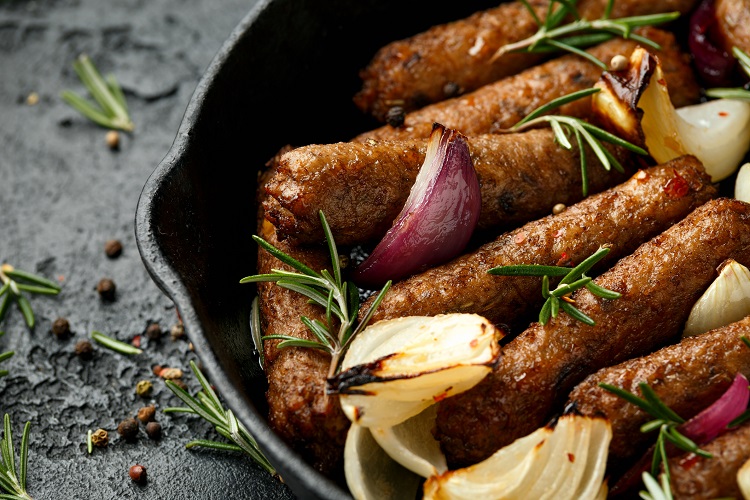
The decision to transfer parts of the court case against the ban on ‘meaty’ names for plant-based foods to the European Court of Justice (ECJ) is being celebrated by advocates of meat- and dairy-free products. This move will see their case against the ban elevated to the supreme court of EU law. The ban, implemented by France in 2020, prohibits the use of ‘meaty’ terminology for vegetarian sausages, plant-based steak, and other similar products, with the exception of ‘burger’. The intention behind the ban is to prevent consumer confusion.
Upon the introduction of the ban, the European Vegetarian Union (EVU) and the Association Végetarienne de France (AVF) filed a complaint against it, deeming it controversial. Members of France’s meat industry supported the ban, hailing it as a positive step towards providing transparent information to consumers. Now, the EVU and AVF are expressing their joy as the France’s Council of State (Conseil d’Etat) has decided to transfer parts of the case to the ECJ.
The ECJ has been asked by the France’s Council of State to address several questions pertaining to food labeling, consumer transparency, and the authority of Member States. Specifically, the court will determine whether Member States have the right to establish their own additional laws, such as the French decree, or if EU-level harmonization prevents them from doing so. If Member States are permitted to enact such laws, the ECJ will examine whether the current form of the French Decree proportionately achieves its aim of ensuring consumer transparency.
Élodie Blanchard, the president of AVF, expressed her support for the decision of the Conseil d’Etat to seek clarification from the ECJ, emphasizing its significance for France and the entire EU. She sees it as a pivotal moment for consumers who are advocating for sustainability and conscious choices, hoping to facilitate the transition to a more sustainable food system.
The ban on ‘meaty’ or ‘dairy-like’ terms for plant-based alternatives is a trend observed in various countries worldwide. In 2017, the ECJ banned the use of dairy names for purely plant-based products, excluding certain exceptions. The European Parliament, however, rejected a ban on ‘meaty’ terms for plant-based alternatives in 2020. Similarly, South Africa and Turkey have implemented bans on ‘meaty’ denominations for vegan products, with the latter also banning the production of vegan cheese alternatives last year.
In conclusion, the decision to transfer parts of the court case against the ban on ‘meaty’ names for plant-based foods to the ECJ is a significant development for meat- and dairy-free advocates. It brings attention to food labeling, consumer transparency, and the authority of Member States, with the outcome potentially impacting the entire EU. This trend of banning ‘meaty’ or ‘dairy-like’ terms for plant-based alternatives is observed globally, highlighting the ongoing debate surrounding food labeling and product differentiation.