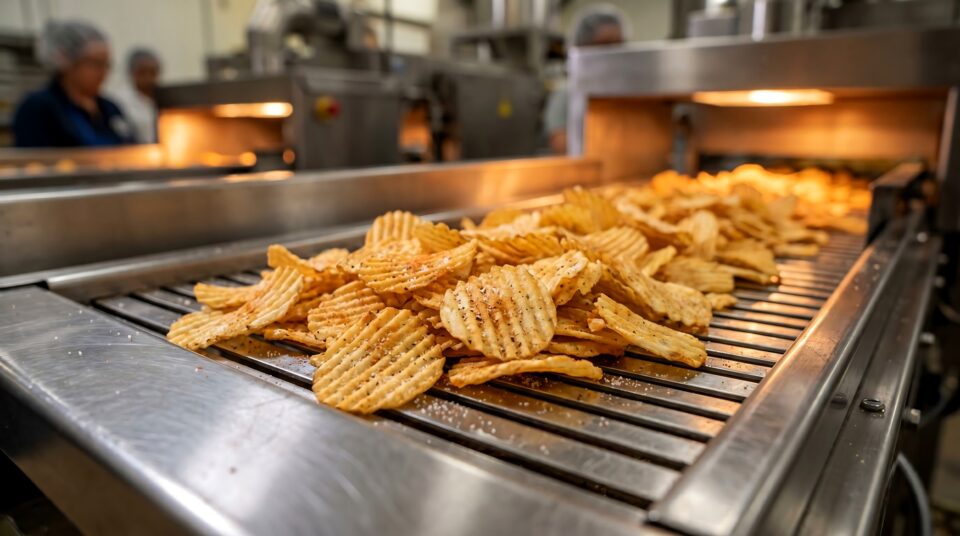
Industry Insight: Snack manufacturing is entering a more demanding phase, driven by HFSS advertising rules, packaging reform, ingredient volatility, AI-led product development and growing demand for nutrient-dense formats. For producers, the opportunity is no longer simply to launch bolder flavours or healthier variants, but to build snack ranges that are compliant, efficient, traceable, reformulated and commercially resilient.
As regulation, reformulation and packaging reform reshape the snack sector, manufacturers are moving beyond flavour-led innovation towards products that are healthier, traceable, efficient to produce and commercially resilient. The next generation of snacks will be defined as much by compliance, data and processing flexibility as by taste, texture and shelf appeal.
From Impulse to Engineered Occasion
The snack aisle has always been fast-moving, but the pressures shaping it have changed. A sector once led by flavour novelty, impulse purchase and format innovation is now being reshaped by regulation, ingredient risk, digital manufacturing and a far more complex definition of value.
Consumers still want indulgence, convenience and variety. That has not disappeared. What has changed is the operating environment behind the pack. Snack manufacturers now have to balance salt, sugar and fat reduction with texture, shelf life and margin. They must improve recyclability without compromising barrier performance. They need supply chains that can prove where cocoa, palm oil or soy originated. They are also being asked to deliver smaller, more functional eating occasions for consumers who increasingly expect protein, fibre, gut health, cognitive support or sustained energy from products that were once bought purely as treats.
This is why the next phase of snack innovation is not just about what appears on shelf. It is about how quickly manufacturers can reformulate, validate, produce, pack and document products in a market where technical flexibility is becoming as important as brand creativity.
Regulation Is Rewriting the Snack Playbook
For snack producers, health regulation is no longer a background issue. In the UK, less healthy food and drink advertising restrictions are now a direct commercial consideration, with limits on TV advertising before the 9pm watershed and restrictions on paid online advertising for affected products. The government’s guidance covers products often described as high in fat, salt or sugar, but the operational impact reaches far beyond marketing teams. It affects reformulation strategy, promotional planning, media spend, brand architecture and new product development.
For manufacturers of crisps, confectionery, biscuits, snack bars and sweet bakery products, the commercial question is becoming sharper: should a product remain indulgent and accept restricted promotional routes, or should it be reformulated to unlock wider marketing flexibility? That decision is not always simple. Reducing salt can alter seasoning impact. Cutting sugar can affect browning, texture and water activity. Lowering fat may change mouthfeel, processing performance and consumer acceptance.
This is where the technical function is moving closer to the boardroom. Reformulation is no longer only a product development challenge; it is a route-to-market decision. Brands that can model nutritional changes, test sensory outcomes quickly and validate shelf-life performance without lengthy trial cycles will be better placed to respond.
AI Moves from Forecasting to Formulation
Artificial intelligence is already familiar in demand forecasting and inventory planning, but its role in snack manufacturing is broadening. The more interesting shift is in product development, where AI tools are being used to compare flavour trends, ingredient functionality, nutritional targets, allergen constraints and regulatory requirements before physical trials begin.
For snack producers, this can reduce wasted development time. A savoury snack reformulation, for example, may need to reduce sodium while maintaining impact and distribution stability across a seasoning system. A snack bar may need to increase protein and fibre without becoming dry, dense or difficult to process. An extruded product may need to incorporate alternative ingredients that behave differently under heat, pressure and shear.
AI cannot replace pilot plant work or sensory panels, but it can narrow the field. By modelling ingredient interactions earlier, manufacturers can reduce failed trials, shorten development cycles and improve the chances that new products are both commercially attractive and technically scalable.

The GLP-1 Effect and the Rise of Nutrient Density
One of the most significant changes in the wider food sector is the growth of GLP-1 weight-management medication use. Its influence on snacking is still developing, but the direction is clear: some consumers are eating smaller portions while placing greater emphasis on protein, fibre, micronutrients and digestive comfort.
For snack manufacturers, this creates a new kind of opportunity. The next wave of functional snacks is not just about “high protein” claims. It is about nutrient density, portion control, satiety, muscle maintenance and gut-friendly formulation. Smaller formats with more deliberate nutritional design may become increasingly important, particularly in bars, bites, savoury clusters, dairy-based snacks and ambient protein products.
However, this also raises technical challenges. High-protein systems can become tough, chalky or bitter. Fibre enrichment can affect texture and moisture. Added functional ingredients can introduce flavour masking problems, allergen considerations or regulatory restrictions around claims. The successful products will be those that make functionality feel normal, enjoyable and repeatable rather than medicinal.
Plant-Based Matures, Rather Than Disappears
The plant-based snack market is not going away, but it is becoming more disciplined. The early excitement around plant-based positioning has been replaced by a more pragmatic focus on taste, price, nutrition and processing performance.
For B2B snack producers, this means plant-based innovation must work harder. Consumers are less willing to accept weak texture, long ingredient declarations or premium pricing simply because a product is plant-based. At the same time, ingredients such as pulses, grains, seeds and vegetable proteins still have strong potential in extruded snacks, crackers, bars and baked formats when they deliver clear functional value.
The strongest direction is likely to be plant-forward rather than plant-based for its own sake. That means products built around recognisable ingredients, protein and fibre, better sustainability credentials and reliable eating quality.
Upcycled Ingredients Become Operationally Useful
Upcycled ingredients are moving from marketing story to practical manufacturing tool. Spent grain, fruit pomace, vegetable fibre, cacao fruit material and other side-stream ingredients can provide texture, colour, fibre, antioxidant content or flavour complexity while helping manufacturers address waste and sourcing resilience.
For snack producers, the appeal is not only environmental. Ingredient volatility has made alternative sources of functional solids more attractive. Cocoa, sugar, oils, eggs and some starches have all faced cost or supply pressures in recent years. Upcycled ingredients cannot solve every sourcing problem, but they can add flexibility when incorporated into products that are designed around their technical behaviour rather than simply decorated with a sustainability claim.
The challenge is consistency. Side-stream ingredients can vary by season, source and processing method. Manufacturers need supplier controls, specification discipline and processing parameters that can handle variation without affecting product quality.
Packaging Costs Are Becoming Product Costs
Packaging is now one of the most important commercial issues in snacking. Flexible packs, flow wraps, pouches and multipacks are central to shelf life, portion control, brand impact and distribution efficiency. Yet these formats are also under pressure from extended producer responsibility, recyclability assessment, recycled content expectations and consumer disposal labelling.
In the UK, EPR for packaging is moving from broad principle to financial reality, with 2026–27 illustrative disposal fees and a stronger focus on how packaging recyclability affects producer costs. In the EU, the Packaging and Packaging Waste Regulation entered into force in February 2025 and generally applies from 12 August 2026, placing recyclability, waste reduction and circularity much closer to packaging design decisions.
This matters particularly in snacks because barrier performance is critical. Crisps, nuts, popcorn, biscuits and bars are sensitive to moisture, oxygen, aroma loss and fat oxidation. Moving from complex multi-material laminates to recyclable mono-material structures is not a simple substitution exercise. It can affect sealing windows, pack stiffness, line speed, shelf life, print quality and machinery settings.
The next wave of packaging innovation is therefore highly technical. Ultra-thin barrier coatings, improved mono-PE and mono-PP structures, better sealing layers and more accurate pack testing will be essential if snack brands are to reduce environmental impact without increasing waste through damaged or stale products.
Digital Links Turn Packs into Data Carriers
Smart packaging is also becoming more practical. The shift towards QR codes and GS1 Digital Link is not only about consumer storytelling. For snack manufacturers and retailers, connected packaging can support traceability, allergen updates, batch-level information, recycling instructions, promotions and potentially more dynamic stock management.
In a sector where short shelf life, seasonal launches and promotional packs are common, this matters. Digital links can reduce the need to fit every message onto physical packaging while providing a route for more current information. Over time, this could support markdowns, waste reduction and better post-sale engagement.
The important point is that smart packaging should be treated as infrastructure, not decoration. If the data behind the code is weak, outdated or poorly maintained, the pack becomes a missed opportunity.
Processing Lines Need Flexibility, Not Just Speed
Automation remains central to snack production, but the objective is changing. High-speed output still matters, yet flexibility is becoming just as important. Manufacturers are dealing with more SKUs, more seasonal variants, more reformulation work, more allergen controls and more packaging formats.
Digital twins, advanced process control and better line data can help manufacturers simulate changes before committing to full-scale trials. In extrusion, for example, a change in protein source, fibre inclusion or starch profile can affect expansion, density, texture and drying behaviour. A digital model cannot remove the need for real-world validation, but it can reduce waste and make scale-up more predictable.
Vision systems, robotics and automated seasoning control are also becoming more valuable as quality expectations rise. Consistency is particularly important in snacks because small variations in colour, seasoning coverage, breakage, oil content or pack weight can quickly affect consumer perception and retailer confidence.
Energy Efficiency Moves Up the Agenda
Snack production can be energy-intensive, particularly in frying, baking, drying, roasting and compressed air systems. As manufacturers pursue decarbonisation and cost control, processing efficiency is becoming a core investment area.
Electrification, heat recovery, improved insulation, smarter oven and fryer control, and more efficient cleaning regimes can all contribute to lower energy demand. The most effective gains often come from understanding where waste occurs: excessive warm-up times, poorly controlled oil systems, inefficient air handling, avoidable product loss or unnecessary changeover downtime.
For many manufacturers, the business case will not rest on sustainability alone. Energy efficiency must also support lower operating cost, improved uptime and better process control.
Smoke, Seasoning and Flavour Reformulation
Flavour remains the emotional centre of snacking, but it is also becoming more technically constrained. The EU’s position on smoke flavouring renewals has created another reformulation pressure for products relying on smoky, barbecue, charred or roasted flavour profiles. The European Commission notes that authorisations for existing smoke flavouring primary products were time-limited, and EU food safety information confirms that several authorisation renewals were refused in 2024, with transitional periods applying.
For savoury snacks, this may require flavour houses and manufacturers to rebuild profiles using alternative extracts, process flavours, encapsulated systems or seasoning blends that deliver similar consumer appeal while meeting regulatory expectations. As with HFSS reformulation, the challenge is not simply replacing an ingredient. It is protecting the sensory identity of a product while maintaining compliance, cost control and production stability.
The New Snack Advantage
The snack sector remains full of opportunity. Consumers still want pleasure, convenience, discovery and value. What has changed is the level of technical discipline required to deliver those things profitably.
The winning manufacturers will be those that connect product development, engineering, compliance, procurement and packaging from the beginning of the innovation process. A new snack can no longer be judged only by whether it tastes good and looks attractive on shelf. It must also be manufacturable at scale, compliant across target markets, packaged in a structure that can withstand regulatory scrutiny, and resilient enough to cope with ingredient and energy volatility.
Smaller bites may define the category, but the demands behind them are getting bigger.
Why are HFSS and less healthy food rules important for snack manufacturers?
HFSS and less healthy food rules affect how many snack products can be advertised and promoted. For manufacturers, this turns reformulation into a commercial strategy rather than a purely technical exercise, because nutritional profile can influence marketing flexibility, retailer discussions and long-term brand planning.
How is packaging regulation affecting snack production?
Packaging regulation is increasing the pressure to use recyclable, lower-impact and better-documented materials. Snack producers must balance these requirements with shelf life, moisture protection, oxygen barriers, line speed, seal quality and the cost implications of EPR and recyclability assessments.
What role is AI playing in snack product development?
AI is helping manufacturers shorten product development by modelling flavour trends, ingredient interactions and reformulation options. It cannot replace sensory testing or factory trials, but it can reduce failed prototypes and help teams identify more promising formulations earlier.
Why are functional snacks becoming more important?
Functional snacks are growing because consumers increasingly expect products to support protein intake, fibre, gut health, energy or wellbeing. The technical challenge is creating products that deliver these benefits while still tasting like enjoyable snacks rather than supplements.
What is the biggest operational challenge for snack producers in 2026?
The biggest challenge is flexibility. Manufacturers need to handle more reformulation, more packaging change, more traceability requirements and more SKU complexity while maintaining efficiency, quality, shelf life and margin.