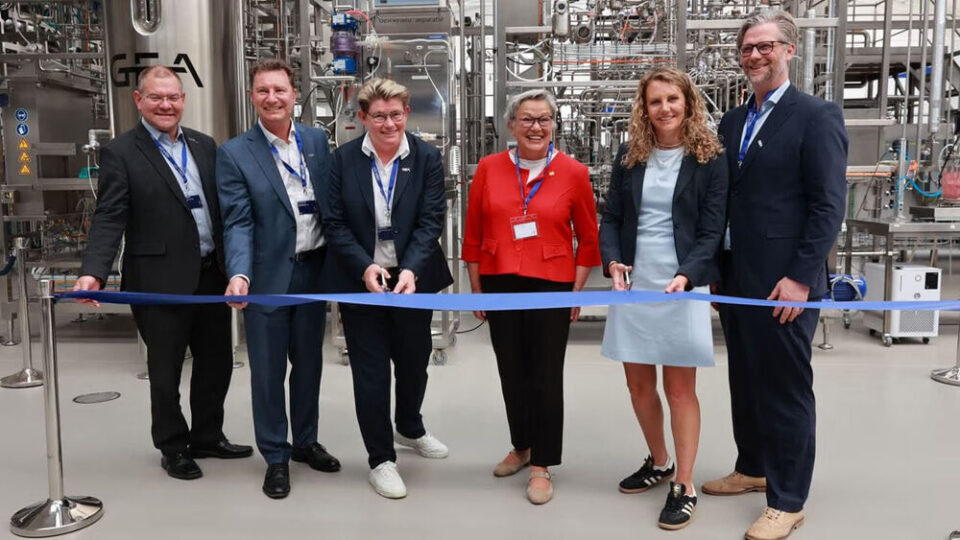
GEA has committed €4 million towards the relocation and expansion of its Application and Technology Center (ATC) dedicated to New Food and Biotechnology.
The center is shifting from a temporary space in Hildesheim to a more permanent and comprehensive location in Sarstedt, Lower Saxony. This transition integrates GEA’s specialized pilot capabilities with its engineering divisions into one centralized facility.
This strategic move aims to eliminate a significant hurdle in the markets for alternative proteins, ingredients, and biotechnology: the conversion from lab insights to economically feasible, industrial-level production. By situating the ATC at its established Sarstedt engineering hub, GEA is set to enhance its workforce, bringing together roughly 240 experts from fields like engineering, sales, automation, and ongoing support services.
Connecting laboratory research to industrial production
The process of scaling up biological activities such as cell cultivation or precision fermentation poses significant challenges. While a functional enzyme or alternative protein may show excellent results in a small laboratory setting, scaling up to thousands of liters often presents issues related to consistency, contamination, and variable quality of yield.
This newly consolidated facility enables manufacturers to experiment and refine their technical assumptions on a pilot scale before investing heavily in industrial operations. To replicate real-world scenarios, GEA connects bioreactors of sizes ranging from 50 to 500 liters with critical upstream and downstream processes. These processes encompass media preparation, sterilization, centrifugal separation, advanced filtration, hygienic equipment design, and automated process control systems.
By assessing these interrelated stages within a cohesive setting, producers can obtain solid technical data. This information equips brands with a strong basis for securing corporate funding, collaborating with third-party contract manufacturers, or advancing to the blueprinting phase for industrial factories.
Providing crucial commercial safeguards for producers
Validating processes at an early stage offers essential protection against costly capital misallocation. Frederieke Reiners, vice president of New Food & Biotech at GEA, emphasized how preliminary piloting significantly reduces financial risk for both start-ups and established food laboratories: “A good lab result creates interest. A solid process creates confidence. And sometimes the most valuable outcome of a test run is a clear no – because a process isn’t stable enough yet, or the cost structure simply doesn’t hold up. Learning that early can save a company a lot of time and capital.”
Broadened scope beyond alternative proteins
Although much of the public focus tends to gravitate towards alternatives for meat, dairy, and fish, GEA’s expanded facility is designed to cater to the wider industrial biotechnology sector. The centre’s pilot systems are fully equipped to innovate and refine high-value functional ingredients such as amino acids, specialty vitamins, agricultural feed, customized enzymes, and natural flavors.
This investment coincides with the German federal government’s emphasis on precision fermentation as a vital technology for securing future supply chains against climate volatility, animal health issues, and raw material shortages. By fostering this scale-up ecosystem in Sarstedt in partnership with entities like the Biotechnology Fermentation Factory (BFF) and Solar Foods, GEA aims to facilitate the swift transition of promising cellular research into dependable, repeatable, and commercially viable food solutions.