Amcor’s collaboration with Ocado Retail on the UK’s leading supermarket-led refill initiative is beginning to set a benchmark for scaling reusable packaging in mainstream grocery retail.
This initiative, executed in conjunction with the Refill Coalition and facilitated by GoUnpackaged, combines valuable consumer insights, advanced packaging technology, and collaborative efforts across various sectors. Such a blend provides insight into the rationale behind Amcor’s design of refillable containers and underscores why Ocado and its partners are optimistic about shifting reuse from a niche solution to a common practice.
Ocado Retail’s choice to prolong the trial initiated in 2024 stems from impressive operational metrics and customer feedback. According to Laura Fernandez, senior sustainability manager at Ocado Retail, the online reuse initiative has “surpassed commercial, operational, customer, and environmental targets since its launch in 2024.” She further notes that the program is expanding to serve “90 percent of our customer base and increasing the product range, making reuse more accessible to customers and setting a new industry standard.”
For Ocado, the appeal lies in the potential of a scalable reuse framework to minimize packaging waste, lower extended producer responsibility (pEPR) expenses, and bolster its reputation as a sustainability leader in the UK grocery sector. The retailer has also contributed to the formation of the Reuse Packaging Partnership (RPP), indicating that significant grocery chains view reuse as a collective challenge rather than a competitive edge.
Amcor’s contribution focuses on creating packaging durable enough to endure repeated cycles of filling, shipping, consumer use, returning, cleaning, and redistribution, all while maintaining food safety and operational efficiency.
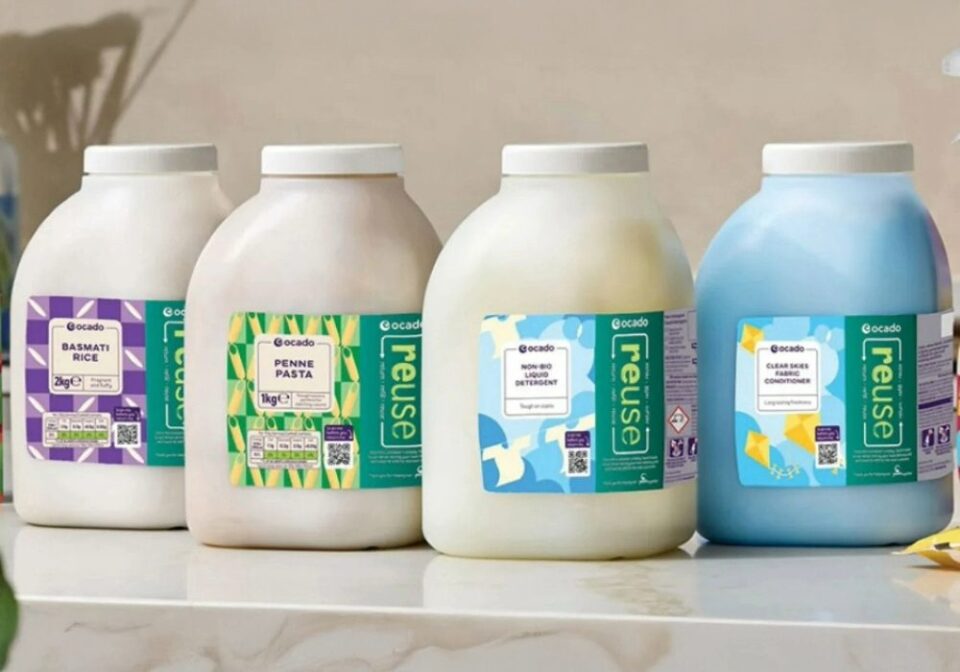
The company has crafted two specialized containers: a 2 kg model with a wide opening meant for dry items and a 3 kg variant featuring a narrower neck for liquids. Each was designed to withstand hot washing, eliminate areas that could trap residues, and optimize space usage in Ocado’s delivery crates.
Florent Souty, general manager for blow moulding specialties at Amcor and a member of the Refill Coalition advisory panel, stated, “We’re proud to be involved in a project that looks to redefine the nature of packaging for the future. By proving the potential for large-scale infrastructure, and planting the seeds for changes to consumer behavior, we can support the latest findings from GoUnpackaged and its partners in the Refill Coalition.”
The design of the containers, featuring thicker walls and a rounded-shoulder profile, is not simply for aesthetics; these choices are driven by the need for durability and reliable washing performance over many cycles.
The continuation of the trial aligns with GoUnpackaged’s recent report, A 30%+ reuse future for the UK, which utilizes Ocado’s trial data to assess the environmental and economic benefits of reuse. The report indicates that achieving a 30% reuse rate across the UK retail sector could lead to a 95% reduction in CO₂e emissions and generate annual savings of £136 million through lower pEPR costs.
Catherine Conway, the reuse lead at GoUnpackaged, stresses the necessity of practical performance data: “We estimate each container can be refilled between 50 and 100 times before being removed from circulation, so the ongoing data from Ocado Retail will be critical to definitively establishing the recommended usage.” She adds, “everything we’re seeing to date aligns with our estimate, and the quality of the packaging solution devised by Amcor is hugely important to the success of the project.”
The collaboration among Ocado, Amcor, and the Refill Coalition is noteworthy as it addresses two major barriers to reuse:
1. Infrastructure readiness: demonstrating that washing, refilling, and redistributing can function effectively at supermarket scale.
2. Consumer behavior: validating that customers will consistently return containers when the process is convenient.
Ocado’s initial achievements—recognized by various industry awards—suggest that reuse can seamlessly integrate into existing e-commerce grocery models without sacrificing service quality.
The refill containers aim to establish a standardized format that other retailers and brands could adopt, fostering economies of scale and shared infrastructure. If the trial continues to yield compelling data, it could hasten the transition from isolated pilot programs to cohesive national systems.