

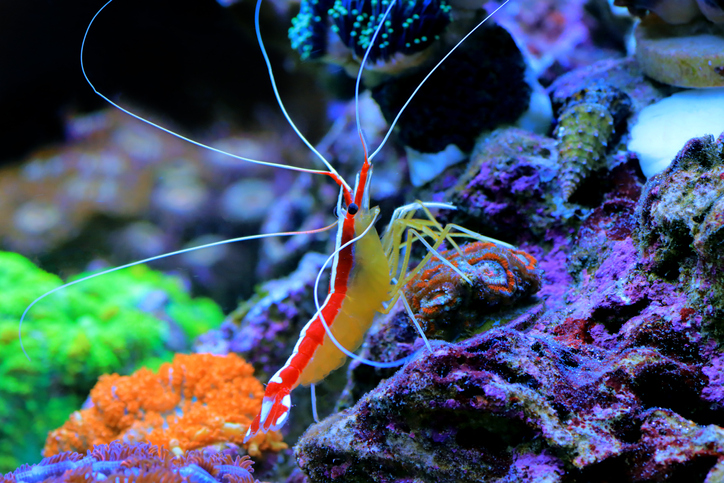
Israeli researchers have discovered a breakthrough in optics by studying the white stripes found on the body of the Pacific Cleaner Shrimp. These researchers have identified a new principle that produces highly efficient white reflectors, which could be used as a potential alternative to E171. The white material produced by the shrimp is less than 5 microns thick and produces exceptional brightness, making it one of the thinnest and most proficient white materials available.
The unique quality in the material found in the cleaner shrimp is that it can form dense scattering layers without compromising the scattering properties. The researchers hope to replicate this effect to create whitening agents in foods, which is a significant challenge for the food industry as it requires whiteness with very little material on very thin scales.
The researchers have realized that the particles found in the cleaner shrimp are liquid crystals, like those found in LCD displays, and exhibit birefringence, dual refraction, which is “exceedingly” rare in the animal world. The splitting of a ray of light into two rays when it passes through certain types of material is dual refraction.
Prof. Dan Oron, from the Department of Molecular Chemistry and Materials Science at the Weizmann Institute of Science, explained that the main challenge is to synthetically produce such anisotropic nanospheres, and forming such nanoscale structures is challenging from any synthetic chemistry point of view.
Start-ups are attempting to create white pigments that scatter light in a similar manner to the Cyphocilus beetle’s shell. There are so many species of animals living underwater, and it is unreasonable that there may not be other animals exhibiting this or related phenomena which can be investigated.
Dr. Ben Palmer from Ben-Gurion University of the Negev stated that it is one of the first times we have learned an entirely new principle from studying an organism. The shrimp has overcome a seemingly fundamental hurdle in optics by creating particles with this special arrangement of molecules. Now the question is, how can we replicate this effect for creating new materials? We could use these as food additives in white bread, in white paint, or in other applications.
Reference:
“Brilliant whiteness in shrimp from ultra-thin layers of birefringent nanospheres” in Nature Photonics. DOI: 10.1038/s41566-023-01182-4

