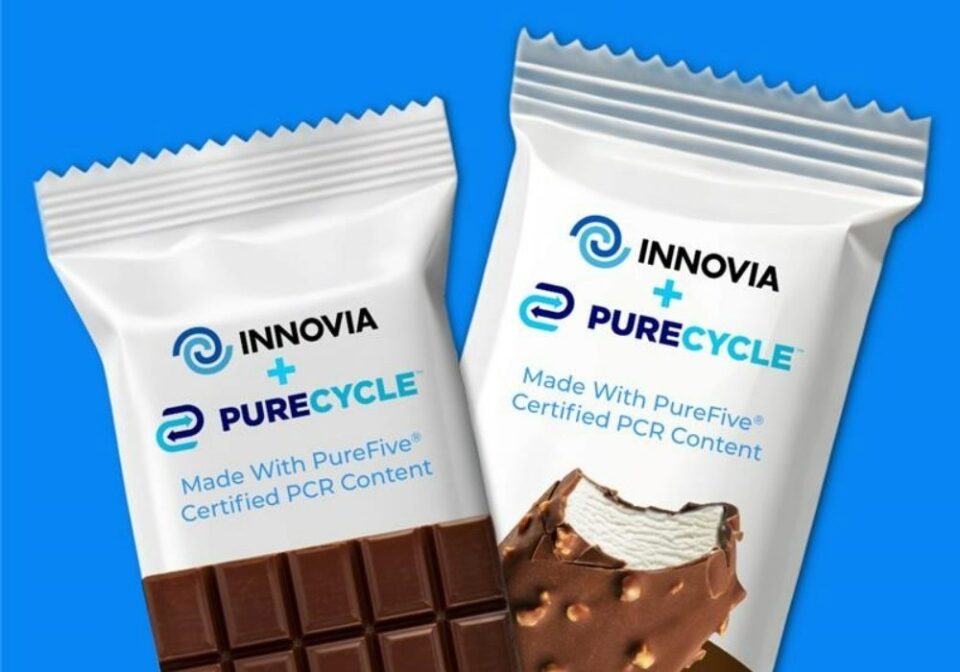
Material science leader Innovia Films has partnered with PureCycle Technologies to successfully create and assess a white, cavitated biaxially oriented polypropylene (BOPP) film featuring over 40% post-consumer recycled (PCR) content. This innovation offers worldwide consumer brands an effective and commercially feasible way to incorporate significant recycled materials into some of the most prevalent shelf-stable packaging formats.
Addressing Challenges in Flexible Formats
White, cavitated BOPP film is commonly used in grocery stores due to its opacity, lightweight nature, paper-like texture, and excellent print compatibility. It serves as a key material for a variety of food-contact applications, like wrappers for candies, ice cream packaging, snack bags, and roll-fed labels.
Historically, introducing substantial amounts of post-consumer recycled material into this specific format has posed significant technical challenges. Given the requirement for impeccable aesthetics, robust mechanical performance, and stringent moisture barriers in flexible food packaging, traditional mechanical recycling methods have struggled to provide the necessary resin purity.
The trial adeptly overcame these challenges by utilizing PureCycle’s PureFive Choice resin, specifically designed for ultra-thin film applications. This resin is produced through PureCycle’s proprietary dissolution recycling process, which effectively removes color, odor, and other contaminants from post-consumer polypropylene to produce a high-purity material that performs similarly to virgin plastics.
“This film produced with PureFive resin represents a major milestone and shift in the sustainability of flexible packaging,” claimed Chris Freshwater, market manager at Innovia Films. “Our research and development team continuously strives to enhance the sustainability of our products. PureCycle’s dissolution recycling technology is a real gamechanger. Not only are we integrating post-consumer recycled content into our films, but we’re also employing an energy-efficient recycling technology.”
Ensuring Efficiency on the Production Line
For fast-moving consumer goods (FMCG) companies, the main concern regarding high-PCR content packaging is maintaining line speed and structural integrity. If an environmentally friendly film compromises sealing capabilities or fails on high-speed wrapping machines, the associated downtime can negate any environmental advantages.
To validate manufacturing suitability, Innovia conducted thorough assessments of the entire cavitated BOPP production process. The trial confirmed that the PureFive Choice resin delivered results on par with traditional virgin polypropylene. Final evaluations showed consistent performance, with the PCR-rich film retaining the essential mechanical, barrier, and sealing attributes needed to protect food products while keeping packaging lines operating efficiently.
Pete Dias, senior director of market, product, and application development at PureCycle, emphasized the significant retail implications of the trial: “The successful production of white, cavitated BOPP film is a major step forward for PureCycle and for the flexible packaging industry. This film can be found throughout grocery stores — in the candy aisle, the ice cream section, or on snack shelves. By collaborating with Innovia, we have demonstrated that our PureFive resin for film meets those challenges and reinforces our belief that PureCycle can be a primary PCR supplier for the global flexible packaging sector.”
Facilitating Brand Commitments
The timing of this commercial breakthrough is crucial for the food and beverage sector. As brand owners face increasingly stringent global packaging regulations and strive to meet voluntary commitments — such as those outlined in the Ellen MacArthur Foundation’s New Plastics Economy Global Commitment — the demand for food-safe recycled polypropylene has surged.
Being one of the few food-contact-compliant recycled polypropylene resins available commercially, the successful scaling of this film empowers brand owners to enhance their supply chains without compromising the appearance or preserving qualities of their core product offerings.