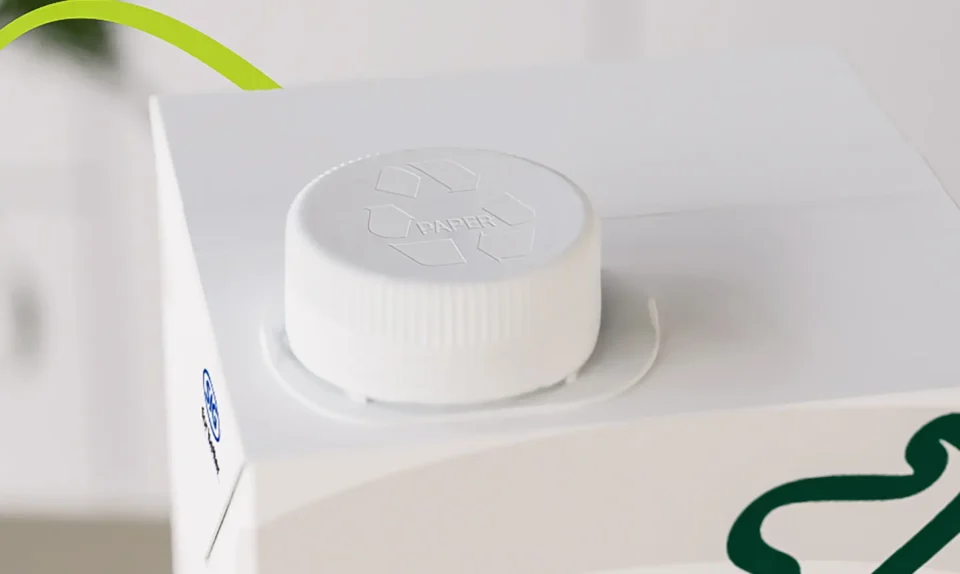
Significant Progress Towards Achieving 90% Paper Content in SIG Aseptic Cartons by 2030
SIG has formed a strategic alliance with PulPac, a prominent player in Dry Molded Fiber technology, to collaborate on developing and scaling innovative paper-based closures for aseptic cartons. This initiative seeks to offer the same performance and ease of use as conventional plastic closures while substantially minimizing plastic usage.
This partnership marks an important milestone in SIG’s commitment to enhance the paper fiber composition of its aseptic cartons to 90% by 2030, including closures. SIG also aims for an interim objective of 85% paper content (excluding closures) by 2024 as part of its vision for a fully regenerative food packaging ecosystem.
Harnessing the Power of Dry Molded Fiber
PulPac’s cutting-edge Dry Molded Fiber technology replaces traditional fiber slurries with a dry fiber web, reducing water consumption during production and achieving significant CO₂ reductions compared to plastic options. This innovative method also offers:
- High scalability to facilitate mass production
- Design flexibility for tailor-made closure solutions
- Reduced environmental footprint, aligning with circular economy principles
Gavin Steiner, Chief Technology Officer at SIG, remarked:
“We see Dry Molded Fiber technology as one of the most scalable solutions for fiber-based replacements of plastic closures. Our aim is to produce a closure composed entirely of paper for both the cap and the base—significantly enhancing the paper content of our cartons while preserving the consumer’s experience and superior opening function.”
Effortless Integration with Current Systems
SIG’s distinctive post-application method guarantees that closures are added after the carton has been sealed and sterilized, preserving its aseptic properties. This technique allows for plug-and-play compatibility with SIG’s current filling equipment and closure applicators—facilitating a smooth transition to paper-based closures without modifications to the production workflow.
Christoph Wegener, Chief Markets Officer at SIG, stated:
“For sustainable packaging advancements to achieve their full potential, they must synergize with existing infrastructure. Plug-and-play designs are a core principle for SIG. By integrating aluminum-free materials with paper closures, we’re making remarkable progress toward 90% paper content in our aseptic cartons—an industry breakthrough and a significant step toward a genuine circular economy.”
A Leap Forward for Sustainable Packaging
This collaboration places SIG and PulPac at the forefront of advancements in sustainable packaging. By utilizing innovative fiber technologies and ensuring effortless production integration, both companies aim to dramatically reduce plastic closures used each year, accelerating the shift toward renewable, fiber-based alternatives.