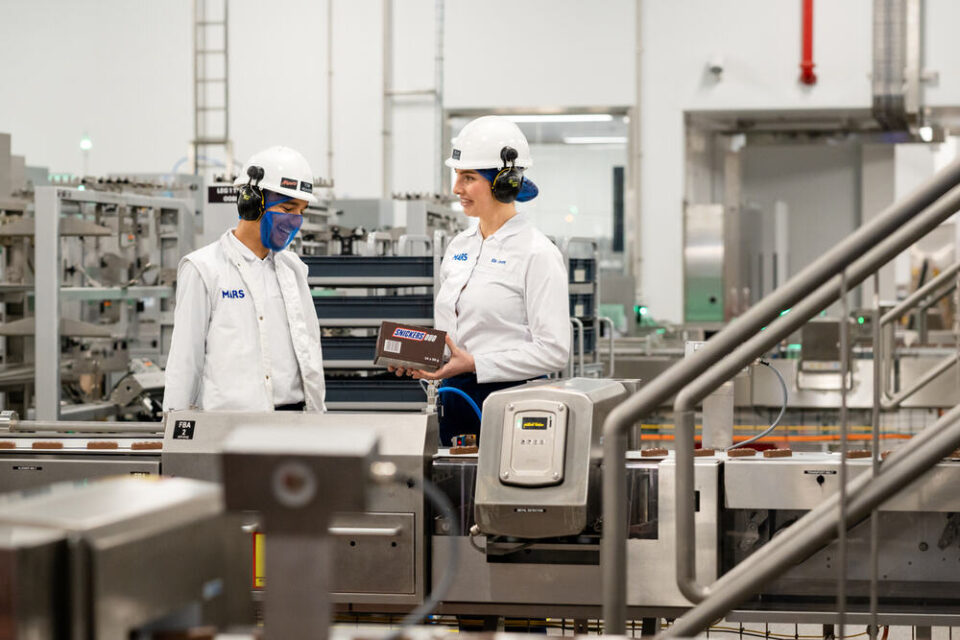
Mars has announced a significant investment of £190 million aimed at transforming its Slough chocolate factory into a cutting-edge manufacturing facility. This initiative represents one of the largest single-site financial commitments in UK food production in recent years.
Spanning from 2023 to 2028, the plan will incorporate advanced robotics, AI-enabled machinery, enhanced utilities, and digital twin technology at a location that has been producing the Mars Bar for almost a hundred years.
Adam Grant, General Manager of Mars Snacking UKI, emphasized that this investment illustrates the company’s enduring faith in Britain’s manufacturing landscape. “This investment reflects our confidence in the UK as a hub to manufacture and innovate,” he stated. “By adopting a long-term perspective, we are positioning our operations to remain world-class, competitive, and future-ready.”
With more than 1,850 employees, the Slough facility serves markets in the UK, Ireland, and the Netherlands. The enhancements will further solidify its importance within Mars’ European framework, especially amid increasing costs and uncertainties in global confectionery supply chains.
A key component of this investment is the integration of AI-driven digital twin technology, which allows engineers to simulate and optimize production in real-time. This advancement is anticipated to boost consistency, minimize waste, and improve overall responsiveness across various product lines.
Mars asserts that the digital twin system will facilitate precise process management and consistently produce the “perfect” Mars Bar, highlighting the commercial advantage of uniformity in a sector where brand loyalty is built on sensory experience.
Additionally, the factory will benefit from state-of-the-art cooling systems and energy-efficient utilities, aligning with Mars’ broader sustainability goals while also streamlining operational costs.
In tandem with these physical improvements, Mars is prioritizing workforce development by creating new opportunities in automation, engineering, and data-driven manufacturing roles. The company’s apprenticeship and mentorship initiatives are already enhancing diversity in technical positions, with 77% of apprentices coming from ethnically diverse or economically disadvantaged backgrounds.
Grant noted the factory’s deep-rooted history in Slough and stressed the importance of preparing the workforce for the future. “Our Slough factory is deeply rooted in our heritage, and as a proud family-owned business, we are committed to investing in a future that creates lasting, positive impact for the communities in which we operate.”
The investment has garnered positive responses from both government officials and local leaders as a testament to renewed faith in UK manufacturing.
Business and Trade Secretary Peter Kyle remarked, “This £190 million investment by Mars is a strong vote of confidence in the UK as a place to manufacture and innovate. For nearly a century, the Slough factory has produced some of the world’s best-loved brands, and this investment shows global businesses continuing to back British skills, workers, and industry.”
Slough MP Tan Dhesi added that this commitment underscores the company’s established presence within the community. “Mars has been part of our community in Slough for almost a century and remains one of our major local employers,” he pointed out. “This £195 million investment is a clear vote of confidence in our local economy and workforce.”
Mars’ modernization initiative mirrors broader trends within the UK food and beverage sector, including advancements in AI production, low-carbon utilities, digitally skilled workforces, and resilient supply chains.
As global FMCG companies reevaluate their manufacturing strategies, Mars’ choice to modernize rather than relocate sets a notable example, demonstrating that traditional UK production sites can evolve into high-value, digitally managed centers that are well-equipped to compete on an international scale.