From blister packs to pouches
Sealing creates strong bonds, and not just in the literal sense. The process that transforms a flat film into a flexible pouch successfully brought two companies together. Ultrasonic sealing paved the way for Herrmann Ultraschall and Gerhard Schubert to develop a groundbreaking technology for producing flowpacks.
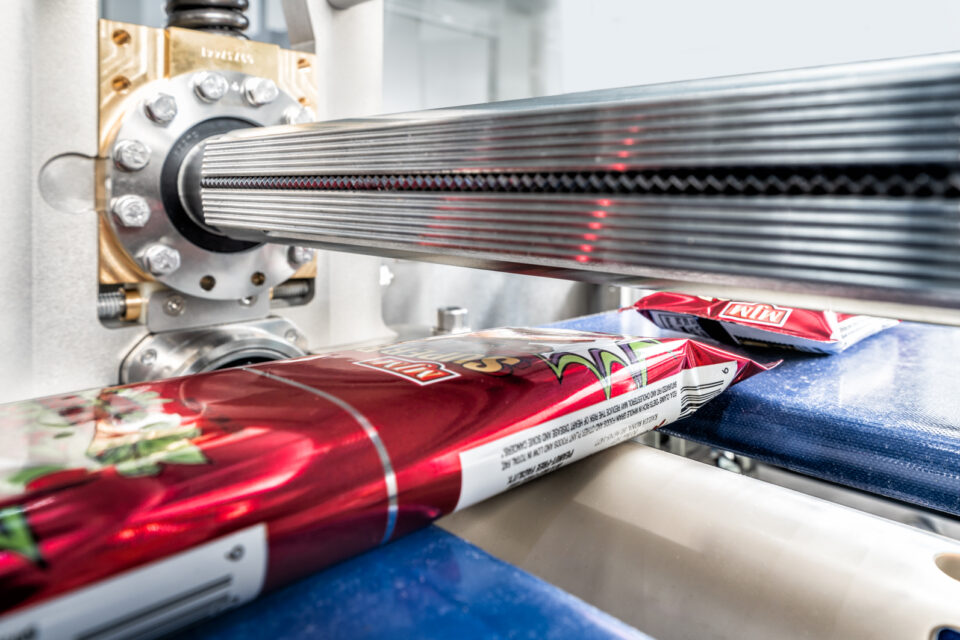
Ultrasonic sealing uses high-frequency mechanical vibrations to melt films in the sealing area through friction and internal heating. Unlike conventional heat-sealing systems, it works with cold tools, is gentler on materials and products, and can consume up to 75 per cent less energy.
Success through vibrations
Walter Herrmann recognised early on the potential of ultrasonic technology for industrial applications. In 1961, he founded Herrmann Ultraschalltechnik, today known as Herrmann Ultraschall. By the late 1980s, the company had expanded into the packaging sector with sealing solutions for plastic-based packaging materials.
At the same time, Gerhard Schubert was establishing itself as an innovation leader in robot-based packaging. In the early 2000s, the company was searching for a way to efficiently seal blister packs for toothbrush heads and turned to Herrmann Ultraschall for support. “At Herrmann Ultraschall, a great deal was technologically feasible at that time, as long as it involved thermoplastics,” recalls Michael Zimbleraikis, Regional Sales Director Packaging at Herrmann Ultraschall.
The collaboration led to the successful integration of several sonotrodes into a thermoforming machine’s sealing unit. After this first project, both companies followed different paths as Schubert focused increasingly on packaging technologies such as pick & place, cartoning and flowpack production.
An important piece of mail
A Christmas greeting from Herrmann Ultraschall eventually reignited contact. In 2013, both companies met again to discuss technology and future opportunities. At the time, Schubert was developing what would later become the Flowmodul. However, conventional heat sealing presented challenges. Varying film speeds could lead to inconsistent seal quality, affecting packaging integrity and product safety.
“We were looking for a way to ensure consistently high-quality seal seams regardless of the film speed,” explains Stefan Horvath, Product Manager at Gerhard Schubert. Ultrasonic sealing offered a solution. Because the sonotrode and anvil remain only lukewarm and generate heat locally through vibrations, the process delivers reliable sealing results while avoiding excessive thermal stress. “Regardless of the film speed, the longitudinal sealing module consistently achieves good sealing results,” says Stefan Horvath.
First-time use of the longitudinal sealing module
In 2019, the next major project followed. A Canadian start-up required five flow-wrapping machines for a 40-metre-long packaging line. Schubert’s Flowmodul, introduced in 2016 as the world’s first fully integrated flow-wrapping unit, provided the ideal basis.
To further increase flexibility, Schubert supplemented the heat sealing with Herrmann Ultraschall’s longitudinal sealing module. The compact design made integration straightforward, while engineers from both companies worked closely on communication interfaces and control systems. “We had sized our sealing unit so that it fitted almost perfectly into the Schubert Flowmodul,” says Michael Zimbleraikis.
The result was a successful engineering collaboration that has since led to around 100 longitudinal sealing modules from Herrmann Ultraschall being used worldwide in Schubert flow-wrapping machines.
Next stop: cross-sealing
Following the success of longitudinal sealing, both companies turned their attention to cross-sealing. The goal was to broaden the technological spectrum and create solutions particularly suited to sustainable packaging materials such as mono-material and paper films. “Ultrasonic sealing essentially makes the processing of sustainable films more practical, so we were once again happy to take on this new challenge with Schubert,” says Michael Zimbleraikis.
Together, the partners developed an ultrasonic Box Motion cross-sealing unit. Schubert supplied films for testing, while Herrmann Ultraschall evaluated them in its ultrasonic laboratory. Based on the results, both companies jointly advanced the engineering work. The outcome was a significant innovation for horizontal flowpack sealing. “Without our long-standing partnership with Herrmann Ultraschall, we could not have solved this challenging task so quickly,” highlights Stefan Horvath.
The technology was presented for the first time at interpack 2023 in a Schubert Flowpacker. Its Box Motion ultrasonic cross-sealing unit can be quickly substituted for a rotating heat-sealing system on the same machine – a first in the industry. For both companies, the project demonstrates the value of close technological collaboration. As Michael Zimbleraikis explains: “We are constantly receiving fresh impetus from end customers, film suppliers and technology partners such as Schubert, and we are delighted to build on these ideas together.”