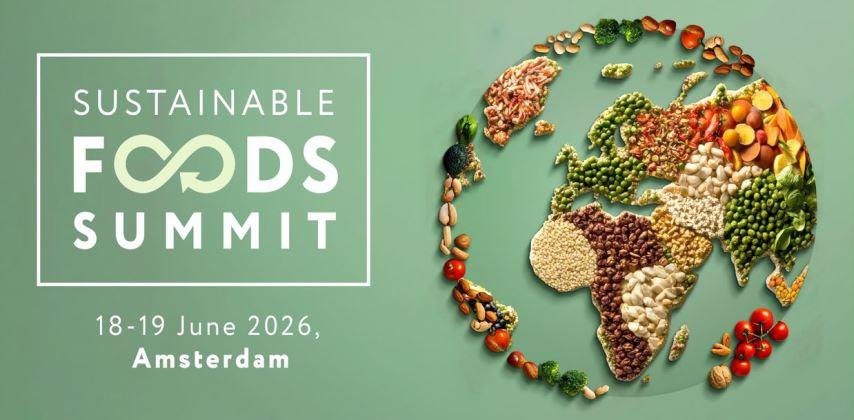
Biodiversity and ethical sourcing, sustainability impacts, and food ingredients will be featured at the Sustainable Foods Summit. The 17th European edition will be hosted in Amsterdam on 18–19 June 2026.
Organised by Ecovia Intelligence, the summit comprises four distinct sessions over a two-day programme. As in previous editions, the event will bring together thought leaders, industry innovators, and leading organisations involved in sustainability in the food industry. Some of the key highlights include:
1. Thought Leadership Keynotes
Award-winning documentary maker John D. Liu will open the summit with a keynote on the paradigm shift required for sustainability. Described as one of the world’s foremost ecological filmmakers, he will share insights into sustainable agriculture and ecosystem restoration.
Mike Barry, Co-Founder of Planeatery Alliance, will deliver the second keynote. He will discuss the growing popularity of regenerative agriculture and explain how it is improving soil fertility and encouraging biodiversity. He will also examine how regenerative agriculture could help tackle some of the major sustainability challenges facing the food industry.
2. Sustainability Impacts
This session will discuss the various ways food companies can address their sustainability impacts, with an emphasis on environmental issues. Johan Oost from Water Footprint Implementation will provide insights into water footprints, including the different types and how they can be measured.
A leading food company will share its experiences in reducing Scope 3 emissions as part of its decarbonisation programme. Anne-To Vervelde from Wageningen University will provide an update on environmental impact labelling schemes. The first panel will discuss the difficulties involved in prioritising environmental impacts. Panelists will include representatives from Unilever, ETG, and Asahi Group Holdings.
The second panel will focus on the economic dimension of sustainability. What does the economic pillar mean in terms of sustainability? How can operators create greater economic value through their food products? Panelists will include representatives from Sodexo, Quorn Foods, B Lab, and the World Benchmarking Alliance.
3. Biodiversity & Ethical Sourcing
At the last UN Biodiversity Conference (COP16), a global framework was established to halt and reverse biodiversity loss, including a commitment to protect 30 percent of land and water by 2030. The summit will explore how the food industry can support these goals through ethical sourcing and nature-positive approaches.
As biodiversity rises on the sustainability agenda, Rik Kutsch Lojenga, Executive Director of the Union for Ethical BioTrade, will discuss business and consumer trends relating to biodiversity. David Hadley from Preferred by Nature will provide an update on biodiversity-related regulations, including the EU Nature Restoration Law, EU Deforestation Regulation, Sustainable Use of Pesticides Regulation, and Corporate Sustainability Reporting Directive.
Lea Riffard, Corporate Sustainability Manager at Ecotone, will share the company’s experience in marketing biodiversity-friendly products. Ecotone, one of Europe’s leading organic food companies, has focused on “food for biodiversity” since 2020. Its brand portfolio includes Allos, Alter Eco, Bonneterre, Clipper, Danival, Isola Bio, Kallø, Tartex, and Zonnatura.
Measuring impact remains one of the major challenges associated with biodiversity. A dedicated panel will examine approaches to quantifying how human activities affect ecosystems, species, and habitats. Panelists will include representatives from Proforest, WBCSD, Naturland, and Royal Canin (Mars).
4. Food Ingredients
New and emerging food ingredients with sustainability benefits will be covered in this session. Hille van der Kaa, CEO & Founder of Vegan Cowboys, will explain how the Belgian start-up is producing vegan casein using precision fermentation. Details will be provided on the technology used to create dairy-identical casein proteins.
The Belgian retailer Colruyt Group will share its experiences in the sustainable sourcing of ingredients. Emese van Maanen from ProTerra Foundation will discuss deforestation-free supply chains for agricultural commodities, while Anneke Voss from ISCC will provide details of certification schemes for regenerative, deforestation-free, and decarbonised agriculture.
Since COVID-19, food ingredient supply chains have been affected by geopolitical conflict, climate change, tariffs, and regulations. Conflict in the Middle East is now affecting fertiliser supplies. Tristan Fletcher, CEO and Co-Founder of ChAI, will discuss the role of AI in assessing and mitigating supply chain risks.
A panel will examine the sustainable supply of raw materials: how are recent events affecting ingredient supply chains, and how are companies adapting their purchasing patterns?
5. Marketing
Helen Breewood from Good Food Institute Europe will present the latest data and trends in the European plant-based food market. Growth projections for leading product categories will also be shared.
Heather Terry, CEO of GoodSAM Foods, will discuss her experiences in marketing products derived from regenerative agriculture. Her company works with smallholders to establish regenerative agriculture projects for fruits, coffee, and cocoa.
David Sack from AKA Foods will discuss the role of AI in developing and marketing sustainable food products. Esme Brewin from Globescan will provide insights into consumer attitudes towards sustainability issues.
The final panel will focus on consumer behaviour. As consumers become more price-sensitive in the current economic climate, how can they be encouraged to make greener choices? How can they be nudged towards purchasing sustainable food products? Panelists will include representatives from Whole Foods Market, Dr. Oetker, and Cupffee.