Six leading consumer goods companies are joining forces to advance paper-based flexible packaging, aiming to create solutions that can operate effectively on manufacturing lines while meeting requirements for recyclability, affordability and product protection.
The PaperFlex Consortium unites Colgate-Palmolive, Mars, Nestlé, PepsiCo, Procter & Gamble and Unilever to address a persistent challenge in packaging development: producing paper alternatives that can match the performance brands currently achieve with plastic.
The Ellen MacArthur Foundation has convened the initiative, with (RE)SET providing operational support. The consortium will coordinate research and industrial trials, with particular attention to regions where organised collection and recycling infrastructure remains limited. Its purpose extends beyond replacing plastic with paper; it seeks to speed up the development of packaging that satisfies technical, commercial and environmental needs.
Pooling expertise and investment
For participating brands, collaboration can spread the expense, risk and knowledge required to develop new packaging systems.
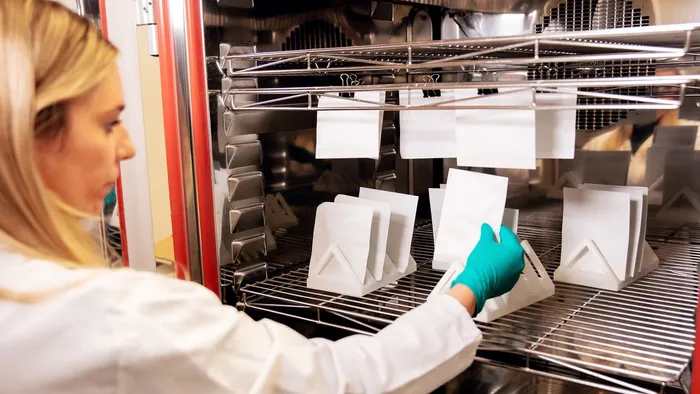
According to the Foundation, the group will design, finance and carry out joint trials focused on biodegradable coatings, advanced coating systems and methods for improving the performance of paper-based materials during production.
This approach recognises that material selection is only one part of the challenge. A paper-based pack must run reliably on existing or modified machinery, protect its contents, preserve shelf life and provide a practical experience for consumers.
Research from the Foundation indicates that responsibly designed paper flexible packaging has not yet reached the performance, production scale or cost levels needed for most applications.
Consequently, manufacturers must consider machinability and operational reliability alongside material innovation. These priorities reflect wider food manufacturing trends, in which companies are expected to improve sustainability without compromising throughput or quality.
Bridging the gap between trials and commercial production
PaperFlex could give companies access to a wider range of technical insights before they commit their own packaging projects to full-scale implementation.
The initiative is especially relevant to sachets, pouches and wrappers. These formats rely heavily on flexible plastics, yet recycling them economically remains challenging in many markets.
Paper alternatives bring their own performance considerations. Developers must assess moisture and grease resistance, barrier properties, seal integrity, coatings, adhesives and operating speeds. Packaging must also satisfy consumer expectations and commercial constraints, not just environmental targets.
Through shared trials, the consortium can build a broader evidence base around industrial performance. Successful approaches will provide valuable direction, while unsuccessful experiments can help companies avoid repeating costly mistakes.
Mars’ global VP of healthy planet and chief circularity officer Allison Lin says the initiative is designed to move companies away from working in isolation. It will do so within clear legal boundaries, appropriate safeguards and the oversight of an independent convenor.
Supporting more affordable innovation
Production scale will play a central role in determining whether paper-based flexible packaging can compete.
Plastic formats have benefited from decades of investment in materials, machinery and manufacturing efficiency. Paper alternatives, by comparison, often remain more expensive and may require additional development before they can achieve comparable performance.
PaperFlex brings together major packaging users to accelerate technical progress and explore ways to make commercial scale-up more economical. The Foundation says joint research and development can help promising solutions reach maturity more quickly while reducing the cost of innovation.
This shared platform could give brands a stronger range of technologies to evaluate when planning future packaging programmes. Instead of solving identical problems separately, companies can draw on collective learning related to materials, processing and production.
Six principles guiding the programme
The consortium will follow six principles previously established by the Ellen MacArthur Foundation.
Paper-based packaging solutions should use responsibly sourced materials and responsible production methods. They must also meet technical, financial and consumer needs, support recycling within local systems, avoid hazardous substances and reduce the risk of persistent plastic pollution. In addition, each solution should contribute to a wider circular economy model.
The programme has two end-of-life objectives. Where suitable collection and recycling infrastructure exists, packaging should be recyclable. In locations where packaging may escape formal waste systems, biodegradability is also considered important.
This distinction has practical significance for manufacturers. The goal is not to exchange one material for another without considering local conditions. Instead, developers must create formats that align with available infrastructure, environmental realities and market requirements.
These principles are increasingly relevant as food and beverage industry trends, food and drink sustainability goals and food and drink regulations influence packaging decisions across global supply chains.
Potential impact across the manufacturing sector
For brand owners, PaperFlex offers a shared development framework covering some of the most complex packaging issues, including materials, coatings, barrier protection, production performance, cost and end-of-life management.
The six founding companies will continue to control their own packaging strategies and decide independently which technologies to adopt. However, the consortium gives them a way to combine expertise, finance testing and exchange information before solutions are introduced commercially.
The Foundation has invited additional FMCG companies, technology developers, suppliers and investors to join the initiative.
Packaging suppliers and machinery manufacturers may also find opportunities to support the next phase of development. Paper-based structures could require adjustments to converting, filling, sealing and other equipment used throughout the production process. This creates potential links with emerging food processing technology and broader food and drink industry innovation.
PaperFlex is not intended to trigger an immediate, industry-wide transition from plastic to paper. Its purpose is to narrow the distance between paper packaging that appears technically viable and packaging that can deliver consistent performance at industrial scale.
As food distribution trends, consumer expectations, food and drink packaging requirements and food and drink marketing priorities continue to evolve, the initiative could provide brands with a broader technology base for assessing practical alternatives.