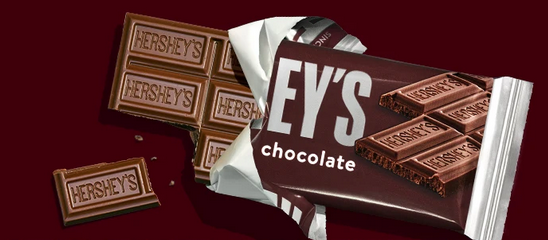
Hershey projects “lower sensitivity” to volume changes from pricing across its product range, even as the confectionery and snacks powerhouse grapples with cocoa inflation.
The maker of Reese’s has factored in a ten-percentage-point increase in pricing to its sales revenue guidance for the fiscal year 2026. This is an uptick from last year’s six-point boost, which led to a 1% decrease in volume/mix.
In 2025, the decline in volume/mix for confectionery was more pronounced, reaching 2% with similar pricing levels. However, volumes for salty snacks, which remain unaffected by cocoa price fluctuations, increased by 8% with a lower price reduction of 1%.
During the analysts’ call following the release of annual results on February 5, President and CEO Kirk Tanner addressed key questions about cocoa pricing and its implications on Hershey’s pricing strategy.
Similar to Mondelez earlier this week, Tanner and CFO Steve Voskuil noted that previous pricing adjustments did not fully recover from cocoa cost inflation, indicating potential further price increases in 2026.
Both Hershey and Mondelez had secured cocoa rates through hedging prior to this year’s notable commodity decline, although futures prices still hover above historical averages following a record high in late 2024.
There are emerging expectations for price deflation in the confectionery sector, reflecting reduced cocoa costs, yet executives are cautious about making definitive statements on this matter.
Tanner remarked, “Our competitors in the category are sophisticated, and they’re large like ourselves, and they likely have coverage for more certainty in their business. Private label remains small here in the US, so that’s the first point. But there’s a big conversation around how we think about pricing and the price of cocoa.”
The CEO also emphasized, “The pricing we took in ’25 – I think this is important – does not fully cover our cocoa cost inflation in 2026. So we are on a recovery path while also adding significant fuel to our growth with investments in marketing, innovation, R&D, really to keep that momentum on the top line going, and keeping the category exciting for consumers and keep that growth moving into ’26, or beyond ’26, into ’27 and ’28. Certainly, the deflationary momentum on cocoa takes future pricing pressure down.”
Voskuil provided a more nuanced perspective, suggesting that cocoa has yet to establish its “new equilibrium,” which is likely to stabilize above historical rates.
“We’re hedged above current market levels. So if you extend current market levels flat, that would suggest that we still have some upside for further deflation in 2027,” he explained.
“With a variety of hedging structures in place, some allow us to benefit from any downside. Thus, even in ’26, we have a slight opportunity. Moving forward to ’27, placing hedges today could indicate deflation between ’27 and ’26, so we’re carefully monitoring that space.”
Looking ahead to more detailed plans on March 31, Hershey’s sales outlook has been projected at 4-5% growth, driven by net price realization, increased innovation, cultural and seasonal activations, and robust advertising efforts to sustain demand.
Organic sales growth is expected to range between 2.5% and 3.5%, compared to 4.2% last year.
The projected earnings per share (EPS) on a diluted basis stands at $7.77 to $8.19, reflecting a significant increase of 79% to 89% compared to 2025, when EPS saw a sharp decline of 60.3%.
In adjusted terms, diluted EPS is anticipated to reach $8.20 to $8.52, up 30% to 35%, a rebound from last year’s drop of 32.7%.
According to Voskuil, “We now expect slightly lower volume sensitivity to pricing actions than previously planned. Our 2026 outlook also incorporates prudent assumptions for potential demand headwinds, including accelerated health-and-wellness trends, increasing GLP-1 adoption, government policy changes, and ongoing consumer financial strain.”