Industry Insight: Filling and depositing was once judged primarily by speed. Today, the more revealing measure is control: how accurately a line holds target weight or volume when viscosity, temperature, particulates, container formats and production schedules change.
Filling and depositing machinery is becoming a critical control point for cost, compliance and product quality. As manufacturers juggle expensive ingredients, wider SKU ranges, lighter packaging and increasingly complex formulations, the strongest returns are coming from accurate dosing, faster changeovers, better process data and hygienic systems capable of keeping production moving.
That changes the investment calculation. A faster machine delivers little advantage if it creates excessive giveaway, damages inclusions, extends cleaning cycles or requires prolonged adjustment every time a new SKU reaches the line. Modern filling technology is increasingly about controlling variation — and turning that control into margin.
Giveaway, Gone: Turning Accuracy into Margin
For manufacturers handling millions of packs, apparently insignificant overfilling can become a substantial hidden cost.
The problem is straightforward. A producer must ensure packs comply with declared quantity requirements, but deliberately running comfortably above target to protect against underweight packs effectively gives product away.
Under Great Britain’s packaged-goods rules, the average contents of a batch cannot be below the nominal quantity, only a limited proportion of packs can fall below the defined tolerable negative error, and no individual pack can fall below twice that tolerance. Equipment must also be suitable for the process and appropriate records maintained where required.
The opportunity for modern filling systems is therefore not simply to hit a nominal target, but to reduce variation around it.
Servo-controlled drives, accurate flow measurement, checkweighing and feedback from load cells can create a closed-loop process in which dosing parameters are continuously monitored and corrected. Instead of building a large safety margin into every pack, manufacturers can operate closer to the required target while maintaining compliance.
The financial implications become particularly significant with higher-value ingredients. Sauces containing premium oils, protein products, confectionery fillings, meat preparations, dairy formulations or functional ingredients can turn a few unnecessary grams per pack into a sizeable annual raw-material cost.
This is where accuracy becomes an ROI calculation rather than simply an engineering specification.
Difficult by Design: Depositing Products That Refuse to Behave
Accuracy becomes more complicated when the product itself changes during processing.
Water-like liquids are comparatively predictable. Batters, dressings, mayonnaise, fruit preparations, nut butters, sauces, doughs, cultured dairy products and plant-based formulations can behave very differently depending on temperature, shear, aeration and formulation.
Some products become easier to pump as shear increases; others can lose structure. Suspensions may settle. Large inclusions can block narrow pathways, while aggressive pumping can damage fruit pieces, vegetables or other delicate components.
That is increasing the importance of matching the pump, valve, nozzle and filling principle to the rheology of the product rather than selecting machinery on headline throughput alone.
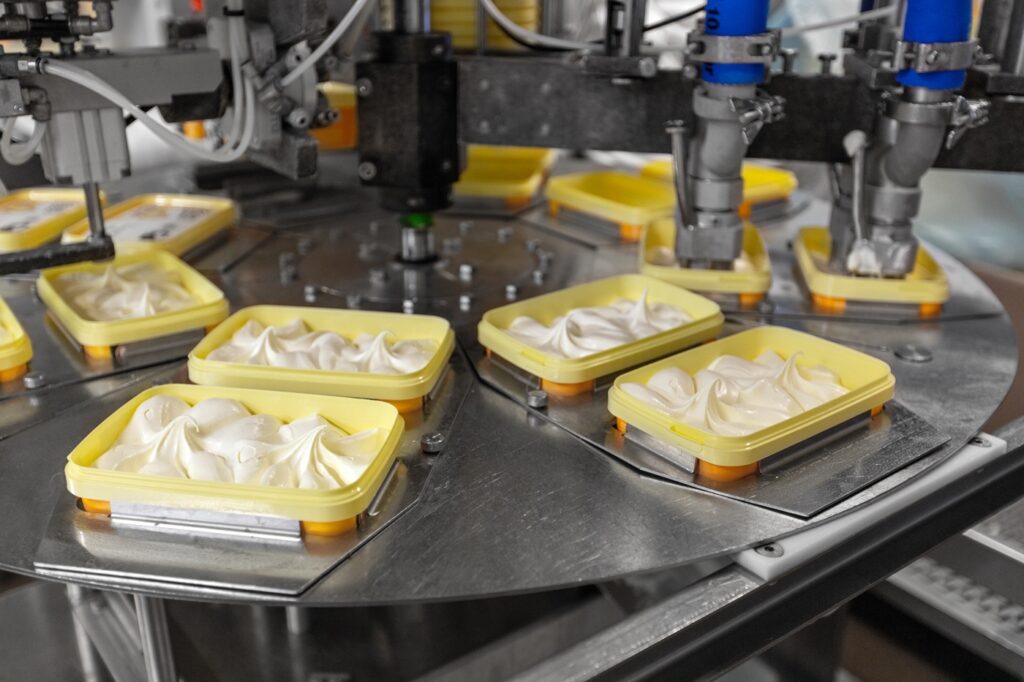
Piston depositors remain valuable where highly controlled portions of viscous material are required. Rotary-lobe and other positive-displacement systems can offer gentler product handling, while larger product pathways and correctly designed valves allow sauces, soups and ready-meal components containing particulates to be handled without unnecessary damage.
Recent machinery development illustrates how specialist depositing remains important even as factories become more automated. At interpack 2026, for example, GEA highlighted its Bake Depositor 2LC for precision depositing of soft doughs and semi-liquid batters, reflecting the continued demand for application-specific control rather than one universal filling technology.
For engineering teams, trials using the manufacturer’s actual product remain critical. A machine capable of exceptional accuracy with water may perform very differently once asked to deposit a cold sauce containing vegetable pieces or a warm, aerated bakery mix.
Change Faster, Run Longer: Why Flexibility Now Rivals Speed
The fastest filler in the factory is not necessarily the most productive.
Growing SKU counts, retailer-specific pack formats, promotional runs and shorter production campaigns mean manufacturers increasingly spend valuable hours moving between products and packs.
That has shifted attention towards changeover engineering.
Stored recipes can automatically recall fill volumes, speeds, pressure settings and other process parameters. Servo-driven adjustments can replace some manual mechanical intervention, while tool-free components, quick-release product-contact parts and clearly identified change parts reduce the opportunity for error.
The objective is repeatability. A line that can return reliably to validated parameters after a product change gives manufacturers something more valuable than convenience: predictable scheduling.
The same requirement is appearing elsewhere across packaging lines. Sidel used interpack 2026 to demonstrate automated systems designed around faster and repeatable format changes, including a robotic bottle-handling system capable of changing collation arrangements in around a minute and bottle formats in approximately two minutes. Although downstream of the filler itself, it demonstrates the direction of travel across packaging operations: flexibility is increasingly engineered into the line rather than managed through lengthy manual intervention.
For plants producing many short runs, improving changeover may therefore deliver more usable capacity than simply increasing maximum running speed.
Light Packs, Tight Tolerances: Filling Meets Packaging Change
Packaging development is also changing the physical environment in which filling machinery must operate.
Lightweighted bottles, increased recycled content, thinner materials and revised packaging structures can behave differently from the packs they replace. A container that uses less material may be more susceptible to deformation during handling, while changing film, tray or sealing structures can alter the tolerances available at the filling station.
This makes filling and packaging development increasingly interdependent.
Nozzle positioning, filling velocity, container support and product movement need to be considered alongside the pack itself. Excessive foaming or splashing may contaminate sealing areas and create rejects, while unsuitable handling can distort lightweight containers before they reach closure or sealing.
For manufacturers considering packaging changes, validating the new material on the complete production process is therefore essential. A pack that performs perfectly in laboratory testing still has to survive filling, sealing, inspection, secondary packaging, palletisation and distribution at commercial line speeds.
That becomes even more important as regulatory pressure continues to alter material choices.
Rules Meet Reality: Regulation Reaches the Filling Line
UK Extended Producer Responsibility for packaging has now moved beyond preparation and into its operational phase.
From the 2026/27 assessment year, household packaging disposal fees are being modulated according to recyclability under PackUK’s Recycling Assessment Methodology. Red-rated packaging attracts an increased modulation factor, amber remains at the base level and green packaging benefits from redistribution of the additional red-rated charges. PackUK says confirmed 2026/27 producer disposal fees will be calculated in November 2026 once producer data has been checked.
Plastic Packaging Tax has also risen to £228.82 per tonne from 1 April 2026 for chargeable plastic packaging containing less than 30% recycled plastic. From April 2027, further changes will allow chemically recycled material to be accounted for through an approved mass-balance approach, while pre-consumer plastic waste will cease to qualify as recycled content for PPT purposes.
For UK manufacturers exporting packaged products to the EU, another significant change has already arrived. The EU Packaging and Packaging Waste Regulation began applying from 12 August 2026, with measures including new restrictions on PFAS in food-contact packaging and further requirements, including recyclability and recycled-content provisions, phasing in later.
None of these measures is a filling-machine regulation. However, they can influence the packaging materials and formats manufacturers need their equipment to accommodate.
The practical question for engineering teams is therefore increasingly: if the packaging specification changes again, can the existing line cope?
Clean More Intelligently: Hygiene Without Losing Production
Hygiene has always been fundamental to filling and depositing, but the commercial focus is shifting towards achieving the required standard with less production interruption.
Product-contact areas designed around hygienic principles, reduced crevices, accessible components and easier strip-down can shorten cleaning and inspection. Automated Clean-in-Place systems can further reduce manual intervention where the process is suitable.
The next development is greater use of process feedback.
Rather than treating cleaning as a completely fixed-duration operation, instrumentation can monitor parameters such as temperature, flow, conductivity or other validated indicators throughout the cleaning cycle.
That provides plants with better evidence of what happened during cleaning and creates opportunities to optimise validated processes rather than simply extending cycles as a precaution.
The benefit is broader than reduced water or chemical consumption. Cleaning time is production time that cannot be sold.
Where a factory makes frequent allergen or product changes, hygienic design and cleaning performance therefore directly affect available capacity. A machine that takes significantly longer to clean may ultimately cost more than a higher-specification alternative even when its initial purchase price is lower.
Data at the Nozzle: Turning Filling into a Measurable Process
Digitalisation is also changing what manufacturers can learn from the filling operation.
Modern control systems can record fill parameters, product recipes, alarms, motor loads, pressures, operating temperatures and production rates. Connected checkweighers and inspection equipment can then provide another layer of information about what leaves the machine.
The real opportunity comes from combining those datasets.
If fill-weight variation begins increasing, engineers can investigate whether it corresponds with product temperature, pump performance, nozzle behaviour, line speed or another process variable. Maintenance can move away from simply reacting to machine failure towards identifying deterioration before it significantly affects output.
AI will increasingly form part of this environment, but manufacturers should distinguish practical applications from marketing language.
Machine vision can support pack and closure inspection. Software can identify abnormal operating patterns. Digital twins can be used to model equipment and production changes before physical intervention.
The value comes when these technologies resolve a measurable production problem rather than when AI is added as a feature in its own right.
There is also a compliance dimension for companies supplying machinery into the EU. Regulation (EU) 2023/1230 on machinery applies from 20 January 2027 and includes explicit requirements around software, control-system integrity and protection from reasonably foreseeable malicious interference. Substantial physical or digital modifications affecting machine safety can also create manufacturer responsibilities for the organisation carrying out them.
For connected filling lines, cybersecurity and change management are therefore becoming engineering considerations alongside mechanical safety.
Buy the Process, Not the Machine: Building the ROI Case
The strongest filling and depositing investments are increasingly evaluated against the complete production process rather than a single headline specification.
Maximum packs per minute still matters, but it is only one variable.
Manufacturers should also examine fill-weight variation, giveaway, product losses during start-up, format-change time, cleaning duration, operator requirements, rejected packs, maintenance access, spare-part availability and the machine’s ability to accommodate future products and packaging formats.
A lower-cost machine may be less attractive if it demands greater giveaway or lengthy changeovers. Conversely, an apparently expensive system may generate a faster return if it consistently reduces ingredient loss and releases additional production hours.
This makes factory trials and reliable baseline data important before capital expenditure is approved. Manufacturers need to understand the existing cost of variation before they can accurately calculate the value of eliminating it.
The same principle applies to automation. Robots, intelligent inspection and advanced controls should solve an identified restriction — labour availability, repeatability, contamination risk, throughput, giveaway or changeover — rather than becoming objectives in themselves.
Precision Pays: The New Filling Equation
Filling and depositing technology is moving away from the simple pursuit of greater speed.
The new target is controlled production.
Manufacturers need lines capable of accurately handling products whose properties vary, packaging that continues to evolve and production schedules containing more SKUs and shorter runs. At the same time, equipment must remain hygienic, maintainable, digitally visible and flexible enough to accommodate requirements that may not yet exist when it is purchased.
That makes filling accuracy more than a quality metric.
Every unnecessary gram has a cost. Every additional minute spent changing products or cleaning equipment removes capacity. Every rejected pack consumes product, packaging, labour and energy without creating revenue.
The next generation of filling and depositing technology is therefore not simply about putting product into a container faster.
It is about controlling exactly what goes in, how reliably it gets there — and how little value is lost along the way.
How is packaging regulation affecting filling machinery?
Regulations including UK EPR, Plastic Packaging Tax and the EU PPWR are encouraging changes to packaging materials and structures. Filling machinery may therefore need to handle lighter containers, increased recycled content and changing packaging formats while maintaining accuracy and pack integrity.
Why are fast changeovers important in filling and depositing?
Manufacturers are producing more SKUs and shorter production runs. Faster, repeatable changeovers reduce non-productive time between products and formats, increasing effective plant capacity without necessarily increasing maximum machine speed.
What filling equipment is suitable for viscous food products?
The correct technology depends on product rheology, temperature, inclusions and required portion size. Piston fillers, positive-displacement pumps, rotary-lobe systems and specialised depositors can all be suitable. Testing with the actual production formulation is important.
How can accurate filling reduce manufacturing costs?
Improved accuracy reduces unnecessary overfilling or product giveaway while helping manufacturers remain within packaged-goods quantity requirements. For high-volume or high-value products, small reductions in average giveaway can create significant raw-material savings.
What is the difference between filling and depositing equipment?
Filling generally refers to dispensing liquids or free-flowing products into containers such as bottles, jars and pouches. Depositing is commonly used for controlled portions of viscous, semi-solid or structured foods including sauces, batters, doughs, fillings and ready-meal components.