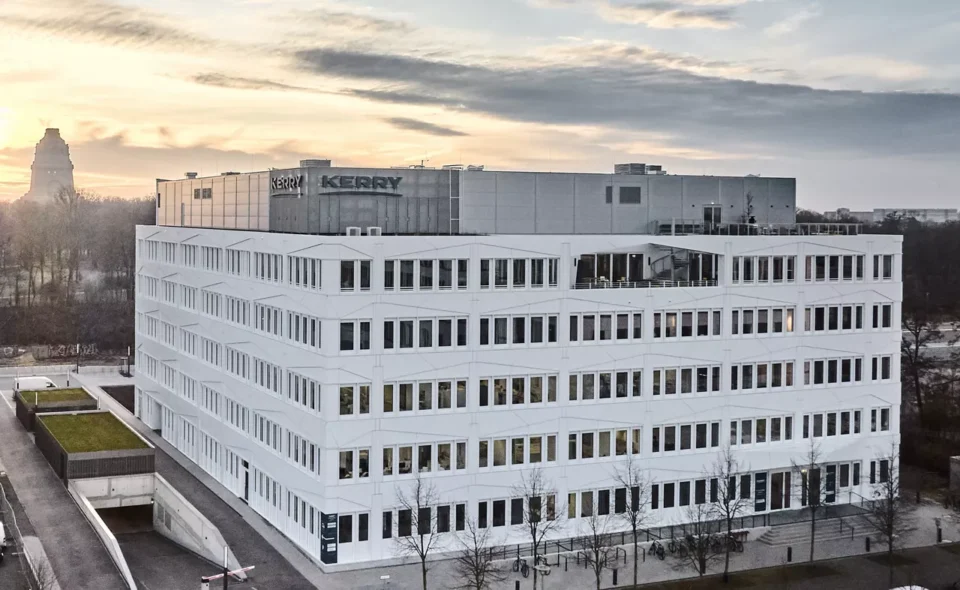
Following the first anniversary of its 10,000 m² Biotechnology Centre in Leipzig, Kerry reports that bringing AI-enabled bioinformatics, strain engineering and pilot-scale fermentation together at one site is reducing discovery times and accelerating the commercial launch of scalable biosolutions.
Responding to industry demands
Manufacturers across the food, beverage and biotechnology sectors are under increasing pressure to lower processing expenses, respond to changing safety requirements and achieve ambitious sustainability goals. In response, Kerry, a global provider of taste and sustainable nutrition solutions, is presenting enzymes as strategic tools for innovation rather than simply as conventional processing aids.
The Kerry Biotechnology Centre (KBC) connects the company’s scientists with capabilities spanning bioinformatics, enzyme development, strain engineering, machine learning and AI-based modelling. The facility also supports fermentation, bioprocess development, scale-up and production. By locating its Enzyme Discovery and Enzyme Engineering teams in a shared laboratory environment, Kerry aims to improve collaboration, accelerate knowledge transfer and reduce development timelines.
Progress during the first year
Kerry identifies five notable achievements from the Leipzig facility’s opening year:
Fungal expression: The team has produced enzymes in filamentous fungal cultures for the first time.
Cloud-enabled discovery: Kerry has transferred its proprietary ENESYZ platform to a cloud-based system. Supported by Next-Generation Sequencing (NGS), artificial intelligence and machine learning-assisted directed evolution, the platform gives research teams across the company’s international locations broader access to advanced enzyme discovery capabilities.
High-volume screening: Automated processes have assessed 17,500 enzymes to locate candidates suited to specific applications.
Biopharmaceutical development: CellTrypase became the first development project launched directly from the new centre. In addition, Denarase High Salt has been supplied to 108 customer testing locations.
Coffee applications and compliance: Acrylerase, which Kerry describes as a new-to-world amidase enzyme, has received a positive scientific safety opinion from the European Food Safety Authority (EFSA). The company presents the enzyme as a straightforward drop-in approach for reducing acrylamide in instant coffee and coffee substitutes while maintaining yield and flavour.
Expanding the value of enzyme technology
Ronan Moloney, vice president, enzymes at Kerry, said these developments reflect a wider change in the industry’s understanding of enzyme technology.
“The perception of enzymes have evolved from simple processing aids into strategic innovation tools that allow food, beverage, and biopharma manufacturers to overcome complex market pressures without compromising on taste or quality,” he said.
He added: “By bringing discovery, strain engineering, and pilot-scale production under one roof in Leipzig and pairing that with our proprietary ENESYZ bioinformatics platform, we are using machine learning to map enzyme sequences faster than ever. We’re incredibly proud of our integrated end-to-end model that enables us to turn complex biological science into scalable, commercially viable solutions that solve our customers’ toughest formulation and sustainability challenges.”
This integrated approach aligns with major food and beverage industry trends, including the need for more efficient food processing technology, lower resource use and faster responses to food and drink consumer trends. It also supports manufacturers navigating food and drink regulations while developing products that meet rising expectations around food and drink sustainability.
Supporting collaboration across the sector
During its first year, the centre developed into a collaboration hub for the broader industry, welcoming more than 400 external visitors through five major industry events. Kerry plans to continue using its biotechnology network to develop high-impact solutions with customers around the world as regulatory requirements change and demand grows for sustainable, resource-efficient production.
The work also reflects wider food manufacturing trends, food distribution trends and food and drink industry innovation, with advances in formulation, food and drink packaging and food and drink marketing increasingly shaped by the need for measurable efficiency and sustainability.