Smart Bin, Borrow by Huskee has received a 2026 Australian Good Design Award in the Product Design – Commercial and Industrial category, recognising its contribution to design excellence, innovation and practical impact.
Huskee, an Australian brand from BioPak, created Smart Bin, Borrow in partnership with Fossick Studio, Particle Design Studio, Tom Kulaga and Simon Kobler. The project responds to a fundamental challenge in reusable packaging: ensuring cups and containers are returned so they can re-enter the reuse cycle.
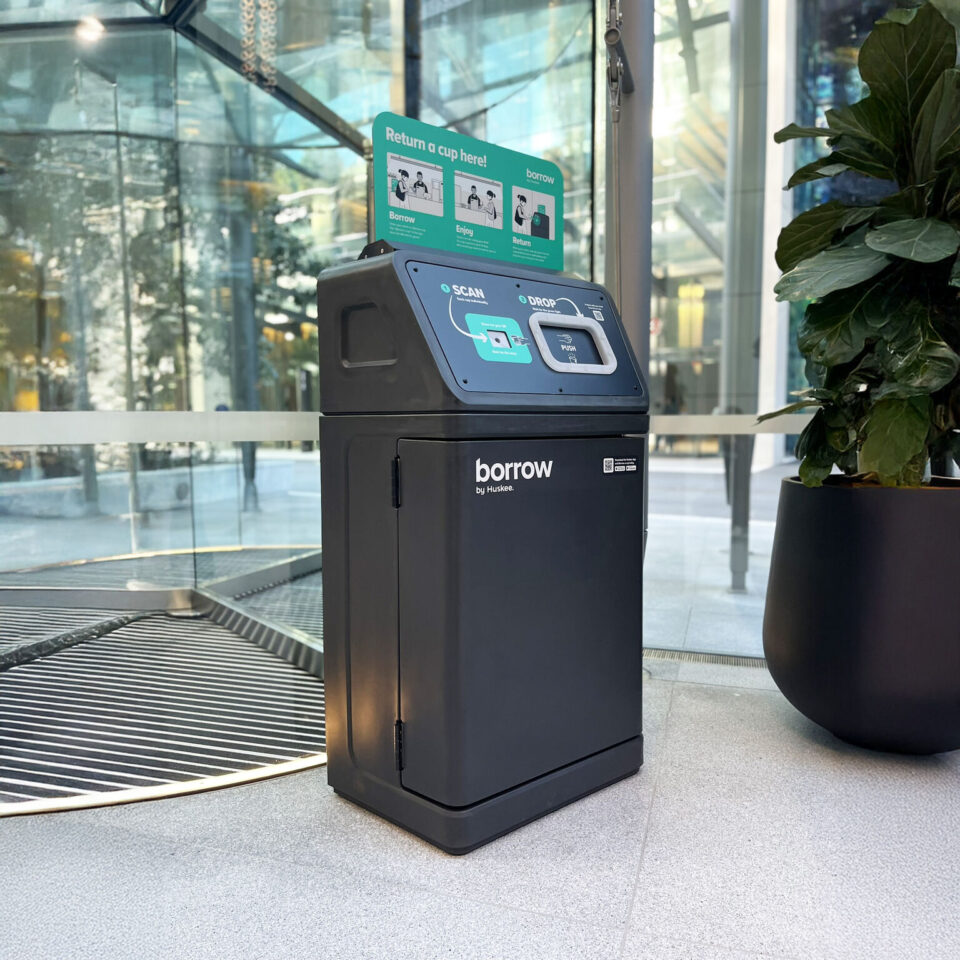
Smart Bin is not a standard waste receptacle. Instead, it operates as an intelligent, IoT-enabled collection point that simplifies the return of reusable food and drink packaging. QR-enabled access, a gravity-powered mechanical mechanism, modular construction and dual power functionality allow the system to operate across diverse commercial and public settings.
For reuse systems to achieve broad adoption, convenience must be part of the design from the outset, according to Saxon Wright, Huskee co-founder and Chief Sustainability Officer at BioPak Group.
“Making reuse work at scale is about much more than designing a great reusable product. We need to make the return journey just as easy, intuitive and convenient as picking up the product in the first place.
“That’s what we set out to achieve with the Borrow Smart Bin. By combining thoughtful industrial design with technology and a simple return experience, we’re removing friction from the reuse system and making it easier for people to do the right thing.
“Being recognised by the Australian Good Design Awards is a great endorsement of the thinking behind the system, and importantly, its real-world impact. We’re proud to see a project designed to help move reuse forward, recognised for both its innovation and its practical application.”
The Australian Good Design Awards Jury highlighted Smart Bin as a systems-level design solution. Its assessment focused on the way the project tackles convenience, one of the most significant obstacles to the adoption of reusable products.
“The Jury recognises the Borrow Bin as an exceptional example of design thinking applied at a systems level, transforming a passive waste receptacle into intelligent, IoT-enabled return infrastructure that addresses one of the most persistent barriers to reuse adoption: convenience.”
Guy Brent, BioPak CEO, said the honour also reinforces the BioPak Group’s commitment to circular solutions and responsible product stewardship.
“Reuse plays a critical part in our BioPak portfolio, one where we are continuing to take responsibility and champion end-of-life solutions for our customers. What this award recognises is not only our leading edge in packaging design but also the importance of making sustainability practical, putting people at the heart of the packaging we use daily. We’re eager to see growing adoption across the country.”
The award arrives as the Australian Good Design Awards presents this year’s theme, Design that Leads. The theme examines how design can help society, industry and the environment respond to complex challenges and deliver lasting change. It also reflects wider food and drink industry innovation, including advances in food and drink sustainability and food and drink packaging.
Project information
Project: Smart Bin, Borrow by Huskee
Category: Product Design – Commercial and Industrial
Recognition: 2026 Australian Good Design Award Winner
Designed in: Australia
Design team:
Huskee – A brand by BioPak
Fossick Studio
Particle Design Studio
Tom Kulaga
Simon Kobler
Commissioned by:
Huskee – A brand by BioPak
Design that leads
The 2026 Australian Good Design Awards will honour projects from across the globe through 13 major design disciplines and more than 30 categories. These include product design, engineering, digital design, services, social impact and sustainability. The breadth of the programme reflects the influence of design on food manufacturing trends, food processing technology and other areas of commercial innovation.
An independent panel comprising more than 100 Australian and international design specialists assesses each entry against three key measures: Good Design, Design Innovation and Design Impact.
Rachel Wye, Managing Director of Good Design Australia, said this year’s successful projects illustrate the ability of design to respond to pressing social and economic issues.
“Design is an important economic and social capability. It influences the products we create, the services we rely on, the policies we develop and the way organisations respond to complex problems,” Ms Wye said.
“This year’s Award winners are addressing energy costs, healthcare, environmental degradation, artificial intelligence, disaster preparedness, accessibility and community wellbeing.”
“Australia has an extraordinary design community and an opportunity to use that capability to strengthen our economy, improve lives and build industries that can compete internationally.”
Celebrating design excellence
The 2026 Australian Good Design Awards ceremony is scheduled for Friday 9 October at the International Convention Centre (ICC) Sydney. More than 1,000 representatives from design, architecture, engineering, business, government and the broader creative sector are expected to attend.
The event will showcase the year’s leading design work and announce the winners of Good Design Award Best in Discipline, Special Accolades, the Good Design Award for Sustainability and the Australian Good Design Award of the Year, the country’s highest design distinction.
Smart Bin, Borrow by Huskee is among the recognised projects demonstrating how considered design can extend beyond individual products. By integrating infrastructure, technology and user convenience, it presents a more practical and scalable model for reuse—an approach aligned with evolving food and beverage industry trends, food distribution trends and food and drink consumer trends.
As businesses also navigate changing food and drink regulations, the award highlights how effective food and drink marketing can support sustainable behaviour when the customer experience remains simple and accessible.