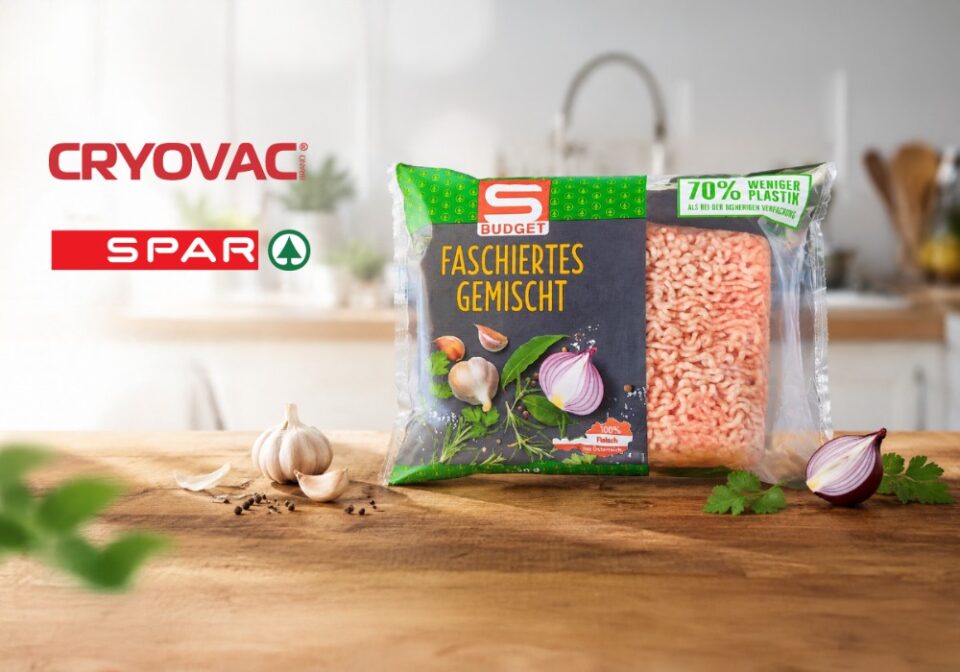
Spar Austria has recently completed a significant packaging pilot that may herald the end of conventional tray-and-lid systems for fresh meat across Europe.
By eliminating the rigid plastic trays for fresh minced meat products entirely, the retailer has achieved an impressive 70% reduction in plastic usage by weight, equating to an annual savings of 14 tonnes of plastic.
This trial, held at Spar Austria’s TANN meat processing site in Marchtrenk and in partnership with Sealed Air, utilized the Cryovac brand MonoPP Flowpack technology. After thoroughly assessing the pilot’s operational and commercial performance, the company is considering extending this tray-free approach to additional TANN processing facilities and SPAR stores throughout Europe.
To align with the forthcoming EU Packaging and Packaging Waste Regulation (PPWR), Spar is moving away from packaging formats that have been in place for decades. This new legislation imposes significant pressures on food processors and grocery retailers to reduce the overall volume of packaging materials and promote circular economic models.
Roman Auinger, the plant manager at Spar TANN Marchtrenk, shed light on this strategic transition: “Tray-and-lid systems have been the norm for fresh meat packaging for many years, providing both product visibility and structural integrity. Yet, our focus has shifted to innovative packaging solutions that meet new regulatory demands aimed at minimizing packaging material use while also addressing rising material costs. Collaborating closely with Sealed Air, we chose a tray-free solution, Cryovac brand MonoPP Flowpack, which has enabled us to cut back on plastic by 70% while maintaining shelf life and production efficiency.”
The traditional tray-and-lid systems highlight multiple operational, environmental, and financial burdens. In addition to the excessive plastic usage, the physical bulk of rigid trays creates substantial logistical challenges.
With the flexible, high-barrier mono-polypropylene (MonoPP) film taking up significantly less space before filling, Spar’s warehousing now requires 176 fewer transport pallets each year. This considerable optimization in supply chain logistics, paired with a reduction in raw materials, has allowed the retailer to lower carbon emissions by approximately 70% during the pilot phase.
Additionally, multi-material tray-and-lid systems complicate municipal sorting processes. In contrast, the Cryovac MonoPP Flowpack material is certified fully recyclable by the Cyclos-HTP Institute, facilitating seamless integration into existing polypropylene (PP) recycling systems.
Markus Zavec, sales director for Austria, Germany, and Switzerland at Sealed Air, highlighted these associated challenges: “SPAR Austria’s traditional tray-and-lid packaging was linked to rising costs across environmental, operational, and financial aspects. The system consumed high volumes of material, required extensive warehouse management, and complicated recycling efforts. The pilot was a timely and necessary response to these issues.”
“Beyond the reduction in packaging material and CO₂ emissions, Cryovac brand MonoPP Flowpack has enhanced SPAR Austria’s overall brand image. Feedback from two-thirds of shoppers has been positive, appreciating the product visibility and the ease of opening that Sealed Air’s packaging solution provides.”
For high-capacity meat processors, a common barrier to implementing flexible flowpacks has traditionally been the concern of lower throughput speeds or compromising the gas barrier essential for shelf life.
The pilot at TANN Marchtrenk demonstrated that the flexible MonoPP barrier film sufficiently meets the stringent shelf-life standards of conventional modified atmosphere packaging (MAP) tray formats. Importantly for production efficiency, SPAR was able to maintain a rapid output of 44 packs per minute without facing increases in component failure, product waste, or reject rates.
As the deadlines for European regulations approach, this transition signifies a crucial turning point for the global meat supply chain: moving from bulky, rigid plastics towards streamlined, mono-material solutions that fulfill both corporate sustainability goals and operational realities.
Reflecting on the broader implications for the industry, Roman Auinger concluded: “Shifting away from traditional packaging formats involves many operational, commercial, and consumer aspects that demand careful analysis. Partnering with Sealed Air has allowed us to thoughtfully address these considerations and discover a packaging solution that balances responsibility with performance, aligning our practices with the principles of the circular economy. With regulations like PPWR emphasizing recyclability and material reduction, mono-material packaging solutions present a more future-oriented path.”