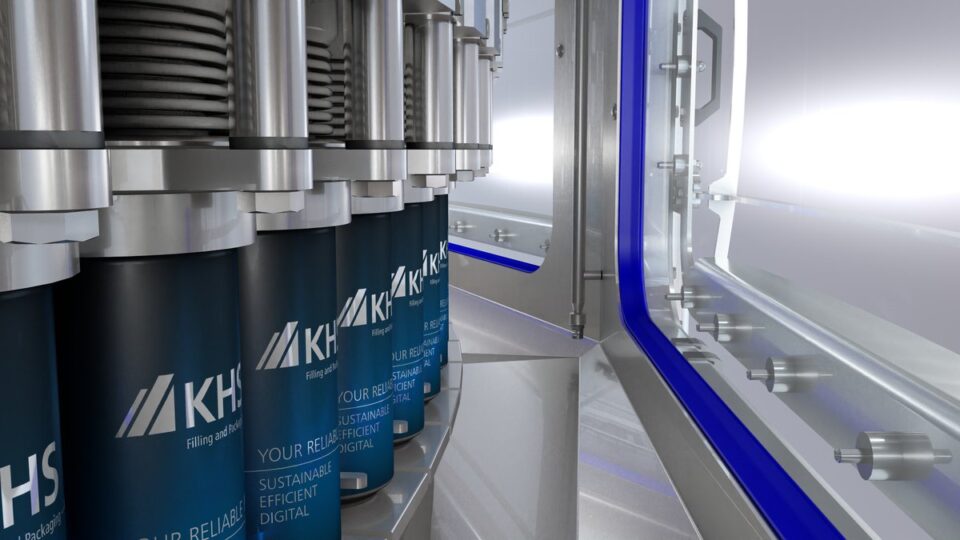
KHS GmbH underscores its position as a market leader in food and drink packaging by achieving a significant milestone in enhancing the hygiene of can filling operations. In collaboration with its long-time technology partner, Swiss engineering firm Ferrum Packaging AG, the Dortmund-based systems supplier has refined its filler/seamer block, first unveiled in 2022: the SmartCan Eco by KHS/Ferrum. This updated system boasts improved hygiene standards, heightened performance and quality, and an array of new features that enhance both efficiency and sustainability.
Higher Performance
The SmartCan Eco’s filler effectively handles up to 135,000 cans per hour; however, the current FS14 seamer’s maximum output of 108,000 cans per hour presents a limitation. The next-largest seamer, the FS18, matches the KHS filler’s capacity and will soon be available as an option within the SmartCan Eco system. “Depending on the seamer, our filler/seamer block can then be used for outputs ranging between 60,000 and 135,000 cans per hour,” explains Manfred Härtel, Filling Product Manager for KHS in Bad Kreuznach, Germany.
High Quality
When compared to competitors, the SmartCan Eco is distinguished by the superior quality of its reliable and durable filling technology. “Our filling valves are particularly appreciated by our customers for their hygienic properties, compact design, and straightforward maintenance,” states Härtel. The computer-controlled filling system features electromagnetic induction flow meters that ensure uniform filling volumes and consistent headspaces within the cans.
Gentle Handling
An additional aspect of quality is can handling. As with PET bottles, the trend is now towards using less material. The standard top load for cans has decreased from 800 newtons to 675, or even down to 550 newtons for the latest lightweight cans. “Decreasing wall thicknesses pose challenges for gentle container handling,” notes Härtel. “They become harder to guide, and any minor damage to pre-lacquered cans is immediately discernible.” The SmartCan Eco effectively addresses this issue, thanks to several features designed for handling lightweight cans while ensuring smooth operation.
Improved Hygiene
The updated block is notable for its significantly reduced hygiene area, now up to 93% smaller than conventional housings. Innovations include tight-fitting cladding and minimized surfaces. Liquid locks are incorporated between static and dynamic components, replacing rubber seals to prevent wear and particle contamination. Sterile air is introduced into the hygienic zone through air filter blowers with a slight positive pressure of five pascals, generating a targeted airflow that facilitates approximately 100 exchanges per hour.
Increased Efficiency
The most substantial impact on the efficiency of the new filler/seamer block stems from the decreased hygiene area. This, coupled with thorough sealing of all windows and joints, enables simultaneous interior and exterior cleaning for the first time. “Previously, we only employed caustic cleaning in product-conducting parts,” Härtel comments. “Now we can sanitize the filler carousel, conveyors, and transfer stars using the same solution.” Instead of being disposed of through sewer systems as before, cleaning solutions are retained within the housing, recirculated back to the CIP system, and reused. This approach saves both time and resources while reducing water and chemical usage during the cleaning process.
Furthermore, the streamlined hygiene area reduces the requirement for air filter blowers; only one to two are now necessary instead of eight to ten, lowering electricity consumption, maintenance efforts, and filter replacement frequency. Even with the minimized hygiene zone, convenient access points remain available for format changeovers and servicing, particularly for filling valves, which are compact components identical to those used in the KHS Innofill Can DVD filler.
Flexibility characterizes the SmartCan Eco, which serves as an all-rounder for low-oxygen filling of beer and still or carbonated beverages. Filling temperatures range from four to 20°C for beer and alcohol-free beverages, reaching up to 95°C for hot filling juices or teas.
The Ferrum FS14 seamer, along with the larger FS18 model, allows for largely automated and recipe-controlled format changeovers. This innovation not only enhances hygiene but also reduces the time previously required for these processes by roughly half. The weight of change parts has significantly decreased, with none now exceeding twelve kilograms, making operations easier for workers.
To summarize, Härtel asserts that the enhanced level of hygiene substantially contributes to greater efficiency. “The more hygienic the filling process, the longer production can continue. Our machines now run significantly longer compared to the previous eight-hour cycles. Essentially, increased production time coupled with decreased cleaning time means that more cans accumulate on the pallets by the end of the week.”