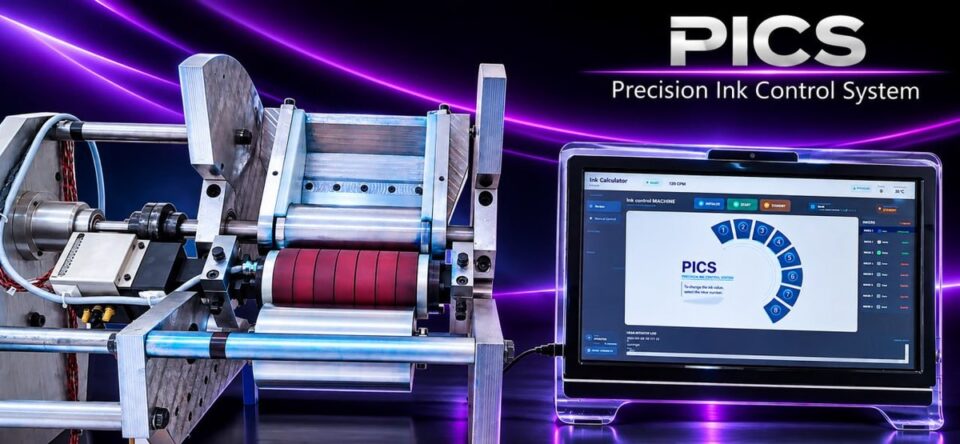
Developed by Mahdi Salahi of Mana Sanat Afagh, the Precision Ink Control System (PICS) provides independent control of seven ink-transfer zones. Operators can store adjustment settings and recall them for repeat production. Laboratory testing has been completed, and production trials are planned to determine whether the system can improve print uniformity, accelerate changeovers and reduce waste generated during start-up.
Limitations of Conventional Ink-Transfer Systems
Traditional manual ink-transfer systems generally control the blade gap within a very narrow range of approximately 0.01–0.04 mm. Reaching the desired ink-transfer level within these limits requires extremely careful manual adjustment and depends significantly on the operator’s experience. Because the mechanism does not use a defined adjustment unit, the risk of error during setup and control remains high.
Mechanical backlash in the ink-film adjustment screws further complicates accurate ink-volume control. At the same time, contact between the blade and fountain roller causes progressive wear to both components. As a result, conventional arrangements provide limited repeatability when operators need to set ink transfer consistently across multiple zones.
Segmented doctor roller systems fitted with single-acting pneumatic actuators and spring returns also create ongoing mechanical and operational challenges. As springs fatigue, their return force can decline, which may reduce the consistency and quality of ink transfer. In addition, placing electropneumatic valves inside the enclosed housing of a multi-piece doctor roller assembly makes inspection, servicing and fault diagnosis more difficult, especially while the machine is operating.
The enclosed location also restricts the release of heat produced by the valve solenoids. Elevated solenoid temperatures may affect valve performance and, in some cases, contribute to premature failure. These limitations are particularly relevant to modern food manufacturing trends, where manufacturers increasingly require reliable automation, repeatable quality and efficient equipment operation.
PICS System Design and Advantages
PICS combines mechanical hardware, electronic controls and software to replace a largely manual adjustment procedure with a programmable, calculation-based method. The system independently manages seven ink-transfer zones and calculates the required settings using production information and the colour-separation data within the print design. This enables coordinated and more accurate control of ink distribution.
The mechanical design uses double-acting pneumatic cylinders instead of single-acting actuators with return springs. This removes reliance on spring force and helps maintain more consistent actuator operation over time. The electropneumatic valves have also been positioned outside the multi-piece doctor roller housing, providing easier access for maintenance and servicing.
External valve placement improves heat dissipation and allows technicians to identify and correct faults more quickly. These improvements could reduce maintenance-related downtime for decorators and support the wider adoption of food processing technology and food and drink industry innovation across packaging operations.
PICS also incorporates U-shaped protective seals engineered to distribute forces generated by elastic deformation more effectively. Their greater tolerance for elastic movement helps preserve seal performance and may extend the working life of both the seals and the doctor roller assembly.
Together, these changes are designed to improve adjustment accuracy, repeatability and consistency while simplifying maintenance. They may also reduce machine downtime, start-up waste and reliance on individual operator expertise. Such benefits align with broader food and drink sustainability objectives, including more efficient use of materials, reduced waste and improved production performance.
Laboratory Testing
Laboratory trials verified the coordinated operation of the PICS hardware and software. The software calculated settings for all seven zones across both identical and varied print designs, then transmitted the resulting values to the processor. The processor converted the data into control signals for the electropneumatic valves and pneumatic cylinders.
Testing confirmed that the adjustment procedure was accurate, repeatable and reliable. Operators could control each zone separately or adjust all zones at the same time. Once established, the settings could be stored and reused for subsequent production runs. A PICS demonstration video shows the test procedure and the coordinated response of the system’s main components.
The ability to retain repeatable setup data may also support more efficient production planning and help converters respond to evolving food and drink consumer trends. Consistent print performance is increasingly important as brands place greater emphasis on product presentation, traceability and differentiated packaging.
Production-Stage Evaluation
The next phase will test PICS on a can printing and decorating machine under normal production conditions. The assessment will examine label changeover times, machine availability, print quality and the system’s ability to reduce production waste.
Initial engineering evaluations suggest that PICS could deliver operational improvements, although the scale of those benefits will depend on the results of the production trials. The findings may be relevant to companies monitoring food and beverage industry trends, food distribution trends and developments in food and drink packaging, where shorter changeovers and improved asset utilisation can strengthen supply-chain performance.
The mechanical and pneumatic elements of the PICS design are covered by an international patent application submitted under the Patent Cooperation Treaty (PCT). The application was published by the World Intellectual Property Organization (WIPO) under publication number WO 2025/074189 A1.
Developer and Company Profile
Mahdi Salahi, Founder and CEO of Mana Sanat Afagh, developed PICS. Mana Sanat Afagh is a technology-focused engineering company that develops industrial solutions for metal packaging and the manufacture of two-piece aluminium beverage cans.
Its work covers innovative technology development, industrial automation, electronic system engineering, industrial software and specialised engineering solutions. Through these activities, the company supports manufacturers responding to changing food and drink regulations, advancing food and drink marketing requirements and the growing demand for efficient, digitally enabled production systems.