Fresh pasta products – including noodles, gnocchi, ravioli and filled pasta – contain significant amounts of moisture. As a result, thermoformed packs and pouches must deliver robust barrier protection and support an appropriate shelf life.
Südpack has built a strong position as a development partner for food manufacturers by providing high-performance films and packaging systems that protect products, support environmental objectives and maintain commercial viability.
Fresh pasta is among the fastest-growing categories within refrigerated convenience foods. Retail shelves continue to expand with new formats, flavour combinations and portion options.
Manufacturers are responding to demand for convenient, premium-quality meals and evolving dietary preferences with high-protein recipes, global and fusion flavours, vegan and vegetarian products, and alternative preparation formats. These developments reflect wider food and drink consumer trends, combining ease of use and appealing taste with both familiar favourites and more adventurous culinary concepts.
The worldwide market for fresh refrigerated pasta is estimated at between USD 9 billion and USD 11 billion. By 2033, it is expected to reach approximately USD 19.5 billion. This expansion is also influencing food and drink packaging, increasing the need to balance product protection, practical performance, cost efficiency and compliance with the Packaging and Packaging Waste Regulation (PPWR).
Managing packaging cost, compliance and performance
The purchase price of packaging material represents only one element of the overall cost calculation. Food manufacturers must also consider the relationship between food and drink regulations, operational efficiency and profitability across the complete packaging life cycle, including disposal and recycling.
Packaging designed with reduced material consumption and aligned with Design for Recycling (DfR) principles may qualify for eco-modulation and recycling-based fee systems. Depending on the market, a higher initial material cost could be outweighed by lower extended producer responsibility (EPR) charges when total costs are assessed. At the same time, manufacturers must preserve process reliability, product protection and shelf life. Packaging films must also withstand the heat exposure associated with pasteurising fresh pasta.
Coextrusion supports advanced mono-material packaging
Coextrusion is a central capability within Südpack’s packaging portfolio. By integrating several functional layers into a single film structure, the company can engineer barrier properties, mechanical strength, sealing behaviour and machine performance for particular applications.
These coextruded films can frequently deliver the required functionality at a lower thickness than laminated alternatives. The resulting lightweight packaging can reduce costs across the supply chain while also lowering carbon dioxide emissions through reduced raw material consumption. This approach reflects wider food manufacturing trends and advances in food processing technology, where efficiency and resource optimisation are increasingly important.
Südpack provides packaging formats for a broad range of fresh pasta applications, including pasteurised and untreated products, refrigerated products and items designed to achieve extended shelf life without refrigeration.
CarbonLite Flow Pack PurePP
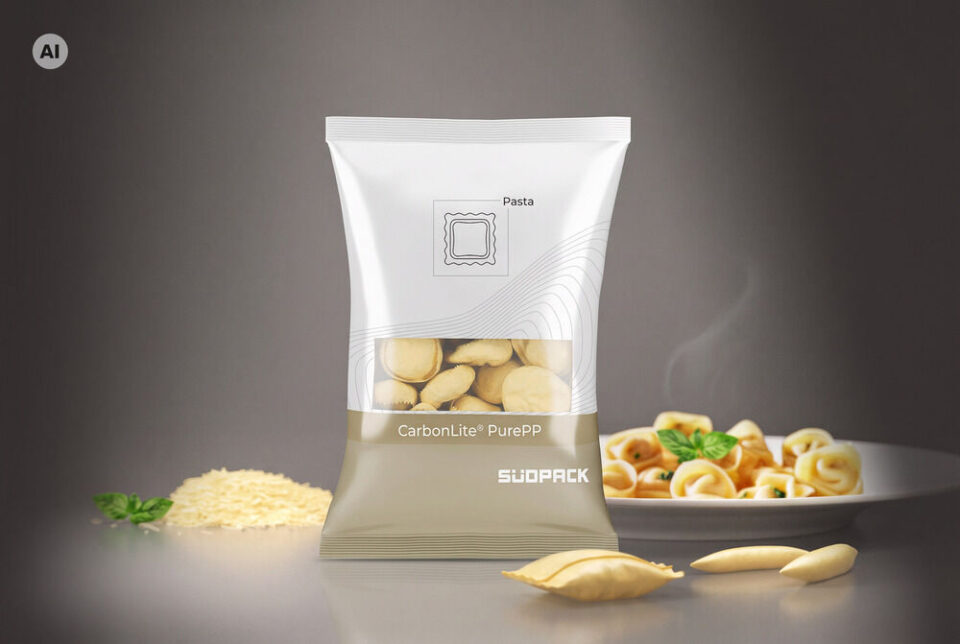
Flow packs have become a widely used format for gnocchi, Spätzle and filled pasta. Unlike tray systems made from separate bottom and top webs, these lightweight pouches are formed from one film web, simplifying purchasing and logistics. Their reduced weight can also lower total packaging costs, including EPR fees, compared with tray-based alternatives.
Südpack’s film is engineered for efficient material use and follows DfR principles. Because it uses a PP mono-material structure, the packaging can enter established polypropylene recycling streams. In one customer application, the solution reduced material consumption by more than 20% compared with the former PA/PP structure. At a volume of 10 million packs, that reduction represented more than 15 metric tons of packaging material, while maintaining the necessary level of product protection.
PP thermoforming solutions
The flexible-film Multifol thermoforming concept is suited to larger products, including filled pasta and ravioli. Vacuum forming holds the product securely inside the pack and enables upright, hanging or horizontal presentation at the point of sale.
This packaging is also designed as a PP mono-material in accordance with DfR principles. Südpack additionally offers PP-based rigid film options, selected according to the product and application requirements. Some versions feature a peelable top web, providing easier opening and improved consumer convenience.
Supporting development through implementation
Successful packaging changes require manufacturers to address several practical questions. Will the new format provide adequate product protection? Can it run effectively on current equipment? How will the material behave during production? What impact will material consumption, recyclability and possible fee structures have on the overall cost?
Südpack supports customers throughout the move towards recycling-oriented packaging, regardless of the format selected. Assistance begins with concept development and continues through testing, optimisation and commercial implementation. Services include application-specific sampling, technical engineering support, trials and validation using specialist equipment, as well as assessments of carbon dioxide emissions and recyclability.
This collaborative process helps reduce the risks associated with packaging transitions and enables manufacturers to integrate new solutions into existing production lines with greater confidence. It also supports the broader objectives of food and drink industry innovation, food and drink sustainability and evolving food distribution trends, while helping producers respond to changing food and drink marketing priorities and consumer expectations.