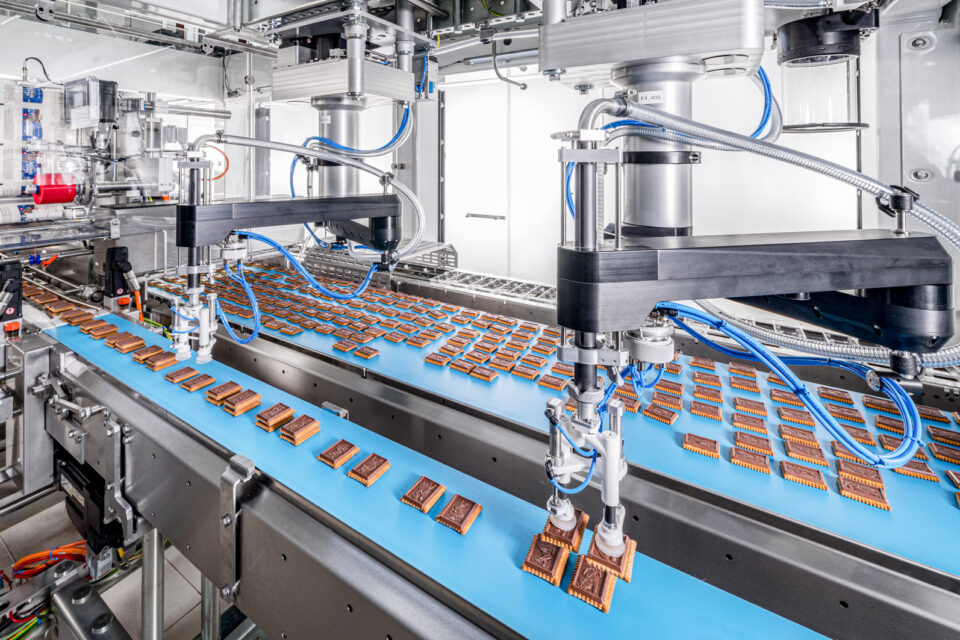
When you hear the term ‘robotic movement’, many people still think of jerky, somewhat awkward sequences like those seen in breakdancing. In modern production and packaging lines, however, the exact opposite is needed: highly dynamic yet smooth movements that protect products and save cycle times. Every unnecessary deceleration or acceleration costs productivity, and every vibration reduces precision while increasing stress on the products and surrounding environment. Intelligent path planning – for example through AI-supported motion optimisation and coordinated interaction between robots and mechanics – allows the potential of robotic motion in packaging processes to be fully exploited.
Author: Michael Döring, Head of Schubert Motion, Dresden
In robotics, the issue of motion planning was long considered to be largely resolved, with a sufficient level of quality. It was primarily a matter of specifying a valid path and following it as smoothly as possible. Whether this was particularly fast, gentle and product-friendly, energy-efficient or cycle-optimised was the subject of scientific research, but for a long time played only a minor role in everyday practice. However, with ever-increasing cycle rates, greater variety in robot mechanics and applications, the handling of sensitive products and fast movement in confined spaces, this standard approach is now reaching its limits – especially in packaging processes. This is where pick & place robots work at high speeds in confined spaces, often in sync with continuously running conveyor belts. Every path needs to fit into a tight cycle window. Practitioners distinguish between functional time, during which actual packaging or sealing takes place, and pure movement time. From a productivity perspective, the latter is a ‘waste product’ and should therefore be designed as efficiently as possible.
Formula 1 logic in the packaging line
This calls to mind associations with motor racing: as in Formula 1, every ‘vehicle’ in the packaging line needs to complete its lap as quickly and safely as possible. At the same time, many factors should be considered: limited acceleration of sensitive products or products with a certain momentum, freedom from collisions in the confined machine space, and drive limits. The motion planning calculated using these parameters also has to be provided in high quality within only a few milliseconds. No small feat, as it involves providing calculation results in real time at the machine. To reconcile all these interdependencies, modern motion control algorithms combine classic optimisation with learning models. Based on a given set of circumstances, these take into account any potential obstacles and restrictions and use them to calculate a path that leads to the destination as quickly and safely as possible.
Artificial intelligence as an accelerator for path planning
The mathematical search for the optimal path curve is a very computationally intensive task. The more boundary conditions are included, the more complex the optimisation becomes. The individual adjustments required to ensure that a line runs smoothly could theoretically also be carried out manually. Such an approach, however, scales very poorly, as results cannot be transferred to changed conditions without loss. Furthermore, motion sequences should continue to run reliably immediately after a format change without requiring long run-in or optimisation phases.
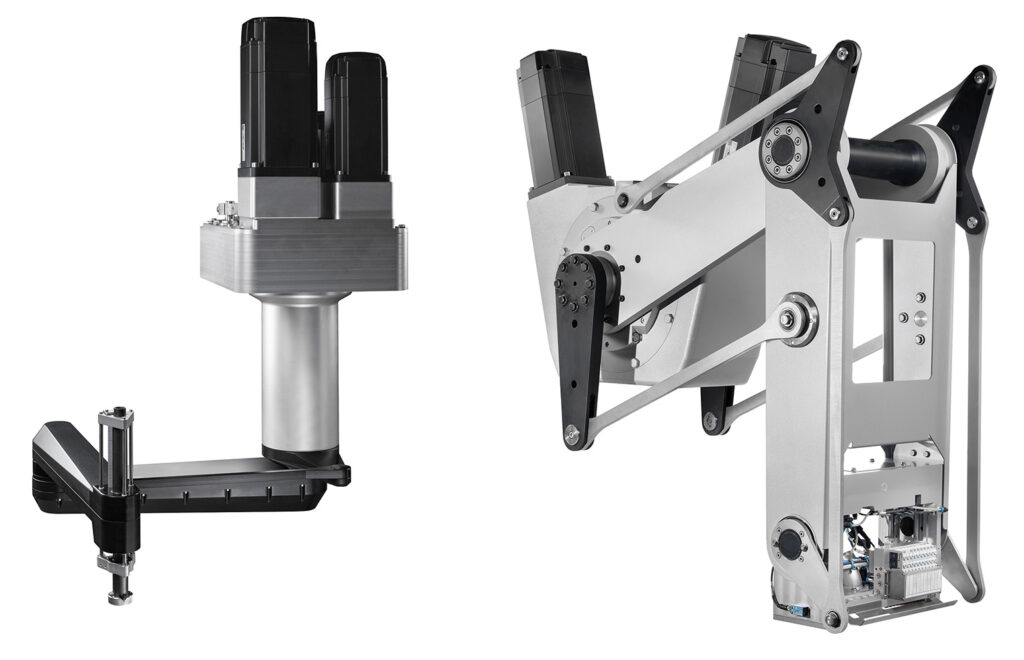
The approach pursued by the Schubert Motion team, for example, shifts a large part of the computing work to the virtual test laboratory. For typical tasks – such as picking up, aligning and depositing products with F2 or F4 robots – countless variants are run through the system and stored as motion profiles in neural networks. On the real machine, the control system retrieves these learned optimal trajectories in a few milliseconds. What would previously have taken seconds of computing time is now available in a few thousandths of a second – a significant advantage in computing time that makes real-time control possible in the first place.
Curved paths, less vibration
There is also potential for optimisation in path design. Conventionally programmed robots often move along simple basic primitives that are ‘rounded off’ or smoothed at transitional points: straight sections with abrupt changes of direction in between. This can lead to short local stresses on the robot and its surroundings and, in particular, to increased vibration excitation in the rounded areas. On the other hand, a slightly curved, organic path, as generated by AI-supported calculation, enables smoother speed changes – and paradoxically leads to faster yet more gentle processes. If it is not necessary to operate at maximum power all the time, significant energy savings of up to 20 per cent are also possible. The new TLM-7 series achieves significant energy savings through energy recovery during braking – a principle that owners of electric vehicles are very familiar with.
When the product sets the pace
When it comes to motion optimisation, the product itself is increasingly becoming the focus of attention. Film pouches containing liquids, porous baked goods or soft, deformable products are sensitive to high acceleration and unexpected movement arcs. In the past, such products were often ‘slowed down’ using conservative parameters, additional robot stations were added or mechanical adjustments were made. A product-oriented motion approach, on the other hand, first asks what stress the product can be subjected to and optimises the motion along these limits. This enables performance reserves to be tapped without damaging the products.
When dynamics challenge the structure
 In the case of packaging robots, there is an additional effect to be considered: every force impulse induced by acceleration causes the machine frame on which the robot is mounted to vibrate. If it is too flexible or insufficiently damped, the system quickly becomes unstable. The result is reduced accuracy of the overall system, which affects the quality of the actual picking process or propagates to downstream stations. Optimised motion profiles reduce these energy inputs into the structure, although they cannot fully eliminate the physical limits of the design. This effect was also evident during the development phase for the new motion of Schubert’s F4 robots. The Dresden-based team therefore developed a new frame concept with four times the rigidity, which significantly reduces the robot’s oscillation while improving space utilisation and system accessibility. Schubert will be presenting more details for the first time at the upcoming interpack fair.
All photos: Gerhard Schubert GmbH