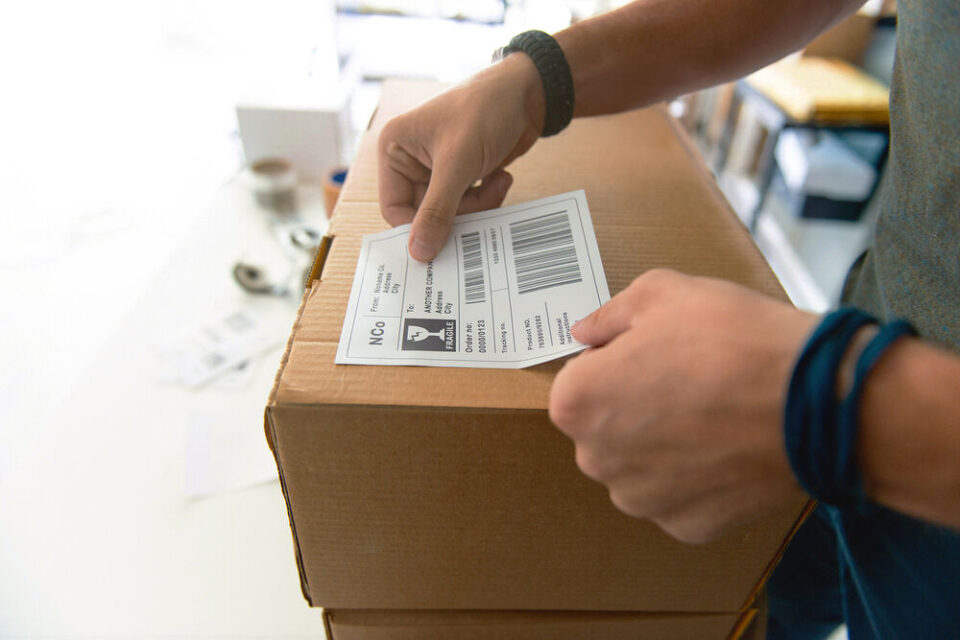
Herma has launched Linerless Plus, a self-adhesive linerless label created to address the durability and application challenges that have limited wider use of linerless formats in logistics and dispatch operations.
The new product broadens Herma’s linerless portfolio at a time when businesses are under increasing pressure to reduce packaging waste in response to the European Packaging Waste Regulation. These requirements are also influencing food manufacturing trends, food distribution trends and wider food and drink sustainability strategies.
Herma explains that “the multi-layer adhesive used in Linerless Plus… enables adhesive to be applied across the entire surface – in contrast to standard solutions on the market, which usually require adhesive-free zones for cutting.” By covering the complete label surface with adhesive, the solution provides stronger immediate and long-term adhesion on difficult materials, including corrugated cardboard and pallet wrap. It also helps limit adhesive build-up in print-and-apply equipment, allowing cleaner cuts and potentially reducing servicing and maintenance needs.
Linerless Plus is suitable for desktop printers as well as automated labelling equipment, adding to Herma’s silicone-free InNo-Liner technology. The combined portfolio supports a broad range of logistics labelling requirements, from high-throughput automated production lines to variable-data desktop printing. Herma states, “for almost all labelling applications in logistics and dispatch, we can now offer linerless labelling with InNo-Liner and Linerless Plus.”
As PPWR increases demand for efficient packaging formats, the launch gives logistics providers a more dependable alternative to traditional self-adhesive labels. It also reflects broader food and beverage industry trends, including advances in food processing technology, food and drink packaging, food and drink regulations, food and drink marketing and food and drink consumer trends, where efficient, reliable labelling is becoming increasingly important.