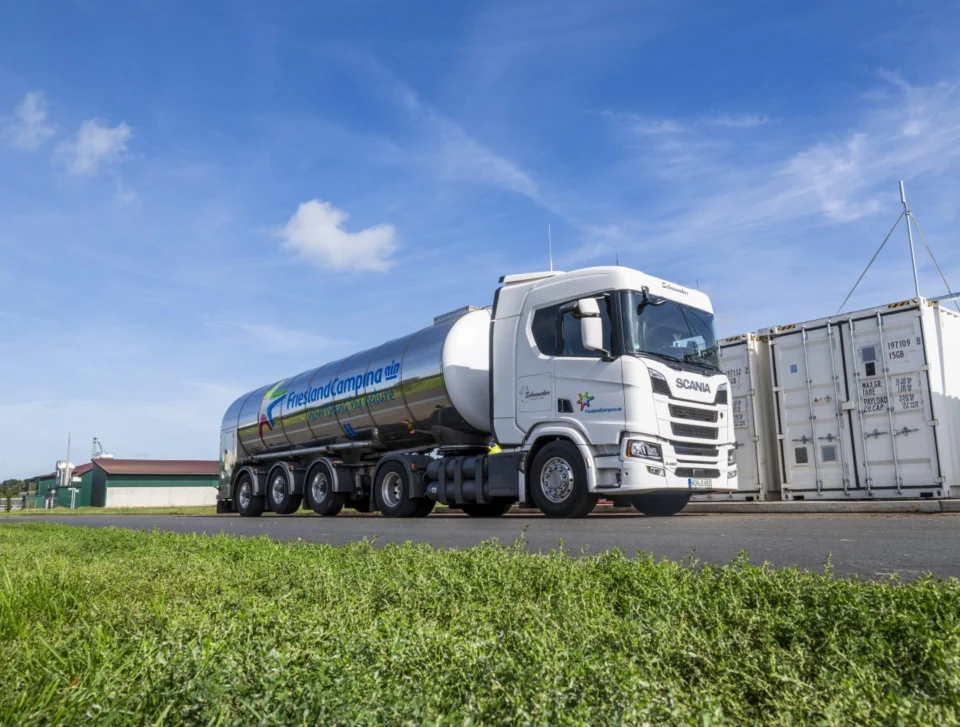
FrieslandCampina is working with seven transport providers in the Netherlands and Germany to cut emissions associated with its milk collection and transport activities.
As current vehicles reach the end of their service life, the partners will increasingly replace them with trucks powered by biomethane, also known as bio-CNG. Over the next several years, approximately half of the fleet operating across the Netherlands, Belgium and Germany is expected to use this renewable fuel.
Mirco Schoemaker, Director of Schoemaker Transporte, says: “Biomethane is currently one of the most practical and scalable solutions for substantially reducing CO₂ emissions from milk transport in the short term. At the same time, switching to biomethane requires significant investment in both vehicles and refuelling infrastructure. Only by working closely together as partners across the value chain can we accelerate the transition towards more sustainable milk transport.”
The companies will also coordinate efforts to develop additional refuelling and charging infrastructure. This expansion will help enable wider adoption of renewable fuels and low-emission vehicles throughout FrieslandCampina’s logistics network.
Part of the biomethane supplied through the initiative will come from dairy manure processed in anaerobic digesters. The approach turns agricultural by-products into a renewable energy source for milk collection vehicles.
“The strength of bio-CNG is that it creates a direct link between our member dairy farmers and our logistics operations. In future, milk can be transported using fuel that is partly produced by our own member dairy farms,” says Marcel Ebbelaar, Manager Milk Logistics & Transport at FrieslandCampina. “This enables us to reduce transport emissions while also making the value chain more circular. It shows how collaboration within the cooperative can contribute to making our operations more sustainable.”
FrieslandCampina member farm Barver Landmilch, located in Lower Saxony, Germany, is already generating biomethane with manure from its own anaerobic digestion facility. The farm also operates on-site fuelling infrastructure, enabling regional milk collection trucks to fill up with locally produced bio-CNG.