


Automation has always been the backbone of food and beverage production, but the technologies shaping tomorrow’s factories go far beyond robotics and sensors. Digital twins, generative AI, and autonomous supply chains are moving from concept to reality, redefining efficiency, compliance, and competitiveness for manufacturers worldwide.
From Automation to Innovation
Artificial intelligence is no longer just a process optimiser—it is becoming a strategic driver of resilience and innovation. The new wave of AI is actively creating products, predicting future challenges, and building more intelligent factories.
- Generative AI: The Virtual Product Developer
Generative AI is transforming research and development. By analysing market trends, ingredient costs, and flavour databases, it can generate and virtually test thousands of recipes in minutes. That means accelerating innovation cycles—formulating a vegan sauce that mimics dairy or reducing salt without sacrificing taste—while ensuring compatibility with existing equipment. - Digital Twins: The Virtual Factory
A digital twin is a real-time, virtual replica of a production line or entire facility. Manufacturers can simulate the impact of a new packaging material, predict how ingredient viscosity will affect throughput, or model responses to machine failures without risk. By linking to IoT sensors, digital twins also support predictive quality and safety, identifying problems before they compromise a batch. - Advanced Vision Systems: Superhuman Quality Control
AI-powered cameras have evolved far beyond pass/fail checks. They now verify whether every pea, slice of pepperoni, or drizzle of sauce is correctly placed, all at line speed. In hygiene applications, vision systems can even assess the cleanliness of tanks and pipes post-CIP, spotting residues invisible to the human eye. - Autonomous Supply Chains
Modern supply chains are volatile, but AI-driven platforms can now manage them proactively. By monitoring weather, geopolitics, and logistics in real time, they can re-route shipments or pre-emptively order from backup suppliers, keeping production running smoothly while competitors scramble to react.
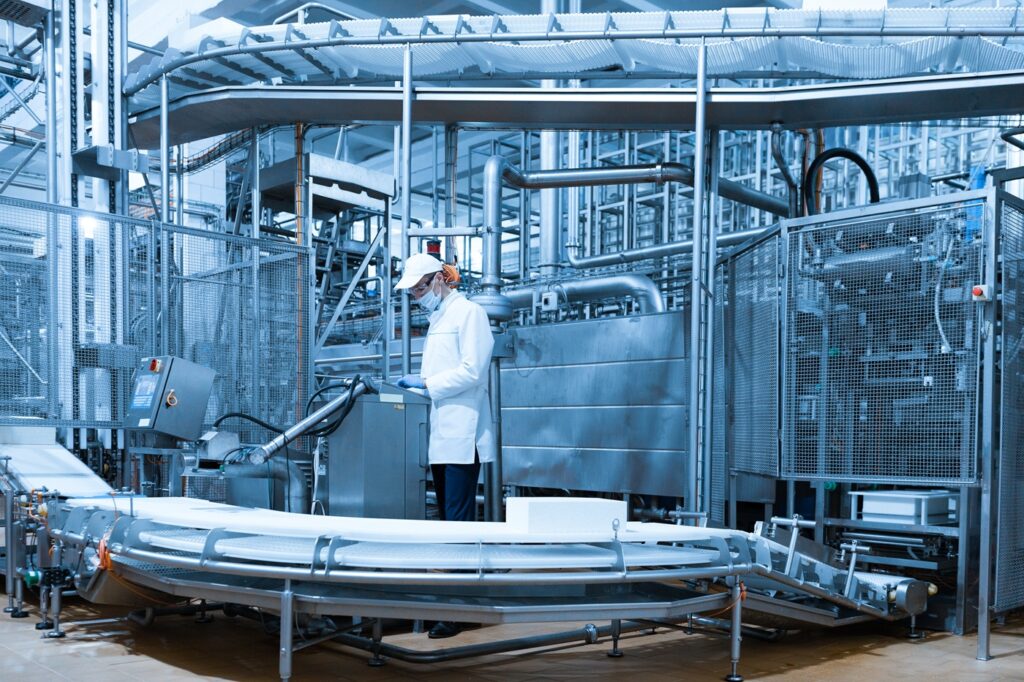
Cobots: Humans and Robots in Partnership
Labour shortages remain a major challenge in food production, making collaborative robots—or cobots—increasingly valuable. Unlike traditional industrial robots, cobots can safely share workspaces with human operators, assisting with repetitive pick-and-place tasks, palletising boxes, or even quality control. This human–machine partnership frees skilled staff for higher-value roles while improving speed and consistency.
Strategic Shifts Driving Adoption
Beyond technology itself, market dynamics are changing how process control and automation are deployed.
- From Just-in-Time to Just-in-Case: Global supply disruptions are pushing manufacturers to hold larger inventories. Data analytics and AI help manage these stockpiles efficiently, avoiding excess waste.
- Hyper-Personalisation: Consumers are demanding personalised products, forcing factories to become agile. Modular lines and flexible automation enable fast changeovers between recipes, packaging formats, and batch sizes.
- Sustainability as a Contract Requirement: Major retailers increasingly require detailed reporting on carbon footprint, energy use, and waste. IoT-enabled monitoring and reporting are now essential not just for compliance but for winning business.
The Future of Intelligent Production
Process control and automation are no longer about simply running lines faster or cheaper. They are about embedding intelligence into every stage of production—from recipe creation and line simulation to quality control and supply chain resilience. For decision-makers, this shift represents both a challenge and an opportunity: invest in the tools that will define the smart factory of tomorrow, or risk being left behind.

