
Industry Insight: Artificial intelligence is changing the role of inspection. The camera above the conveyor is no longer simply looking for a missing label, damaged seal or unacceptable product. Increasingly, it is becoming part of a connected quality system that can identify process drift, support root-cause analysis, verify traceability information and warn that a line is beginning to move out of control.
Machine vision is moving beyond pass-or-fail inspection. Connected sensing, edge AI and intelligent traceability are helping producers cut waste, identify process drift and turn every detected defect into a better production decision.
At the same time, advances in hyperspectral sensing, three-dimensional imaging, edge computing and vision-language models are expanding what machines can detect and how easily people can interrogate the information they produce. Inspection systems can now look beyond surface appearance, compare performance across shifts and batches, and explain recurring defects in language that operators and quality teams can understand.
Regulation is developing alongside the technology. Manufacturers must consider how AI systems are validated, monitored and governed, particularly when they influence food safety, machinery safety, product release or regulatory compliance. However, not every camera using artificial intelligence will automatically fall into the highest regulatory risk category. Responsibilities will depend on the system’s intended purpose, its influence over safety-critical decisions and the level of human oversight maintained.
For manufacturers, the priority is therefore not simply buying a more powerful camera. It is building an inspection system whose decisions are measurable, explainable, connected and commercially useful.
The Reject Gate Is Only the Start: Inspection Becomes a Source of Factory Intelligence
For decades, automated inspection was largely a binary process. A sensor confirmed that an item was present, a conventional camera compared a pack against fixed measurements and a reject mechanism removed anything that fell outside the programmed tolerance.
These systems remain effective where products are highly uniform and defects are predictable. Their limitations become more apparent when acceptable products naturally vary in colour, position, shape or surface texture.
A traditional system may classify harmless variation as a fault, unnecessarily rejecting saleable production. It may also allow a genuine defect to pass because the problem does not match the exact rule it was programmed to identify.
AI vision changes this by learning the characteristics of acceptable and unacceptable products from data. It can evaluate multiple features simultaneously, distinguish natural variation from meaningful deviation and recognise defects that would be difficult to describe through fixed rules alone.
The most significant development, however, is not simply improved detection. It is the ability to retain, combine and analyse inspection results as operational data.
A rising number of incomplete seals may indicate deteriorating tooling, unstable temperature or inconsistent film tracking. Changes in product colour, dimensions or surface condition could point to raw-material variation or an upstream process moving out of control. Repeated label-position errors might reveal vibration, slippage or an incorrectly configured changeover.
Instead of rejecting each faulty item and forgetting it, the system can identify patterns across batches, suppliers, products, shifts and machines. Quality inspection then becomes an early-warning system for the wider production process.
This changes the commercial value of the technology. The return is no longer limited to preventing defective goods from reaching customers. It can also come from reducing downtime, protecting yield, improving maintenance planning and preventing relatively small deviations from becoming sustained production losses.
Seeing More Than the Human Eye: Advanced Sensors Expand the Detectable
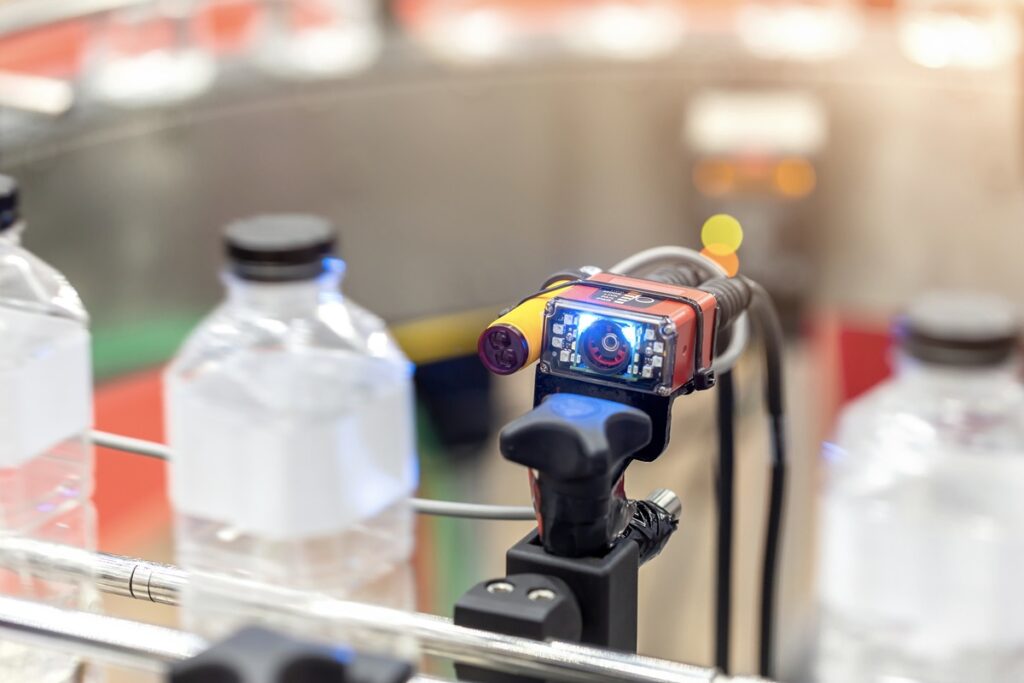
Standard red, green and blue cameras remain the backbone of visual inspection. They are well suited to checking colour, dimensions, surface condition, label placement, print quality, closure presence and general pack assembly.
However, visible-light cameras are no longer the only option available.
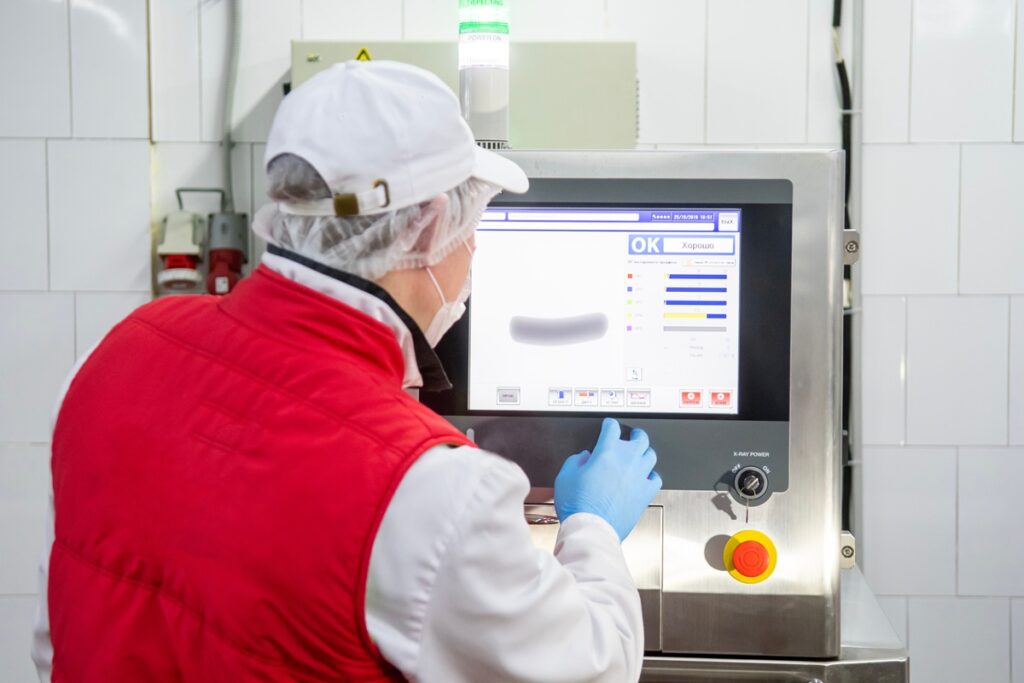
Three-dimensional imaging can measure height, shape, volume and fill profiles. Thermal cameras can reveal temperature differences associated with sealing, cooking, cooling or refrigeration performance. X-ray inspection can examine density variations within sealed products and identify certain foreign bodies, missing components or structural problems that cannot be seen from the outside.
Hyperspectral imaging extends inspection further by capturing both spatial and spectral information. Rather than recording only the visible appearance of an item, it measures how the product or material responds across numerous wavelengths.
With an appropriately developed and validated model, this can support the non-destructive assessment of characteristics such as moisture, maturity, composition, bruising and material variation. It may also help distinguish substances that appear visually similar but have different chemical or physical properties.
The technology is particularly relevant where an important quality difference is not visible to either a standard camera or the human eye. Applications are developing across fresh produce, meat, bakery, grains, confectionery and packaging materials.
However, hyperspectral imaging should not be purchased simply because it appears more advanced than a conventional camera. It produces larger datasets, requires careful calibration and can be affected by lighting, temperature, surface moisture, presentation and line speed.
The correct starting point is the defect or quality attribute that must be detected.
An RGB camera may be entirely adequate for confirming label position. X-ray may be more appropriate for identifying dense contaminants. Three-dimensional imaging may provide the best answer for portion size or pack deformation. Hyperspectral sensing becomes valuable when the relevant difference is chemical, compositional or material rather than simply visual.
Successful projects select the sensing technology around a clearly defined problem rather than trying to find applications for an expensive piece of equipment after installation.
Sustainable Materials Create New Variables: Inspection Must Adapt with the Pack
The transition towards recycled content, lightweight packs, thinner films and alternative materials is creating new inspection challenges.
Recycled plastics can show greater variation in tint, opacity and surface appearance. Lightweight containers may distort more easily during conveying, filling and closing. Flexible films can stretch, reflect light or move differently as line speed changes. Fibre-based materials may include natural variations in texture and colour that would be regarded as defects on a uniform plastic pack.
A vision system trained around one rigid appearance may therefore reject acceptable packs after a material change, even though those packs remain within specification.
The obvious response might be to widen the inspection tolerance. However, broadening tolerances too far risks allowing genuine defects to pass.
AI can help by learning a wider acceptable operating window, but only when the training data represents the materials and production conditions that will actually be encountered. This may include different recycled-content batches, suppliers, print runs, line speeds, lighting conditions and seasonal environments.
Packaging sustainability and inspection strategy should therefore be considered together.
Changing a material specification without reassessing the inspection system can turn an environmental improvement into a source of waste, downtime and customer complaints. The camera may continue operating exactly as configured while its understanding of what constitutes an acceptable pack becomes outdated.
This is particularly important when businesses move between virgin and recycled materials, introduce downgauged films or change pack suppliers. Each change can affect reflection, transparency, movement and presentation at the inspection point.
The inspection system should form part of the material-change validation process rather than being treated as a separate piece of equipment that will automatically adapt.
From Camera to Conversation: Vision-Language Models Change the Operator Experience
Most production vision systems currently use specialised models trained to complete a tightly defined task. They may classify a seal as acceptable or defective, locate a contaminant or confirm that a code is present.
Vision-language models add another level of interaction. These systems can interpret images alongside written instructions and produce natural-language explanations of what they detect.
Instead of receiving only a pass-or-fail signal, an operator could ask which defect type increased during the previous shift, request examples of repeated label failures or compare the latest batch against earlier accepted production.
A quality manager could ask the system to identify all instances of a particular seal anomaly, group them by machine setting and prepare a summary for investigation. Engineering teams could search historical inspection images without manually reviewing thousands of individual records.
This does not mean a general-purpose vision-language model should be placed in direct control of a high-speed reject mechanism.
The more practical architecture is likely to be hybrid. A fast and validated specialist model performs the critical inspection task at line speed, while a vision-language layer helps classify unusual cases, search historical images, explain results and prepare reports.
Smaller, application-specific models may also be deployed directly at the production line, while more computationally demanding analysis takes place on a local server or secure cloud platform. This allows manufacturers to balance speed, data privacy, resilience and cost.
The development also strengthens the role of human oversight. Rather than presenting an unexplained rejection, a system may be able to show which visual features influenced the decision, compare them with previous examples and indicate its confidence level.
The operator remains responsible for interpreting the result, but the information supporting that decision becomes far more accessible.
Intelligence Moves to the Line: Edge AI Supports Faster Decisions
Sending every production image to a remote cloud platform is not always practical. High-speed lines can generate enormous volumes of data, while network interruptions, latency and cybersecurity concerns can make continuous external processing undesirable.
Edge AI addresses this by running the inspection model close to the production line, either within the camera, an industrial computer or a local processing device.
This enables immediate decisions without waiting for data to travel to an external server and back. It can also reduce bandwidth requirements because only selected images, summaries or exceptions need to be retained centrally.
For manufacturers, the advantages include faster response, greater resilience and improved control over commercially sensitive production data.
Edge deployment is also supporting the convergence of vision and physical automation. Inspection systems can increasingly communicate directly with robotic pickers, sorters and handling equipment, enabling them not only to identify a problem but also to remove, redirect or rework the affected item.
The challenge is managing the models once they have been distributed across multiple lines or sites. Businesses need a controlled way to monitor performance, release updates, maintain version histories and prevent an untested model from being introduced into production.
A model operating at the edge should not become an invisible black box. It must remain part of the factory’s wider quality and change-control processes.
Close the Loop Before Quality Drifts: Vision Connects with Line Control
Inspection data becomes considerably more valuable when it leaves the camera system.
Connected to a line controller, manufacturing execution system or quality platform, inspection results can trigger an intervention before a defect rate becomes commercially damaging.
An increase in seal failures could prompt a check of temperature, pressure or dwell time. Variation in portion size could lead to depositor adjustment. A developing pattern of damaged packs might generate a maintenance task before the line suffers a breakdown.
This moves quality control from detection towards prevention.
Digital twins can extend this approach by combining inspection results with information from motors, sealers, conveyors, coders and other production assets. The model can compare current line behaviour against expected performance and identify developing mechanical or process problems.
A camera may observe a gradual change in pack alignment before the operator notices it. Combined with vibration or motor-load data, the system may indicate that a guide rail, bearing or conveyor component is beginning to deteriorate.
The objective is not to create a visually impressive digital representation of the factory. It is to use live data to understand why defects are occurring and intervene before they multiply.
The strongest implementations connect inspection results with equipment conditions, product specifications and batch information. This allows teams to move beyond the question of what was rejected and investigate what changed in the process immediately before the defect appeared.
From Defect Detection to Better Planning: Quality Data Reaches MES and ERP
The previous generation of quality systems often treated rejected products as a local production issue. Yet changes in rejection levels can affect output, material requirements, customer orders and distribution plans.
Connecting inspection data to manufacturing execution and enterprise resource planning systems allows the wider business to respond.
A sudden increase in rejects changes the expected quantity of saleable product from a batch. If this information is captured quickly, planners can recalculate output, adjust the next production run, review material requirements and provide customers or distribution centres with a more accurate delivery position.
This is not the same as using inspection data to predict consumer demand.
The more immediate opportunity is improving yield forecasting and ensuring that the supply plan reflects what the factory is genuinely capable of producing. Consumer demand forecasts may indicate what the business intends to sell, while live quality and yield information shows whether the production plan remains capable of delivering it.
The data can also expose relationships that traditional reports overlook.
A particular ingredient supplier may correlate with higher sorting losses. One packaging-film batch may generate more seal failures. A specific changeover sequence may increase coding errors. A machine may perform well on one pack format but struggle consistently with another.
Once those relationships are visible, procurement, engineering, operations and quality teams can make decisions from the same evidence.
The camera stops being an isolated quality-control device and becomes another source of factory intelligence.
Every Code Must Count: Vision Protects Digital Traceability
Inspection is also moving from checking the appearance of packaging to verifying the identity and traceability information carried by the pack.
Optical character recognition can confirm that lot numbers, date codes and production information are present, legible and correct for the scheduled product. A system can compare printed information with data held in the production order, preventing a correctly printed but incorrect code from reaching the market.
This is important because simply confirming that ink is present does not prove that the information is accurate.
The global move towards two-dimensional barcodes will increase the need for robust code verification. These codes can connect products with batch details, expiry information, traceability records, certification data, sustainability information and digital product content.
Inspection systems must therefore verify more than the physical presence of the code. They may need to confirm readability, print quality, data structure and consistency with the product moving through the line.
For businesses supplying the United States, the Food Traceability Rule introduced under FSMA Section 204 remains an important consideration. Enforcement has been deferred until July 2028, but the underlying requirement to maintain specified traceability information for covered foods remains.
Vision cannot create a traceability system by itself. It can, however, prevent unreadable, missing or mismatched identifiers from breaking the digital chain before goods leave the factory.
The strongest systems connect what was printed, what was inspected, what was packed and where it was sent. This creates a more defensible electronic record and allows affected production to be isolated with greater precision if an incident occurs.
Regulation Meets Reality: Not Every AI Camera Is High-Risk
Regulatory discussion around artificial intelligence can create the impression that every system using AI will face the same obligations. The reality is more nuanced.
Under the EU AI Act, the classification of a system depends on its intended purpose and the context in which it is used.
An AI camera performing routine cosmetic quality inspection will not automatically be treated in the same way as a system controlling a safety function, influencing a regulated product decision or operating as part of safety-critical machinery.
Food and beverage businesses therefore need an inventory of the AI systems they use, the functions those systems perform and the decisions they influence.
The same underlying technology may carry very different responsibilities depending on whether it identifies a slightly misaligned label, verifies a safety-critical contaminant check or controls the movement of automated machinery.
The UK continues to favour a sector-led approach, but this does not remove the need for governance. The Food Standards Agency has emphasised that AI should support rather than replace accountable human decision-making in areas related to food safety and authenticity.
For manufacturers, good governance should include documented intended use, representative training data, validation records, performance thresholds, human escalation routes and procedures for monitoring changes after deployment.
Businesses should be able to explain what the system was trained to detect, what it cannot reliably detect, what happens when confidence is low and who has authority to override or stop it.
A decision that cannot be reconstructed after an incident will be difficult to defend to an auditor, customer or regulator, regardless of how impressive the original demonstration appeared.
Accuracy Does Not Equal Profit: False Rejects and False Accepts Matter
Inspection suppliers frequently present model performance as a single accuracy percentage. That number rarely provides enough information for an investment decision.
Manufacturers must distinguish between false acceptance and false rejection.
A false acceptance allows a defective product to continue through the process. A false rejection removes a product that was actually acceptable.
The cost of false acceptance may include customer complaints, retailer penalties, rework, withdrawal, recall exposure or harm to the consumer. The cost of false rejection appears as unnecessary waste, lost yield, additional inspection and reduced line efficiency.
A system can appear highly accurate while still producing an unacceptable commercial result.
It may eliminate almost every defective item but reject a damaging quantity of good production. Alternatively, it may protect yield by applying tolerances that are so broad that unacceptable products continue downstream.
The business case should therefore measure both error types alongside product giveaway, scrap, rework, inspection labour, complaints, downtime, changeover losses and maintenance intervention.
The financial value will vary significantly between applications.
A high-volume line filling an expensive product may justify investment through a small reduction in giveaway. Another project may depend on avoiding coding errors, reducing manual inspection or detecting a low-frequency but severe hazard.
Capital purchase is no longer the only route to adoption. Subscription software, managed services and vision-as-a-service models can reduce the initial commitment and make advanced inspection more accessible to smaller and mid-sized producers.
However, cameras, lighting, reject equipment, line integration, training and validation may still require capital expenditure.
The strongest proposal begins with a measured baseline. Without knowing the existing reject rate, defect escapes, inspection labour, waste and downtime, it is impossible to prove what the technology has improved.
Start with One Costly Problem: A Practical Route to Deployment
A successful project rarely begins with an instruction to install AI across the entire factory.
It begins with one clearly defined problem whose cost and consequences are understood.
The first pilot should ideally involve stable product presentation, controllable lighting, sufficient examples of acceptable variation and a defect that matters commercially.
It should also include difficult cases rather than relying solely on clean demonstration images. The model needs exposure to real production variation, including borderline products, damaged packaging, changing ingredients and the conditions experienced during routine operation.
Validation should cover different shifts, line speeds, suppliers, pack formats, cleaning conditions and environmental changes.
For seasonal ingredients or naturally variable products, the validation period may need to extend across several production cycles. A system commissioned using one harvest, supplier or climatic condition may perform differently when the underlying product changes.
Performance must then be monitored after deployment.
Cameras can move, lenses can become dirty, lighting can deteriorate and products can change. A model that performed well during commissioning may drift away from reality if no one checks it.
Change control is equally important. A new label, film, ingredient supplier or line configuration may require reassessment. Model updates should be documented and tested before release rather than introduced invisibly by a supplier.
Integration should also be planned from the start. If inspection results remain trapped in a proprietary camera interface, much of their operational value is lost.
Engineering teams should establish how information will reach the line controller, quality platform, historian, MES or ERP system and how it will be connected with batches, products and machine conditions.
Human Judgement Still Matters: Good Systems Know When to Escalate
AI vision is most valuable when it removes repetitive inspection while preserving human judgement for ambiguous, unfamiliar or high-consequence decisions.
A mature system should recognise uncertainty.
Low-confidence results, new defect patterns or disagreements between sensors should trigger quarantine or expert review rather than an unjustified automated decision.
Operators need more than basic equipment training. They must understand what the system can and cannot detect, how contamination or lighting changes affect performance and how to identify deterioration in the model’s behaviour.
Quality personnel must remain involved in defining acceptance criteria. Engineers need to understand the mechanical causes behind the patterns being detected. IT and cybersecurity teams must protect the data and connections that allow the system to operate.
This is particularly important as vision systems become connected with more factory equipment and business platforms. A compromised or poorly controlled inspection system could affect production records, reject decisions, traceability information or automated machinery.
The objective is not to remove people from quality control. It is to give them earlier, more consistent and more useful information.
Every Defect Teaches the Factory: Inspection Becomes a Competitive Advantage
The next generation of vision inspection will not be judged solely by how many defective products it removes.
Its value will be measured by how quickly it identifies process drift, how effectively it protects yield, how accurately it verifies traceability and how well its information supports decisions across engineering, quality, maintenance, planning and procurement.
Hyperspectral sensing, edge processing and vision-language models are expanding what inspection systems can detect and explain. Integration with line controls, MES, ERP and digital traceability platforms is expanding what manufacturers can do with the results.
The technology still requires discipline.
Models need representative data, controlled validation, defined escalation routes and continuous monitoring. Greater intelligence does not remove the need for good engineering or human accountability.
Used properly, however, AI vision turns every inspected item into evidence.
Instead of discovering quality problems through customer complaints, end-of-shift reports or rejected deliveries, producers can see deviations developing while there is still time to intervene.
That is the real move beyond the reject gate: from detecting defective products to understanding and improving the process that created them.
What is AI vision inspection in food and beverage production?
AI vision inspection uses cameras or other imaging sensors with machine-learning software to assess products, packaging and production processes. Unlike traditional rule-based vision, which compares an image against fixed measurements, AI models can learn acceptable variation from examples. Systems may detect damaged products, incorrect labels, poor seals, missing components, fill-level problems, coding errors and other non-conformances. Inspection results can also be connected to production and quality systems to identify trends and support root-cause analysis.
Can AI vision detect defects inside food or sealed packaging?
A conventional colour camera primarily detects visible surface characteristics. Internal or sub-surface inspection requires additional sensing technologies. X-ray can identify certain dense foreign bodies and missing internal components, while three-dimensional or thermal imaging measures shape, volume or temperature variation. Hyperspectral imaging captures spectral information that can support the assessment of material or chemical differences. The correct technology depends on the product, defect, packaging, line speed and level of validation required.
How can AI vision support FSMA 204 traceability?
AI vision can verify that lot codes, dates, two-dimensional barcodes and other identifiers are present, readable and matched to the correct production order. This helps prevent missing or incorrect information from breaking the traceability chain. FSMA 204 requires covered businesses handling foods on the Food Traceability List to maintain specified data linked to Critical Tracking Events. Although enforcement has been deferred until 20 July 2028, businesses may still need to provide relevant traceability information to the FDA in an electronic sortable spreadsheet within 24 hours. nspection systems classed as high-risk under the EU AI Act?
Are food inspection systems classed as high-risk under the EU AI Act?
Not automatically. Classification depends on the system’s intended purpose. Routine cosmetic inspection will not necessarily be high-risk. An application may be classified differently if it performs a safety function within regulated machinery or another product covered by EU harmonisation legislation and meets the applicable conformity-assessment conditions. Manufacturers should document each system’s purpose, decisions, data, human oversight and risk controls rather than applying one classification to every AI vision application.
How should manufacturers calculate the ROI of an AI inspection system?
ROI should be calculated using the plant’s existing costs rather than a generic industry payback period. The baseline should include waste, giveaway, rework, manual inspection, customer complaints, defect escapes, line stoppages and maintenance costs. Manufacturers should separately measure false rejections, where acceptable products are removed, and false acceptances, where defective products pass inspection. The investment case can then compare these costs with equipment, integration, validation, training, support and ongoing model-management expenditure.