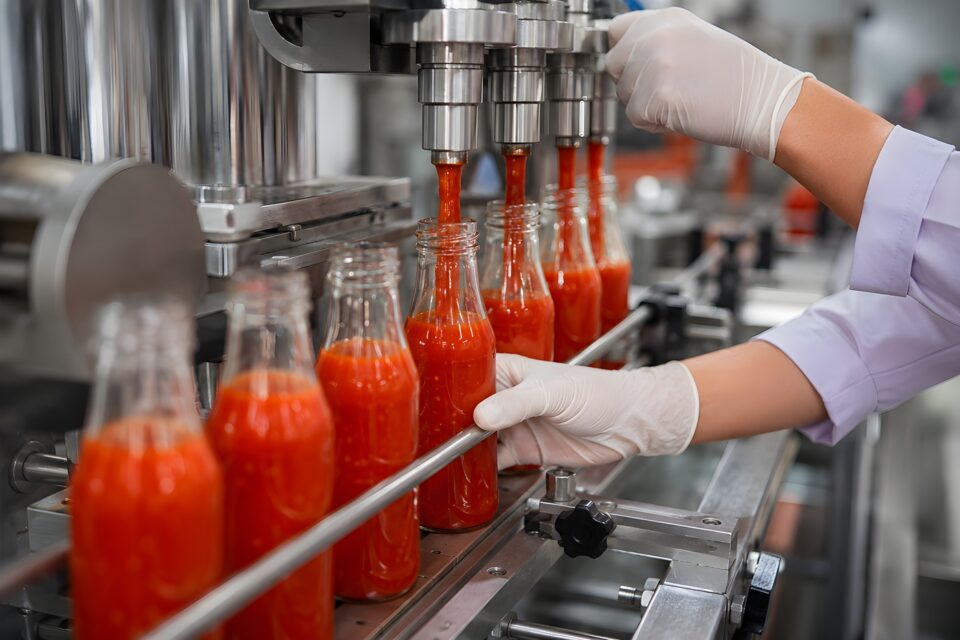
Industry Insight: Soup and sauce production is becoming an increasingly complex exercise in balancing food safety, texture, shelf life, nutrition, packaging and cost. Extended Producer Responsibility is turning packaging recyclability into a direct financial consideration, while new advertising rules are adding pressure around product formulation. At the same time, developments in continuous heating, high-pressure processing, aseptic technology and AI-assisted process control are giving manufacturers new ways to protect quality while increasing throughput. For processors, the opportunity is no longer simply to develop a better recipe. It is to design the recipe, process and pack as one integrated manufacturing system.
From tikka sauce flowing through an electrically heated production system to chilled pesto preserved using extreme pressure, technology is changing how soups and sauces are manufactured. But processors must now balance innovation with tougher packaging economics, reformulation pressure and increasingly complex compliance requirements.
Soups and sauces might appear to be among the food industry’s simplest products. In reality, they can be among its most technically demanding.
A manufacturer may need to pump a product containing particulates without damaging them, heat every component sufficiently for food safety, maintain viscosity throughout processing, prevent scorching, achieve accurate filling, preserve colour and flavour, and then deliver months of shelf life — all while reducing salt, sugar or additives.
Change one variable and several others can move.
Reducing sugar can alter body and mouthfeel. Removing starches or stabilisers can change pumping and filling characteristics. Increasing vegetable or protein content can affect viscosity and heat transfer. Moving from a multilayer pouch to a more recyclable format may alter barrier performance or sealing behaviour.
That is why the next stage of soup and sauce development is increasingly being driven as much by engineering as by culinary innovation.
Heat Without the Hammer: Rethinking Thermal Processing
Traditional steam-jacketed vessels, batch cooking and retort processing remain fundamental to the industry, particularly where processors require robust microbiological control and long ambient shelf life.
The challenge is avoiding unnecessary thermal load.
Long heating cycles can influence colour, flavour, nutrient retention and the integrity of vegetables, meat and other inclusions. Thick sauces also create particular problems because heat does not move through them as readily as through low-viscosity liquids.
Continuous processing technologies are therefore receiving greater attention.
One particularly interesting development is continuous-flow ohmic heating, where electrical resistance within the food generates heat throughout the product rather than relying solely on heat transfer from a hot surface.
That makes the technology attractive for pumpable products such as sauces, soups and slurries, particularly where scorching or uneven heating can become an issue.
Recent research involving Sheffield Hallam University and Premier Foods has gone a stage further. Researchers developed OhmNet, an artificial neural-network model capable of predicting how the viscosity of a tikka sauce changes during continuous-flow ohmic heating. The work demonstrated an AI model capable of predicting viscosity in real time, potentially allowing future control systems to alter operating parameters as product behaviour changes.
For manufacturers, that points towards a much broader development: production equipment that does not simply follow a predetermined recipe but responds dynamically to the physical characteristics of the product passing through it.
Cold Under Pressure: Extending Life Without Cooking the Product
High-pressure processing continues to offer another route, particularly within premium refrigerated sauces, dips and chilled soups.
HPP applies extremely high hydrostatic pressure to packaged food, reducing vegetative microorganisms while avoiding the level of heat associated with conventional pasteurisation.
Research on pesto sauce, for example, found HPP achieved more than a four-log reduction in Listeria monocytogenes and Salmonella Typhimurium while maintaining acceptable chemical quality during refrigerated storage.
The important distinction is that HPP is not a universal replacement for thermal sterilisation.
For low-acid ambient soups, bacterial spores remain a fundamental safety consideration. HPP is consequently better viewed as a technology for appropriate chilled, high-moisture products rather than a simple route to shelf-stable soup without heat.
Where the application fits, however, it can support longer chilled shelf life, fresher sensory characteristics and formulations that depend less heavily on traditional preservatives.
The Reformulation Trap: Taking Something Out Changes Everything Else
Health-driven reformulation is also becoming more technically demanding.
Salt, sugar and fat do much more than influence nutrition panels. They contribute flavour, structure, preservation, body and overall sensory perception.
Removing them can therefore create problems elsewhere in the formulation.
Sugar reduction provides a good example. Lowering sugar can reduce viscosity and alter mouthfeel, forcing formulators to reconsider fibres, starches, hydrocolloids, proteins, sweeteners and flavour-modulation systems.
Ingredient developers increasingly describe clean-label reformulation as a systems problem, rather than simply replacing one ingredient with another.
That philosophy was evident at IFT FIRST 2026, where ingredient companies demonstrated formulation systems addressing sugar reduction, fibre enrichment, protein addition and clean-label requirements while attempting to maintain texture and taste. Ingredion also introduced an AI-powered assistant designed to help R&D teams identify and compare potential ingredient solutions more quickly.
Other AI-assisted systems are beginning to recommend ingredient combinations and formulation ratios according to targets such as sugar reduction, product requirements and cost.
Crucially, these systems are not replacing food technologists. Their immediate value is in narrowing a vast number of potential formulation combinations into more promising starting points before pilot and application testing begins.
Texture Is the Product: Why Viscosity Is Becoming a Control Parameter
Texture is especially important in soups and sauces because consumers often associate viscosity with quality.
A pasta sauce that becomes watery, a gravy that pours inconsistently or a soup in which particles settle quickly can undermine a product regardless of flavour.
Viscosity also affects the factory.
It determines pumping requirements, flow rates, mixing performance, heat transfer, residence time and filling accuracy.
As manufacturers produce increasingly complex recipes — including plant proteins, vegetable inclusions, fibres and reduced-sugar formulations — maintaining rheological consistency becomes more difficult.
This explains growing interest in connecting inline measurement, modelling and automated process control.
Rather than checking consistency after a batch has already been produced, future systems could increasingly use data from temperature, pressure, flow and viscosity measurements to identify deviation while production is still running.
That has direct commercial implications. A tighter process window can reduce giveaway during filling, improve batch-to-batch consistency and reduce the quantity of product requiring rework.
Compliance Moves Into the Recipe: Understanding the HFSS Rules
Nutrition policy is adding another layer of complexity.
Since 5 January 2026, restrictions have applied across the UK to advertising identifiable less-healthy food and drink products, including a 9pm watershed for television advertising and a 24-hour restriction on paid-for online advertising.
But soup and sauce manufacturers need to be careful not to oversimplify the rules.
A product is not automatically subject to the restrictions merely because it receives a particular nutrient-profile score. It must both fall within one of the categories specified by the regulations and meet the relevant nutrient profiling threshold. The advertising restrictions principally apply to businesses with 250 or more employees.
Standalone sauces, for example, are explicitly excluded from several product categories, although products incorporating sauce as part of a complete meal may fall within scope.
Manufacturers therefore need product-by-product assessment rather than assuming an entire category is either included or excluded.
The landscape may change further. In March 2026, government opened consultation on applying an updated nutrient profiling model to existing advertising and promotion restrictions. The proposed approach places greater emphasis on issues including free sugars and fibre.
For R&D departments, regulatory horizon scanning increasingly needs to sit alongside recipe development.
Packaging Meets the P&L: EPR Changes the Calculation
Packaging decisions are also moving much closer to the profit-and-loss account.
Under Extended Producer Responsibility for packaging, large producers must assess the recyclability of household packaging using the Recyclability Assessment Methodology.
Packaging is classified red, amber or green, and those ratings increasingly affect the waste-disposal fees producers pay.
For 2026/27, red-rated packaging attracts a modulation factor of 1.2, effectively increasing the relevant disposal fee by 20%. The planned factor rises to 1.6 in 2027/28 and 2.0 in 2028/29. Green packaging benefits from money redistributed from the higher charges applied to red-rated material, while amber remains at the base rate.
For sauce manufacturers heavily dependent on flexible packs, sachets and multilayer structures, that turns pack design into an economic issue as well as an environmental one.
Yet there is an important complication.
Mandatory household and workplace collection of plastic films in England has been postponed until 1 April 2030, reflecting concerns over the sorting and reprocessing infrastructure required.
Manufacturers are consequently having to design for a recycling system that itself remains in transition.
Mono-material structures may improve recyclability assessments, but they still need to withstand hot filling or retort conditions, provide adequate oxygen and moisture barriers and seal reliably when exposed to oily or particulate products.
A cheaper EPR rating is little use if the redesigned pack reduces shelf life or increases leakage.
The Invisible Failure Point: Seal Integrity and Automated Inspection
Sauces create another packaging problem that is particularly easy to underestimate: contamination of the sealing area.
A tiny quantity of product trapped within a flexible-pack seal can weaken it sufficiently to create a leak pathway later in distribution.
Higher line speeds make manual inspection increasingly unrealistic.
Vision systems, thermal imaging, leak detection and automated inspection therefore have an expanding role in high-throughput filling operations.
The wider opportunity is to link inspection equipment with upstream processing and filling data.
If seal failures suddenly increase, the underlying cause might not be the packaging machine itself. Fill temperature, viscosity, nozzle timing or product stringing could all be contributing.
Connecting those datasets allows manufacturers to move from rejecting defective packs to identifying why the defect occurred.
One Recipe, Hundreds of Variables: Automation Becomes the Competitive Advantage
Automation in soup and sauce plants is therefore moving beyond robotics.
Recipe-management systems can control ingredient addition, mixing speed, cooking temperatures, hold times and transfer sequences. Inline instrumentation provides immediate feedback, while production-management platforms can compare actual performance with specification.
The next development is likely to be increasingly predictive.
Instead of simply warning operators when temperature, pressure or viscosity falls outside tolerance, software can identify patterns indicating that a deviation is developing.
For manufacturers producing frequent recipe changes, seasonal products or short private-label runs, that capability becomes particularly valuable.
The prize is not automation for its own sake.
It is shorter changeovers, fewer rejected batches, more consistent filling, reduced giveaway and the ability to launch more complex products without creating equally complex manufacturing problems.
From Recipe to Manufacturing System: Where Competitive Advantage Now Lies
Consumer appetite for new flavours will continue.
Regional chilli sauces, cooking pastes, premium stocks, protein-enriched soups and globally inspired recipes will keep product developers busy.
But the manufacturers most likely to succeed will be those that consider manufacturability at the same moment they consider flavour.
Can the product be pumped without destroying inclusions?
Can it be heated rapidly and safely?
Can salt or sugar be reduced without changing rheology?
Can the packaging survive the process while achieving an acceptable RAM rating?
Can the filling line control portion weight as viscosity varies?
And can every one of those parameters be monitored reliably at industrial scale?
The modern soup or sauce is no longer simply a recipe inside a container.
It is the output of an interconnected system involving formulation science, thermal engineering, automation, microbiology and packaging technology.
For processors, mastering that system may prove far more valuable than discovering the next fashionable flavour.
How can AI be used in sauce formulation and production?
AI can help R&D teams identify potential ingredient combinations, model formulation changes and evaluate cost or nutrition targets. In processing, machine-learning systems can also model variables such as sauce viscosity, potentially allowing equipment settings to respond more intelligently to changes occurring during production.
Are soups and sauces covered by the UK HFSS advertising restrictions?
Not automatically. A product must fall within one of the categories specified by the regulations and also meet the nutrient profiling threshold. Manufacturers should therefore assess individual products and their intended use rather than relying solely on nutrient composition.
How does Extended Producer Responsibility affect sauce packaging?
Large producers must assess household packaging through the UK Recyclability Assessment Methodology. Red, amber and green ratings influence disposal fees. Red-rated packaging receives a 1.2 modulation factor in 2026/27, increasing the financial incentive to redesign difficult-to-recycle structures.
Can high-pressure processing replace heat treatment for soup?
Not universally. HPP can be highly effective for suitable refrigerated products, but it does not reliably destroy bacterial spores. Low-acid shelf-stable soups therefore still require validated processing capable of controlling spore-forming organisms.
What new technologies are being used in soup and sauce production?
Manufacturers are exploring continuous-flow ohmic heating, high-pressure processing, advanced aseptic processing, inline viscosity measurement, automated inspection and AI-assisted process control. The objective is generally to improve heat treatment, texture, consistency, shelf life and production efficiency while reducing unnecessary processing.