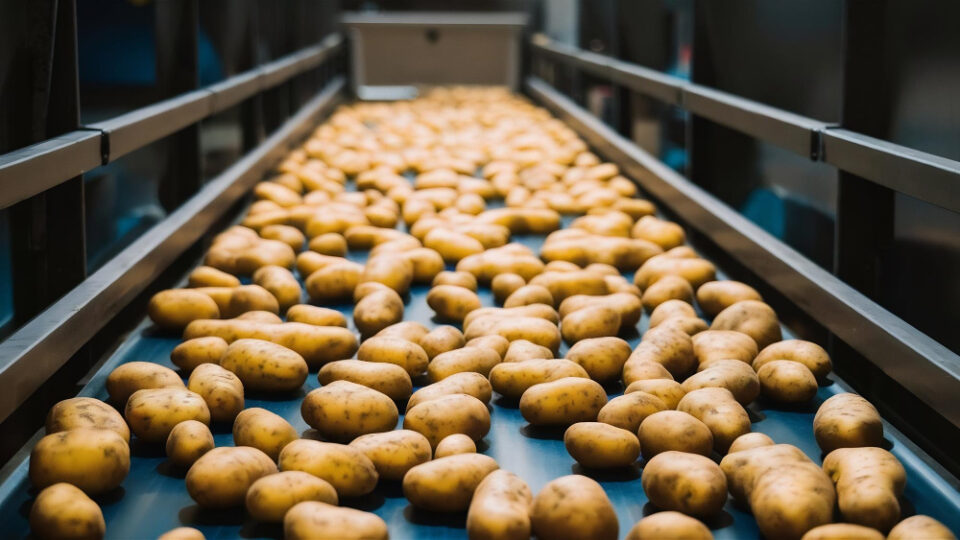
Food waste in the Dutch potato processing sector declined again in 2025. According to the latest monitoring data from Food Waste Free United (Samen Tegen Voedselverspilling), the average waste rate for frozen potato products dropped to 4%.
Wageningen University & Research (WUR) gathered the data through its food waste monitor in partnership with six leading potato processors. The results show that 96% of the potatoes, vegetable oils and other ingredients entering production were converted into food products. Much of the remaining material was also recovered for productive purposes, such as food ingredients, animal feed and bio-based applications.
The findings demonstrate how higher processing efficiency and stronger by-product recovery can support wider food manufacturing trends focused on reducing resource loss.
Advanced sorting supports better potato utilisation
Greater production efficiency played an important role in lowering residual material levels during 2025. Potato processors are increasingly using optical sorting systems to assess incoming raw materials more accurately and reduce unnecessary rejection or loss.
This food processing technology identifies potatoes based on specific characteristics, enabling manufacturers to separate raw materials with greater precision. As a result, a larger proportion of the incoming crop can be directed into finished products.
Manufacturers are also improving the timing and efficiency of starch separation from process water. Extracting starch before it reaches the wastewater stream protects a potentially valuable resource and can improve its quality for other uses, including incorporation into animal feed.
Innovation expands the use of residual materials
Waste prevention is increasingly shaping product development across the sector. Processors are investigating products that retain the potato skin and new formats that use smaller or shorter pieces that would previously have been treated as residual material.
These initiatives allow manufacturers to obtain greater value from each potato while expanding the product range that can be produced from the available raw material.
At the same time, companies are seeking higher-value applications for residual streams. The priority is to direct these materials towards food, feed or material production wherever possible, rather than using anaerobic digestion as the first destination.
Grey starch remains an important opportunity
Recovery of grey starch, a material produced during potato blanching, is receiving particular attention from the industry.
Converting this starch into animal feed could deliver further reductions in food waste. Lamb Weston has invested in extra infrastructure at its new Kruiningen facility in the Netherlands, allowing the company to make grey starch available for feed production.
Regulatory developments will influence how widely this opportunity can be adopted. Changes to food and drink regulations could create additional routes for using grey starch in animal feed applications.
Industry remains focused on the 2030 objective
The sector has made clear progress. In 2025, food waste from frozen potato processing was 7% lower than the average recorded between 2021 and 2023.
That performance places the industry on a path towards the European Union’s 2030 goal of reducing food waste from food processing by 10% against the 2021–2023 baseline. However, processors must achieve further gains to reach the target.
Now in its sixth consecutive year, the monitoring programme highlights the benefits of measuring waste across an entire sector. Shared data helps processors locate losses, benchmark performance and direct investment towards equipment and processes that improve raw material utilisation. This approach complements wider food and beverage industry trends, including food and drink sustainability, food and drink industry innovation and more efficient supply chains.
For potato manufacturers, the next phase of progress will likely combine highly accurate sorting with improved separation and recovery of starch and other residual streams. The goal extends beyond reducing the quantity of waste leaving a site. It is about converting a greater share of every incoming tonne into a useful product, while supporting evolving food distribution trends, food and drink packaging priorities, food and drink marketing strategies and food and drink consumer trends.