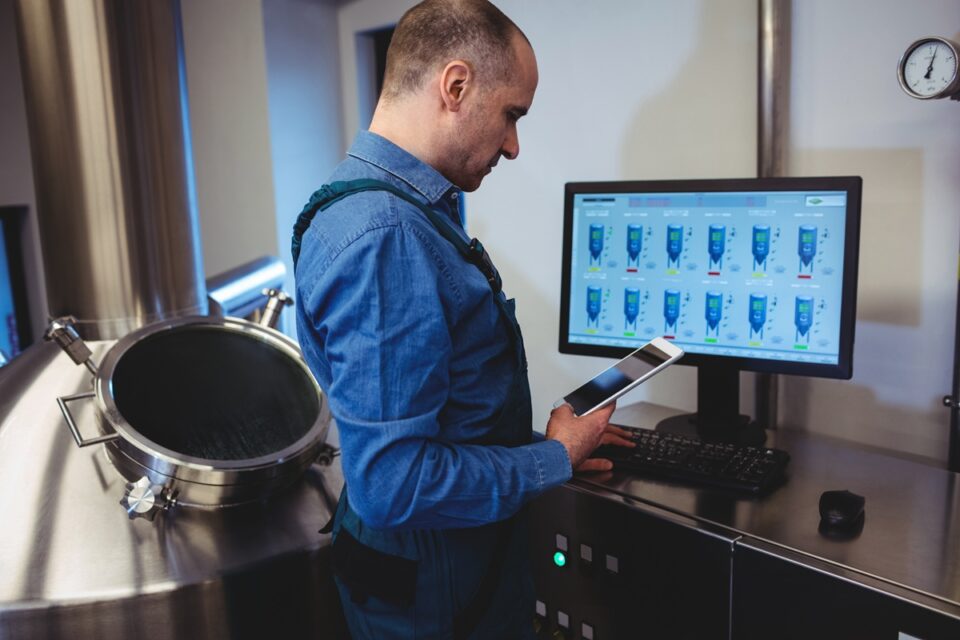
Industry Insight: The smart factory conversation is shifting from experimentation to execution. Rockwell Automation’s latest global study of more than 1,500 manufacturing leaders found that 59% are actively using smart manufacturing technologies, while only 18% remain in pilot mode. Importantly, the survey covers manufacturing broadly — including food and beverage, consumer packaged goods, automotive, semiconductor, energy and life sciences — rather than representing food production alone. The UK findings tell a similar story. Some 87% of UK manufacturers now describe digital transformation as essential, 49% have already invested in AI and only 45% of the operational data being collected is used effectively. Half also reported experiencing at least one cyberattack during the previous year. The challenge is therefore changing. Access to technology is no longer necessarily the biggest obstacle. Manufacturers increasingly need to integrate it with existing plant, extract useful information from the data already available and demonstrate measurable returns without introducing unacceptable operational, food safety or cybersecurity risks.
The next generation of process control is not simply about automating more tasks. AI, digital twins, edge computing and increasingly connected control architectures are giving manufacturers the ability to predict problems, simulate decisions and adapt production in real time. The opportunity is significant — but so are the demands around data, cybersecurity, validation and compliance.
Automation has spent decades making production faster, repeatable and less dependent on manual intervention. What is emerging now is something different: production systems capable of interpreting considerably more information before determining what should happen next. A traditional control system responds to defined conditions. Temperature rises beyond a set point, a valve changes position. A sensor detects a missing pack, the product is rejected. Those deterministic controls remain fundamental to safe food production.
Artificial intelligence does not replace that foundation. Instead, it is beginning to add another layer around it — analysing combinations of process variables, detecting patterns that might otherwise go unnoticed and predicting where a process is heading rather than simply reporting where it has been.
That distinction could define the next stage of factory automation.
From Automated to Adaptive
Industrial automation has traditionally relied heavily on predefined logic: when one condition occurs, the system performs a predetermined response.
Increasingly sophisticated analytics can now examine dozens or hundreds of variables simultaneously.
Rather than waiting for a filling machine to exceed an alarm threshold, for example, a system could identify small changes in vibration, motor current, temperature and cycle time that together suggest deterioration.
It could then compare that information against the maintenance schedule and planned production, allowing engineers to intervene during a format change or other convenient window rather than after a failure stops the line.
The same principle can be applied to the product itself.
Changes in ingredient characteristics, ambient conditions, viscosity, product temperature or equipment performance can be analysed against previous batches, helping operators identify variability before it becomes waste or a quality problem.
This is where the growing discussion around agentic AI becomes relevant.
Generative AI primarily creates or interprets information. Agentic systems go further by planning actions and, within defined boundaries, potentially initiating them.
On the factory floor, that might eventually mean an AI system identifying deteriorating machine performance, checking production schedules, recommending maintenance, generating a work order and proposing the least disruptive intervention window.
The crucial phrase, however, is within defined boundaries.
For food manufacturers, the realistic near-term model is not an AI system freely making whatever production changes it chooses. It is supervised autonomy: tightly scoped systems operating within validated limits, with people retaining authority over decisions carrying significant safety, quality or operational consequences.
When AI Reaches the HACCP Plan
This becomes particularly important when artificial intelligence moves closer to food safety controls.
HACCP systems depend on manufacturers identifying hazards, establishing appropriate controls and defining how those controls will be monitored and verified.
If AI is simply analysing historical downtime or recommending a maintenance window, governance may be relatively straightforward.
If its recommendation could influence a critical control point, the questions become considerably more serious.
A manufacturer would need to understand exactly what the system is permitted to change, the validated limits within which it can operate, how any recommendation or adjustment is recorded and when human authorisation is required.
Consider thermal processing.
An AI system might identify that changing product characteristics are influencing heating performance and recommend an adjustment. That information could be valuable to an operator, but allowing an adaptive algorithm to move a safety-critical parameter outside an established validated process would be a very different proposition.
The same principle could apply to chilling, metal detection, allergen changeovers or other processes where failure could have food safety consequences.
For engineers and technical teams, therefore, AI governance is likely to become part of HACCP and change-control discussions rather than remaining solely an IT consideration.
The question will increasingly be not simply “Can the system optimise the process?”, but “Can we demonstrate that the process remains controlled, validated and auditable when it does?”
Intelligence Moves to the Edge
Not every industrial decision can wait for information to travel to a cloud platform, be analysed and returned.
This is driving greater interest in edge computing, where analytics and AI models operate close to the machine or production line.
For high-speed vision inspection, process deviation detection or rapidly changing production conditions, latency matters. Local processing can also allow essential analytical functions to continue if external connectivity is interrupted and reduces the amount of plant information that needs to leave the production environment.
The result is increasingly a hybrid architecture.
PLCs and safety controllers continue handling deterministic machine control and safety.
Edge systems provide rapid analytics, machine vision and anomaly detection.
SCADA and manufacturing execution systems provide production context, batch information and plant-level visibility.
Cloud platforms can then handle larger datasets, multi-site comparison, model development and longer-term optimisation.
Competitive advantage will come less from any individual layer than from making those layers communicate effectively.
Digital Twins Become Decision Tools
Digital twins featured heavily in early discussions around Industry 4.0, but their role is becoming considerably more practical.
Instead of simply providing a digital representation of equipment, sophisticated twins can combine engineering models, simulation and operational data to explore what happens when something changes.
A manufacturer considering a faster line speed, revised equipment layout, different pack format or additional automation can therefore test scenarios virtually before modifying the physical line.
PepsiCo provides an indication of where this can lead.
Working with Siemens and NVIDIA, the company has been developing high-fidelity digital twins of selected US manufacturing and warehouse facilities. At one US Gatorade plant, Siemens reports that the initial deployment delivered a 20% increase in throughput within three months. The wider programme has also reportedly identified up to 90% of potential issues before physical modifications and is expected to reduce capital expenditure by 10–15% through virtual validation and identification of unused capacity.
These remain company-reported results rather than universal industry benchmarks, but they demonstrate why simulation is moving beyond technological demonstration towards a practical capital-planning tool.
For food producers, the possibilities also extend beyond factory layouts.
A process twin could explore the effect of changes in recipe, viscosity, heating profile, cleaning cycle or packaging format before those alterations are trialled on live production.
Combined with real-time production information, the twin can increasingly become a means of comparing what should be happening with what is happening.
Seeing More Than Pass or Fail
Machine vision is undergoing a similar transition.
Traditional vision systems were often built around comparatively simple rules: Is the label present? Is the cap fitted? Is the product the correct shape?
AI-based systems can deal with considerably greater variability, making inspection practical for irregular products or defects that are difficult to define using fixed rules.
Manufacturers can also combine visual information with other process data.
Colour, shape and surface condition might be assessed alongside weight, temperature, spectroscopy or equipment readings to build a more complete picture of product quality.
For production engineers, however, detecting a defect is only part of the opportunity.
A system becomes far more useful when repeated defects can be connected to what is happening upstream.
A recurring seal failure might point towards temperature or pressure drift. Variation in filling accuracy could indicate changing product viscosity or pump performance.
Quality control therefore begins moving from:
detect and reject
towards:
detect, understand and correct.
For technical teams and auditors, that potentially creates a richer evidence trail too — showing not only that non-conforming products were removed, but what happened within the process and how the manufacturer responded.
The Brownfield Problem
The most sophisticated AI platform is of limited value if the factory cannot provide reliable information to it.
Many food and beverage plants contain machinery installed across several decades.
Different PLC generations, proprietary communications, isolated equipment, manually completed quality records and inconsistent naming conventions may all coexist within the same facility.
Replacing everything is rarely economically realistic.
The practical challenge is therefore connecting brownfield equipment without destabilising production.
In many cases, that may mean installing gateway devices, additional sensors or edge controllers around older equipment rather than replacing complete production lines.
Standards and technologies such as OPC UA, industrial Ethernet and MQTT can help move information between machinery and higher-level systems.
But connectivity alone does not create useful data.
A temperature reading means little without context.
Which machine generated it? Which product was running? Which batch did it belong to? Was the sensor calibrated? Was the line running normally, cleaning, starting up or shutting down?
That context is what turns plant data into operational information.
Rockwell’s UK survey provides a useful reminder of the problem: manufacturers reported using effectively just 45% of the operational data they collect.
For many businesses, improving that data foundation could deliver more value than immediately purchasing another AI platform.
Cybersecurity Enters the Engineering Brief
Greater connectivity inevitably creates greater exposure.
Half of the UK manufacturers surveyed by Rockwell Automation said they had experienced at least one cyberattack during the previous year.
This changes how automation projects need to be specified.
Cybersecurity can no longer be considered simply an IT department issue addressed after machinery has been commissioned.
Network segmentation, account permissions, remote-access controls, patching policies, backups and recovery procedures increasingly need to form part of engineering and procurement discussions from the beginning.
Questions that once might never have appeared on machinery specifications are becoming increasingly relevant.
Can the machine be isolated within its own network segment? How is remote supplier access authenticated? How long will security updates be provided? Who is responsible for applying them? What happens if external connectivity is unavailable?
Regulation is reinforcing that direction.
Under the EU Cyber Resilience Act, manufacturers of products with digital elements have been subject to reporting requirements for actively exploited vulnerabilities and serious security incidents since 11 September 2026. Initial warnings are required within 24 hours, followed by fuller notification within 72 hours.
For a food manufacturer buying connected machinery, the direct legal obligations may sit primarily with the equipment or software supplier, but the practical implication is clear: cybersecurity capability is becoming a relevant purchasing criterion.
In the UK, the Cyber Security and Resilience Bill is also progressing through Parliament, seeking to strengthen the country’s network and information systems framework. Because its parliamentary status may continue to change before publication, manufacturers should follow the final legislation rather than treating the proposals as settled law.
When AI Meets Machinery Law
Automation investment must increasingly consider regulation as well as performance.
The EU Machinery Regulation applies from 20 January 2027, replacing the Machinery Directive and updating the framework for increasingly software-driven, connected and autonomous machinery.
Significantly, the Regulation explicitly recognises software performing safety functions and safety components with fully or partially self-evolving behaviour using machine-learning approaches.
It also requires safety-related software and data to be protected against corruption and places requirements around the behaviour and logging of control systems capable of varying levels of autonomy.
For manufacturers buying AI-enabled machinery, that makes the Machinery Regulation the more immediate compliance milestone.
The EU AI Act remains important, but the relationship between the two frameworks is more nuanced than simply saying that every AI-enabled machine automatically becomes subject to one universal AI deadline.
The practical message for food and beverage manufacturers is simpler.
As software takes a greater role in machine safety and decision-making, engineering teams will increasingly need documentation showing what the system does, what its limits are, how changes are controlled and how safety-related decisions or software modifications can be traced.
That requirement should influence machinery procurement long before a new line reaches factory acceptance testing.
Traceability Becomes Part of Control
Another important development is the convergence of process control and traceability.
Production systems increasingly need to connect what physically happened on a line with the digital history of the product.
That can mean automatically associating ingredients, batches, processing conditions, quality checks, operator interventions and packaging codes with a particular production lot.
The US Food Safety Modernization Act Food Traceability Rule illustrates this direction.
For foods covered by the Food Traceability List, businesses are required to maintain Key Data Elements associated with defined Critical Tracking Events and be capable of providing required information to the FDA within 24 hours.
Although enforcement has effectively been postponed until 20 July 2028, the underlying requirements have not disappeared.
For UK manufacturers supplying the US, that has obvious implications.
But the wider lesson reaches beyond America.
Traceability is increasingly becoming part of production data architecture rather than something reconstructed later from separate ERP records and paperwork.
Building those links retrospectively is far harder than designing them into control, MES and coding systems as they are upgraded.
Start With the Problem, Not the Platform
Perhaps the most important automation lesson is also the least glamorous.
Successful projects usually begin with a clearly defined manufacturing problem.
That could be excessive giveaway, recurring stoppages, inconsistent changeovers, labour-intensive palletising, inaccurate coding, poor downtime visibility or a packaging defect that repeatedly generates waste.
The technology comes afterwards.
A targeted vision system that eliminates a recurring label or seal problem may provide greater value than a factory-wide AI project with no defined operational objective.
Likewise, predictive maintenance might initially make sense on three critical assets rather than every motor in the building.
Useful early projects might include:
- automated downtime and changeover monitoring;
- machine vision targeting a known recurring defect;
- condition monitoring on a small number of production-critical assets;
- improved batch-level process data capture;
- connecting previously isolated equipment into plant monitoring systems.
Each can be measured against outcomes that production teams already understand: OEE, yield, giveaway, downtime, waste, labour hours, changeover time, quality incidents and maintenance cost.
Only when those benefits are proven does broader deployment become easier to justify.
The Factory Learns — But People Still Decide
The next generation of process control is unlikely to remove engineers, operators or quality teams from production.
It will change where their time is spent.
Machines will collect more information automatically.
AI will interpret more of it.
Digital twins will allow changes to be tested before they reach production.
Vision systems will identify deviations that people cannot reliably detect at line speed.
And increasingly connected control systems will bring together information that previously sat in separate machines, spreadsheets and databases.
People move towards supervision, optimisation, investigation and decision-making.
That represents a more significant change than simply installing another robot.
The factory of the future is unlikely to be completely autonomous.
It will instead become increasingly aware of what is happening, capable of predicting what may happen next and able to identify where human or automated intervention could deliver the greatest value.
The factory may learn.
But in food production, people will still need to decide where that intelligence is allowed to take control.
Which regulations affect connected automation and AI in food manufacturing?
Requirements depend on where equipment is manufactured, installed and sold. Important developments include the EU Machinery Regulation, applying from January 2027, the Cyber Resilience Act and NIS2 cybersecurity requirements. The EU AI Act may also be relevant depending on the system and its function, while exporters to the US should consider FSMA Food Traceability Rule requirements.
What is a digital twin in food production?
A digital twin is a virtual representation of a machine, production line, process or facility that can be combined with operational data and simulation. Manufacturers can use twins to test equipment layouts, production changes, process adjustments and capital projects before making physical changes, helping reduce commissioning risk and identify potential problems earlier.
Can AI be used with HACCP critical control points?
AI can support monitoring, analysis and decision-making around food safety processes, but its role must be carefully governed. Where an AI recommendation could influence a critical control point, manufacturers need clearly defined operating limits, validation, change control, audit trails and human oversight so that food safety controls remain demonstrably effective.
How is artificial intelligence being used in process control?
AI can analyse large volumes of production data to identify patterns, predict equipment problems, detect quality deviations and recommend changes. Emerging agentic AI systems may also initiate tightly controlled actions or workflows. In food production, consequential or safety-related changes should remain within validated parameters with appropriate monitoring and human oversight.
What is process control and automation in food and beverage production?
Process control uses sensors, PLCs, software and control equipment to maintain production variables such as temperature, pressure, flow, speed and dosing within defined limits. Automation performs production tasks with reduced manual intervention. Increasingly, MES, machine vision, AI and analytics are being connected to these systems to improve productivity, quality, traceability and maintenance.