Quick, nimble helpers
Many notions exist about robots, but very few of them correspond to today’s industrial reality. This is especially true when it comes to consumer goods: anyone looking for humanoid robots with two legs, two arms and a rudimentary face is in for a disappointment. Yet manufacturers are teeming with robots. Integrated into packaging lines, they perform more tasks than any human could ever manage. Some lines are veritable armies of highly versatile machines. Reason enough to take a closer look.
First things first: you don’t have to look very far to find robots. They do their jobs wherever high quality, flexibility and gentle processes are required. This is the case virtually everywhere in the food, confectionery and cosmetics industries. Tasks such as grouping, transporting, erecting and sealing are performed by all types of agile engineering solutions that can recognise, grip, place or transport products – both on and off packaging lines. They all look very different and perform their work in different locations.
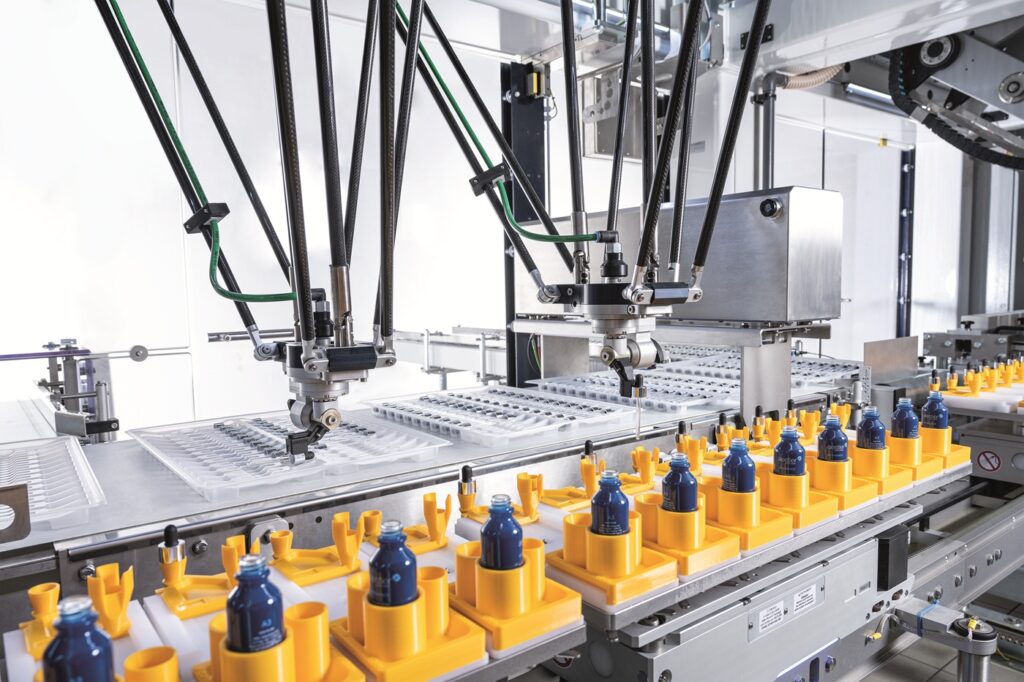
Take biscuit production, for example: once baked, crispy cookies or biscuits leave the oven, wide conveyor belts most often take them straight to the packaging process, where they quickly encounter their first special type of machine. Biscuits are rarely packaged as loose goods in bags; the market is dominated by packaging that combines trays and flowpacks. So how do biscuits end up in the tray? It’s quite simple: a robot – usually a so-called F4 or T4 – picks up each biscuit individually and places it precisely into a tray cavity, usually working in a ‘team’ with other robots of the same type.

Pick & place – the premier league
These packaging robots specialise in the gentle, fast picking and placing of products of any shape or consistency, as well as the processing of packaging materials. F2 and F3 robots, for example, achieve great results: they can precisely erect flat blanks for a wide variety of packaging formats, place pre-grouped products into cardboard or plastic packaging and close them securely.
Schubert laid the foundation for all these developments back in 1981 with the first four-axis robot, the SNC-R1, also known as ‘Roby’: Gerhard Schubert designed the machine for packaging individual products into trays or boxes. In 1984, the model automated a chocolate packing line for the very first time, paving the way for further developments, one of which set new standards in the same year. The SNC-F2 marked the beginning of the successful automation journey for a technology that has been used in thousands of installations worldwide to successfully package products in the most varied sectors. This advance made it possible to erect, fill and seal cartons with a single robot and the corresponding tools.
F robots are based on the SCARA principle. The acronym stands for ‘Selective Compliance Assembly Robot Arm’ and, put simply, refers to ‘one-armed’ robots. Their special arm geometry gives them high rigidity in the vertical direction, while allowing them to remain flexible in the horizontal plane. As a result, they require little space and have a large radius of action, which is especially advantageous for wide conveyor belts.
On the subject of space requirements, T3/T4 and T5 robots, which are based on the delta robot type, are also extremely compact. Resourceful engineers developed this technology in the 1980s at the École Polytechnique Fédérale de Lausanne (EPFL). Classic delta robots have at least three parallel arms that are attached to the top of the frame and connected to a motor; grippers are located at the lower end of the arms. The triangular arrangement of the arms resembles the Greek letter delta (Δ), which is how the robot type got its name.

Seamless efficiency with the Transmodul
Packaging lines can run this reliably because there’s a simple structure that links robots for different steps – such as setting up blanks, gluing and sealing – and which has very little in common with previous solutions. Without it, the entire process would come to a standstill. After all, filled trays or other packaging materials have to be transported to the respective systems.
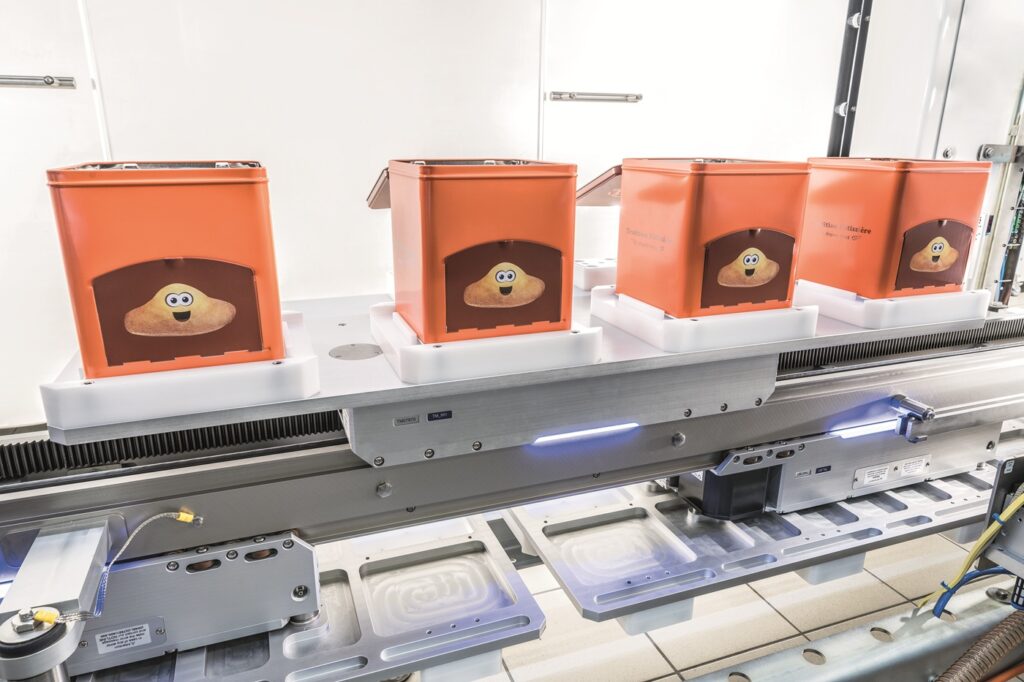
Anyone thinking of conveyor belts here is mistaken. Especially in cartoning and multipack lines around the world, a compact platform travels back and forth on a track between the system components. Its cargo may include erected carton bases, metal cans, individually packaged products or ready-made secondary packaging – in short, anything that needs to be moved within the line. Of course, we’re talking about the Transmodul, another innovation from Crailsheim.
The Transmodul transport robot has been travelling along a successful, continuous journey in packaging lines since 2009. It is used in lines that handle multiple packaging formats – i.e. not only different box formats, but also tin cans or plastic crates, for example. This requires flexibility, which the extremely agile Transmodul delivers. A vacuum blower holds packaging materials or products securely in place. This is ensured in no small part thanks to product-specific format plates on the transport surface. To set up a new packaging format, you simply need to change the format plate.
When it comes to process reliability, the Transmodul has an ace up its sleeve that classic transport chains lack: if a Transmodul fails, it can be quickly replaced by another one – or the line can continue packing with one less Transmodul. It never comes to a standstill. When they reach the end of their route, something fascinating happens: unloaded Transmoduls tilt sideways and travel back to the starting point on the underside of the track – creating a continuous cycle.
Beyond the line itself
Of course, there is much more going on within the line. But it is also worth taking a look outwards. Robots can take on upstream tasks and transport lightweight products via pick & place, for example. Cobots – short for collaborative robots – often work in close proximity to humans. Depending on their speed and range of motion, they are located within a safety cell so that humans and machines cannot interfere with each other.
What makes the cobot so unique is that it combines state-of-the-art robot technology with AI-supported image processing. The vision system, which is ‘trained’ in advance with images, enables cobots such as Schubert’s tog.519 to quickly find individual products, even in unsorted piles, pick them up and move them to a different location. Thanks to intelligent image recognition, the tog.519 can even pick up products that it sees for the first time. As an entirely autonomous system, the mobile cobot can be positioned virtually anywhere – in front of or behind a machine, as a stand-alone robot line or as automation between two stations.
Gentle gripping
A cobot, an F4 or a T4 would only be half as impressive if they didn’t also work gently. Like all robots that pick up and place products, they have so-called end effectors specifically for this purpose. Gripping or suction tools tailored to the product are suitable for packaging robots. Gripping tools hold objects in place with mechanical fingers or jaws. Direct physical contact allows them to hold even heavy or irregularly shaped products securely – regardless of their surface. The disadvantage is that they can damage sensitive products.
This is why baked goods, for example, are usually picked up by robots using suction tools. These tools create a controlled vacuum that causes lightweight products with smooth, air-impermeable surfaces to adhere to the tools. Schubert uses sensors to continuously monitor the flow rate in the vacuum system. This allows them to determine whether or not the suction tools are holding the products – an important prerequisite for precise, complete production. Once suctioned or gripped, products, blanks or parts can be processed further – as gently as only a robot can.
Website: www.schubert.group