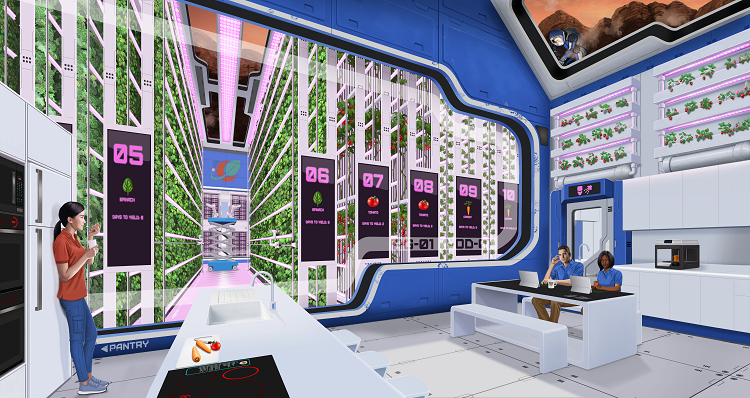
Vertical Future, a leading vertical farming company, will spearhead a UK Space Agency project alongside international experts in plant biology and space technologies. Collaborating with partners such as Axiom Space, Saber Astronautics, and renowned universities, including the University of Southern Queensland, the University of Adelaide, and the University of Cambridge, the project aims to develop a fully autonomous agricultural system for future space exploration endeavors.
In Phase One of the project, the focus will be on researching the design requirements of this autonomous system, which will be capable of remote monitoring and operation using artificial intelligence. The goal is to create a system that can support space missions like the future Moon-to-Mars Artemis missions.
Phase Two entails implementing the controlled environment agriculture (CEA) system on the International Space Station (ISS) and the world’s first commercial space system, currently being developed by Axiom Space. The Axiom Station is set to replace the ISS once it reaches the end of its life cycle.
Vertical farming, a type of CEA, utilizes technology to create controlled environments for plants. This approach aims to enable year-round cultivation with reduced agricultural inputs and lower carbon emissions compared to traditional open farms.
The importance of providing plants for space travel and future settlements in order to ensure long-duration survival is emphasized by Dr. Jason Held, CEO of Saber Astronautics. He believes that achieving successful plant growth in space requires a collaboration of experts in botany, engineering, and operations.
Dr. Jennifer Bromley, chief scientific officer at Vertical Future, expresses her excitement about the project, noting that the co-developed technology will be transformative. Access to high-quality fresh produce is crucial for both nutrition and mental well-being, and astronauts typically lack variety in their diets while in space. This project aims to solve this issue by providing a wide range of high-quality produce that can be grown on a space vessel.
Dr. Bromley emphasizes the need for innovative ways to help astronauts thrive and survive not only on the Moon but also on Mars and beyond. She highlights the potential for applying the findings from this project to technological advancements on Earth, further advancing Vertical Future’s technologies.
This partnership with the Australian Research Council (ARC) Centre for Excellence in Plants for Space research center is not Vertical Future’s first venture into outer space exploration. They previously collaborated to investigate the cultivation of water spinach using vertical farming technology, both on Earth and beyond. The project aims to reduce the size of water spinach, control its nutritional parameters, and shorten its lifecycle through various approaches, including investigating environmental conditions, growth regulator treatments, and gene-editing technologies.
By bridging the gap between vertical farming and space exploration, Vertical Future and its partners are paving the way for sustainable and nutritious food production in space. The project’s outcome will not only benefit astronauts but also provide valuable insights and technologies for the food and beverage industry on Earth.