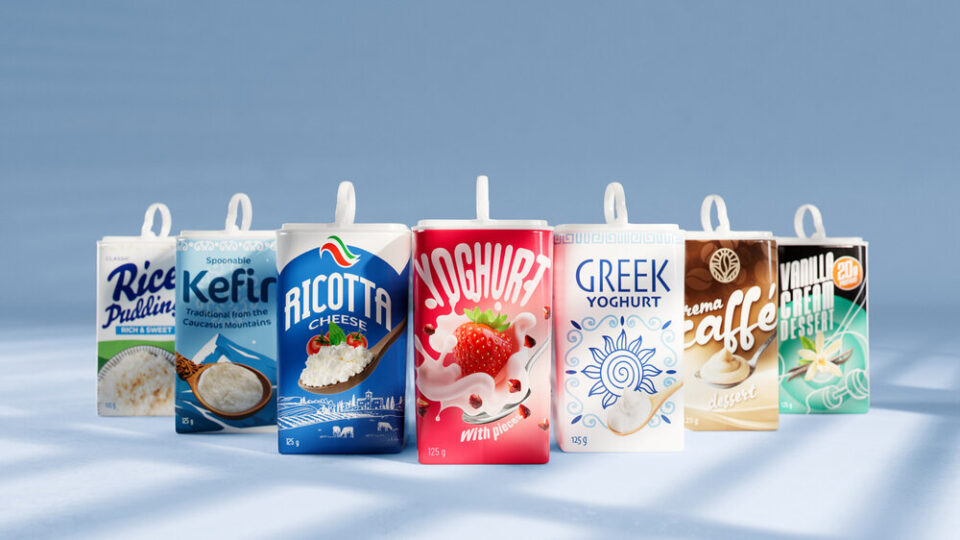
Tetra Pak has introduced Tetra Reva, a paper-based carton designed for spoonable foods. The company describes the format as one of its most important recent packaging developments, extending its portfolio into a new product category.
The carton is intended for yogurt, pudding, desserts, plant-based alternatives and soft cheeses, including cottage cheese, ricotta and mascarpone. Its format provides brands with an alternative to the traditional pot while responding to wider food and beverage industry trends.
Standing apart from the standard pot
Tetra Reva uses a square profile to create a clear visual difference from the round containers commonly found in chilled food aisles. The shape also provides a broad surface for brand identity, product information and food and drink marketing.
Its filling technology is suitable for both chilled production and high-acid ambient applications. According to Tetra Pak, this gives manufacturers greater choice when planning production and adapting to evolving food manufacturing trends.
A simpler opening experience
The package features a complete top opening, allowing consumers to use a spoon directly from the carton. Its small lid is designed to support convenient consumption at home, at work or while travelling.
A pull-ring provides access to the product. Tetra Pak says that by placing a finger through the ring and pulling, the lid opens “simply and smoothly in one satisfying movement”. The company says this offers an advantage over conventional foil closures, which can be challenging to hold and may split or tear during opening.
In initial consumer testing, participants responded positively to the package’s appearance, durability and ease of use, Tetra Pak reports.
Designed for evolving product preferences
Tetra Pak is launching the format as demand grows for protein-focused yogurt, spreadable cheese and plant-based foods. The carton can accommodate a broad selection of recipes and consistencies, including dense, high-protein yogurt and desserts containing fruit pieces.
Tatiana Liceti, executive vice president, packaging solutions at Tetra Pak, said: “Our new Tetra Reva™ solution represents a major step forward for Tetra Pak and for the spoonable food category. As the world’s first globally available, industrialised paper-based packaging solution for yogurt, desserts and soft cheeses, it gives producers a new opportunity to deliver these products to consumers in an innovative and distinctive format.”
She added: “This is an exciting and fast-evolving category. Protein-rich yogurts are increasingly consumed as meals, new varieties of spreadable and flavoured cheeses are reaching the market, and consumers are exploring a broader range of plant-based products, textures and flavours.”
Expanding paper-based packaging
The launch forms part of Tetra Pak’s wider strategy to increase the role of paper-based materials in food and drink packaging. The company plans to invest about €100 million each year through 2030 in paper-based packaging development. Its work includes formats with fewer material layers and a higher proportion of renewable content, supporting priorities linked to food and drink sustainability.
These developments also reflect the growing influence of food processing technology, food and drink regulations and food distribution trends on packaging design. As producers seek solutions that can meet operational, environmental and logistical requirements, paper-based formats are becoming an increasingly important area of food and drink industry innovation.
Liceti said: “By bringing our expertise in paper-based packaging into spoonable foods, we are opening a new chapter for our customers, consumers and Tetra Pak.”
Positioned for the next stage
For dairy and dairy-alternative manufacturers, Tetra Reva creates a paper-based option in a category traditionally dominated by pots. The format combines shelf differentiation with filling flexibility and a pull-ring opening designed to improve convenience.
Its development also reflects changing food and drink consumer trends, from the rise of protein-led products to greater interest in plant-based recipes and varied textures. Alongside the company’s ongoing investment, the launch indicates that paper-based packaging will continue to feature prominently in future food manufacturing trends and the broader evolution of the sector.