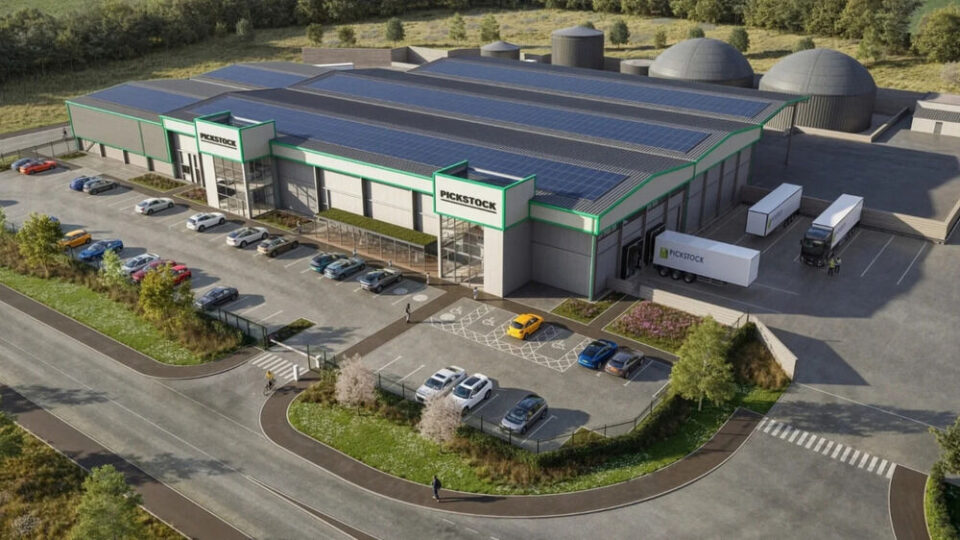
Pickstock Telford has begun work on a beef processing plant valued at more than £24 million in Ecclefechan, Dumfries and Galloway. The development will establish a new Scottish base for the company, strengthen its regional supply network and expand its investment in processing capacity, advanced technology and lower-carbon operations.
The project represents more than an additional production site. It will give Pickstock a permanent presence in one of Scotland’s key farming areas, enabling the business to bring its integrated supply-chain model closer to local beef producers.
Construction started on 16 September following £4.7 million in support from South of Scotland Enterprise (SOSE). The facility is scheduled to begin operating in early 2029.
Strengthening links with Scottish farmers
The plant’s location will bring Pickstock closer to its Scottish agricultural supply base, creating opportunities to build deeper and more consistent relationships with farmers.
According to the company, the Ecclefechan operation will support longer-term partnerships with Scottish producers and help retain a greater share of the value created by Scottish beef within the rural economy.
This approach reflects Pickstock’s broader Integrated beef model, which combines contracted farms, agreed production standards and data collection. Together, these measures are designed to improve product consistency, traceability and environmental performance throughout the supply chain.
Processing cattle closer to the farms that supply them should also give Pickstock greater oversight from farm through to processor while cutting livestock transport distances. For a business serving retailers, foodservice customers and other buyers seeking reliable British beef supplies, a closer connection between production and processing can strengthen its commercial offering.
Creating room for future expansion
The investment will provide Pickstock with another platform for growing its processing activities.
The company already operates facilities with the capacity to process as many as 500 cattle each day and debone up to 8,000 quarters per week. Its operations also span retail and foodservice markets.
Ecclefechan will extend that existing footprint while adding purpose-built infrastructure designed around modern production requirements. Rather than adapting an ageing site, Pickstock can develop the facility to reflect current expectations for food processing technology, energy management and supply-chain efficiency.
The new plant should allow the company to expand its Scottish sourcing network as demand and volumes increase. It also creates scope to align production systems with wider food manufacturing trends, including stronger traceability, improved resource use and more flexible customer supply.
Designing a lower-carbon operation
Energy provision is a central part of the planned development.
The facility is expected to include anaerobic digestion, combined heat and power systems and solar generation. These solutions should help produce renewable energy, improve resilience and reduce dependence on external energy supplies. In addition, locating the plant closer to Scottish farms should limit the distances livestock travel.
The combination of efficient processing and renewable generation will support Pickstock’s broader environmental objectives. It also reflects the growing importance of food and drink sustainability across the sector, as manufacturers respond to customer expectations and pressure to reduce emissions.
Pickstock already places sustainability, animal welfare and efficient resource use at the centre of its integrated beef strategy. At Brongain Farm, the company is testing commercially practical methods for reducing environmental impact while working towards a Net Zero target by 2030.
The Ecclefechan project will extend those principles beyond the farm and into the processing environment.
Embedding technology into the new facility
The development will allow Pickstock to introduce modern production systems as the business expands its Scottish operations.
Greg Pickstock, managing director of Pickstock Telford, said the company intends to use technology investment and continuous improvement to create a more resilient and sustainable food supply chain.
The site will need to deliver more than basic cattle processing. Pickstock’s existing business model brings together processing, traceability, product development, packaging expertise and supply-chain management, supported by its partnership with OSI.
As a result, the Scottish plant can become an important part of the company’s wider manufacturing network. Its design may also support evolving requirements linked to food and drink packaging, product specifications and customer demand, alongside the broader direction of food and drink industry innovation.
Developing local skills and employment
The project will create employment and provide a foundation for developing specialist skills in the region.
Approximately 250 jobs are expected to be supported during construction, while around 90 permanent roles are forecast once the facility opens. The project is also expected to generate about 40 apprenticeship opportunities across both the construction period and the operational phase.
This will enable Pickstock to build a local workforce with expertise in contemporary beef processing and related technical disciplines. The company plans to combine established industry knowledge with modern production capabilities as the Ecclefechan operation takes shape.
Developing those skills locally should benefit both the facility and the wider regional economy, particularly as food manufacturing employers respond to changing food and beverage industry trends.
A foundation for Pickstock’s next phase
The Ecclefechan investment brings several strategic benefits together. It will strengthen Pickstock’s relationships with Scottish livestock producers, increase processing capacity, reduce livestock travel distances, add renewable energy capability and create opportunities to develop a new workforce.
Because the facility will not be operational until early 2029, its immediate importance lies in the platform it creates rather than in any short-term production increase.
However, construction will offer a clear indication of how Pickstock plans to expand its integrated beef model. The project brings together farmer relationships, processing technology, traceability, energy efficiency and customer requirements within the wider British beef supply chain.
Its development will also take place against a backdrop of changing food distribution trends, evolving food and drink regulations, shifting food and drink consumer trends and growing demand for responsible food and drink marketing.