Industry Insight: The defining change in transport and logistics is not one breakthrough technology or regulation, but convergence. Customs data, cold-chain monitoring, route planning, warehouse automation, vehicle charging and workforce management are becoming parts of the same digital operating environment. That matters particularly in food and beverage, where a late vehicle is rarely just a transport problem. It can shorten shelf life, disrupt production, increase storage costs, compromise temperature integrity and leave customers without stock. The logistics businesses creating an advantage are therefore moving beyond visibility towards prediction: knowing not only where goods are, but what is likely to happen to them next — and having systems capable of responding before disruption becomes loss.
Food and beverage logistics is entering a new phase. Border processes are preparing for another major reset, trade documentation is moving online, artificial intelligence is reaching warehouses and cold chains, and fleet electrification is becoming a practical investment decision rather than a distant ambition. For manufacturers and logistics operators, resilience increasingly depends on connecting these changes rather than managing them separately.
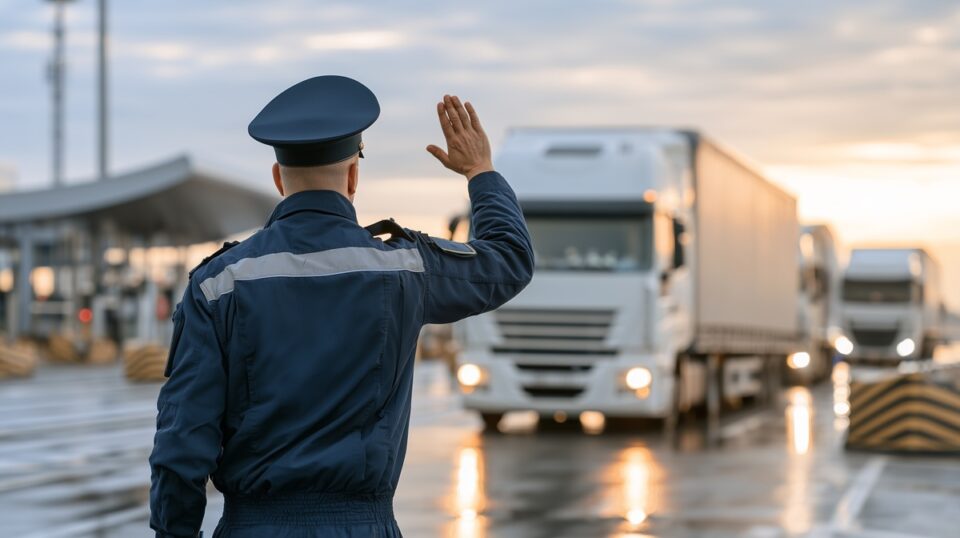
For food businesses trading with Europe, border management remains one of the biggest areas of change.
The Border Target Operating Model transformed the way sanitary and phytosanitary goods entering Great Britain from the EU are handled, introducing risk-based controls, pre-notification and additional documentary and physical checks.
Yet the system manufacturers are operating today is already heading towards another major change.
The UK Government and European Union are negotiating a new Sanitary and Phytosanitary agreement covering plants, animals, food and feed. The Government currently intends the agreement to take effect in mid-2027, although the exact timing remains dependent on negotiations.
For food supply chains, its significance is considerable.
Under the planned arrangements, dairy products, fish, eggs, meat, plants and plant products moving between Great Britain and the EU are expected to cease requiring routine SPS border checks. Many export health certificates and phytosanitary certificates are also expected to disappear. Customs controls, however, will remain.
That distinction is important.
The next border model is not a return to pre-Brexit frictionless trade. Instead, food manufacturers will potentially face fewer veterinary and plant-health formalities while continuing to operate within customs, origin, fiscal and data requirements.
The agreement will also involve Great Britain applying certain EU SPS and related agrifood rules. Areas identified as being within scope include food and feed safety, nutrition and health claims, food labelling, organics, compositional standards, pesticides and biocides.
Logistics departments therefore need to resist the temptation to treat mid-2027 simply as a date when paperwork disappears. Product master data, supplier information, certification workflows, customs systems and responsibilities between manufacturers, freight forwarders and customs intermediaries will all need reviewing.
There is another twist.
The long-promised UK Single Trade Window, intended to allow traders to supply border information through a single gateway, was paused for 2025 and 2026 because of affordability considerations. Instead, Government attention is increasingly shifting towards improving existing digital customs processes.
HMRC has subsequently confirmed work on electronic trade documents, digital verifiable credentials and trials examining how artificial intelligence could assist customs officers with real-time documentary checks.
For manufacturers, the lesson is becoming clear: the future border may involve fewer physical interventions, but it will depend more heavily on accurate, structured and shareable data.

Paper Starts to Disappear: Digital Trade Becomes Operational
For decades, international logistics has combined sophisticated physical infrastructure with surprisingly old-fashioned administration.
A container may be tracked by satellite, transferred by automated handling equipment and delivered using algorithmic route planning — while critical documents still travel through email attachments, courier packages or manually re-entered spreadsheets.
That disconnect is beginning to close.
The Electronic Trade Documents Act gave qualifying electronic trade documents the same legal recognition and functionality as their paper equivalents in the UK. Bills of lading and other documents can therefore be transferred electronically where the necessary controls over authenticity and ownership are met.
The more important development now is implementation.
In July, the Department for Business and Trade published details of its Digital Trade Corridors programme, which has tested digitalised trade processes on live routes involving countries including France, Germany, Japan, Taiwan and New Zealand. The programme is specifically examining how secure electronic documentation can remove paperwork and reduce delays caused by document errors.
Government guidance cites trials where digitalisation reduced overall trade processing time by 40%, increased staff productivity by 67% and dramatically reduced paper and email traffic.
Digital ATA Carnets also went live in the UK on 1 June, part of an international transition towards electronic carnets that the International Chamber of Commerce aims to complete by the end of 2027.
Although carnets themselves are a relatively specialist part of food logistics, the direction of travel is much broader.
The business case for electronic documentation is not about becoming “paperless” for its own sake. It is about removing duplicate data entry and creating information that can flow automatically between manufacturers, carriers, customs agents, ports and customers.
That opens the door to something much more valuable: exception-based management.
Instead of staff manually checking every movement, systems can identify the consignment with the missing certificate, unusual commodity code, delayed vehicle or incomplete customs record and direct attention towards the problem.
For high-volume manufacturers, reducing human intervention in routine shipments can potentially be as important as reducing physical journey time.
The Cold Chain Starts Thinking: AI Moves Beyond Route Planning
Artificial intelligence has been discussed in logistics for years, but its application is becoming considerably more practical.
DHL’s current Logistics Trend Radar identifies artificial intelligence, advanced analytics, computer vision, robotics, the Internet of Things and digital twins among the technologies expected to reshape logistics operations.
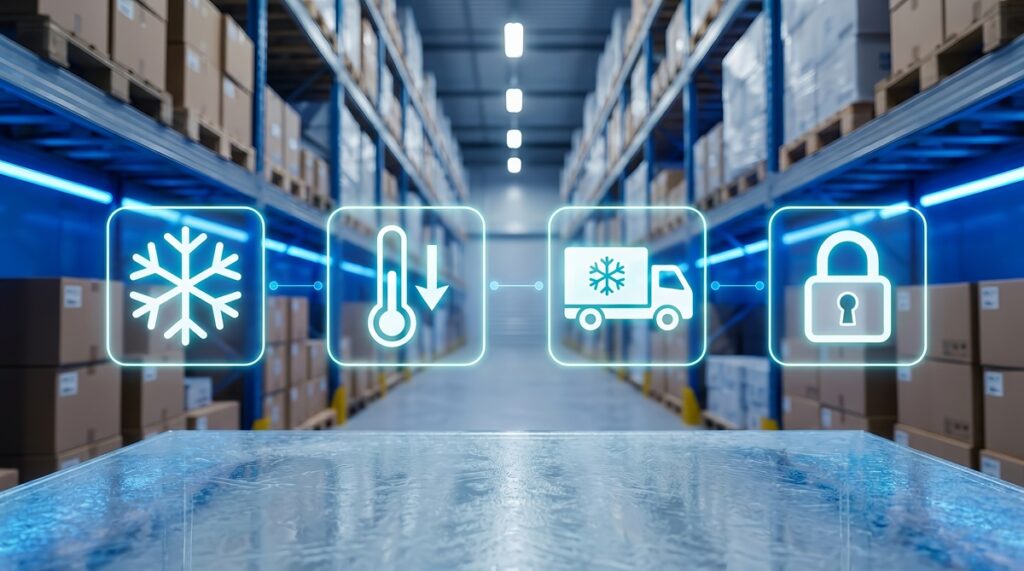
For food and beverage companies, the opportunity is particularly strong in temperature-controlled supply chains.
Traditional telematics tells an operator that a refrigerated vehicle is at a particular location and its load space is at a particular temperature.
The next generation of systems combines multiple streams of information.
Temperature, humidity, door openings, refrigeration performance, traffic conditions, estimated arrival time, warehouse capacity and potentially product shelf-life data can be analysed together.
The question therefore changes from “Is the trailer cold enough?” to “Is this consignment likely to arrive in specification with sufficient remaining shelf life?”
That is a far more valuable question.
Advanced analytics can identify deteriorating refrigeration performance before a load is compromised. Estimated arrival times can continuously update production and warehouse schedules. A delayed short-life product can potentially be redirected to a nearer customer. Stock allocation can change before a vehicle reaches the distribution centre.
Digital twins extend the same idea further by creating virtual representations of physical assets or processes that reflect their real-world conditions. These models can be used to visualise operations, diagnose problems, predict outcomes and test potential changes without interfering with the physical system itself.
Within warehouses, computer vision can track products and assets, identify handling errors and support automated inspection, while autonomous mobile robots increasingly move pallets, cases and ingredients between storage, picking and dispatch operations.
The ROI argument is consequently changing.
Automation is no longer solely about replacing labour or increasing warehouse throughput. In food logistics, it can also protect shelf life, improve traceability, reduce picking errors, prevent rejected deliveries and help businesses make better use of expensive refrigerated capacity.
The companies that gain most from AI may therefore not be those buying the most sophisticated algorithms. They will be the businesses with sufficiently clean and connected operational data for those algorithms to use.
The Labour Problem Changes: From Driver Shortage to Capability Gap
The UK logistics workforce has not suddenly ceased to be a concern, but the nature of the problem is changing.
Logistics UK’s Employment and Skills Report argues that the challenge is increasingly moving from simply finding enough workers towards ensuring businesses have people with the skills required to operate a more automated and digitally dependent logistics industry.
There is still an uncomfortable demographic problem. 61.6% of HGV drivers are aged 45 or over, according to Logistics UK’s analysis, while almost half of warehouse managers are also within that age group.
But recruitment alone cannot solve what comes next.
Drivers increasingly interact with telematics, digital delivery systems, route optimisation, electronic compliance records and electric vehicle technologies. Warehouse teams work alongside increasingly sophisticated warehouse management systems, automated picking technology and robotics.
Transport managers are simultaneously being asked to understand customs compliance, carbon performance, vehicle charging, data analytics and increasingly integrated supply-chain platforms.
Automation does not therefore remove the workforce issue. In many cases it changes which skills are scarce.
That makes implementation strategy particularly important.
Buying an automated warehouse system without investing in the employees who operate, maintain and interpret it can simply exchange one constraint for another.
For manufacturers assessing automation projects, training requirements, maintenance capability, systems integration and change management should sit alongside headline calculations for labour saving and throughput.
Electric Freight Gets Real: The Question Shifts to Infrastructure
Fleet electrification is also moving beyond pilot schemes.
The Government announced a £1 billion support package in March covering zero-emission truck and van grants alongside investment in depot charging.
For the heaviest eligible zero-emission HGVs, operators can receive support worth up to £81,000 per vehicle, capped at 40% of the purchase cost. Grants for eligible electric vans extend to £5,000.
Perhaps more significant for larger food fleets is the Depot Charging Scheme.
Businesses and public authorities can receive support towards charging infrastructure for vans, coaches and electric HGVs, potentially covering up to 70% of eligible costs and reaching £1 million for larger installations.
This addresses a fundamental problem with electric freight: purchasing the vehicle is only half the project.
A refrigerated truck also needs to move payload while potentially supplying energy to temperature-control equipment. Depots must consider grid connections, charging windows, vehicle dwell time, simultaneous charging demand and future fleet expansion.
The decision therefore becomes a site-energy and logistics-planning exercise rather than simply a vehicle procurement exercise.
Policy remains fluid too.
The Zero Emission Vehicle Mandate currently sets a 2026 target under which 24% of manufacturers’ new van registrations should be zero emission. However, on 14 August 2026, the Government launched a fresh review of the mandate, with consultation running until 23 October as it considers the pathway towards zero-emission new cars and vans by 2035.
Operators planning fleet replacement should consequently model several scenarios rather than assuming today’s incentives and vehicle economics will remain unchanged.
Urban charging has also become less about rapidly multiplying Clean Air Zones than managing an established patchwork. England currently has seven charging Clean Air Zones: Bath, Birmingham, Bradford, Bristol, Portsmouth, Sheffield and Tyneside.
London continues to operate separately. Its Congestion Charge rose from £15 to £18 a day from 2 January 2026, while qualifying electric vans and HGVs registered for Auto Pay currently receive a 50% Cleaner Vehicle Discount rather than the former complete exemption.
Again, the operational message is that electrification should be evaluated route by route.
A vehicle covering predictable depot-to-depot journeys may offer a very different payback from one operating irregular long-distance refrigerated routes.
Resilience Becomes Measurable: From Moving Goods to Managing Decisions
The most important development across transport and logistics may ultimately be invisible.
Border reform, electronic documentation, AI, telematics, automation and electrification are all producing data.
Used individually, each can improve a particular process.
Connected together, they begin to create a supply chain capable of making better decisions.
A manufacturer could know that an inbound ingredient shipment has cleared documentary requirements, see that its ferry is delayed, calculate the effect on factory arrival time, automatically adjust the production schedule and allocate another load to the vacated unloading slot.
A chilled distributor could identify that a vehicle delay threatens remaining product life and redirect stock before it reaches the original depot.
A fleet system could combine planned routes, electricity tariffs and charging capacity to determine which electric HGV should undertake which journey and when it should recharge.
This is where transport technology becomes strategically important.
The goal is no longer simply to move goods more efficiently. It is to reduce the time between something changing and the business responding.
Food and beverage supply chains will always face disruption. Weather, geopolitics, border policy, vehicle availability, labour and customer demand cannot all be controlled.
What businesses can increasingly control is how quickly they see disruption coming — and what they do next.
That may ultimately be the biggest logistics transformation of all.
What is changing with UK-EU food border controls?
The UK and EU are negotiating a new SPS agreement expected to take effect from mid-2027. Routine SPS checks and much certification for many agrifood products moving between Great Britain and the EU are expected to be removed, although customs controls will remain.
What technology is having the biggest impact on food logistics?
Artificial intelligence, advanced analytics, IoT sensors, computer vision, robotics and digital twins are increasingly being combined to improve forecasting, warehouse automation, asset tracking, route optimisation and cold-chain visibility.
How can AI improve the cold chain?
AI can combine temperature and condition data with traffic, journey time, equipment performance and inventory information to identify risks earlier. Rather than simply recording a temperature breach, predictive systems can help operators intervene before product quality is affected.
What support is available for electric HGVs?
Eligible zero-emission trucks over 26 tonnes can currently receive grants of up to £81,000 or 40% of the vehicle's purchase price, while the Government is also supporting depot charging infrastructure.
Is the UK logistics industry still suffering from a driver shortage?
Recruitment remains important, but Logistics UK says the challenge is increasingly becoming a skills and capability issue. An ageing workforce must also adapt to telematics, automation, digital compliance systems and increasingly sophisticated logistics technology.