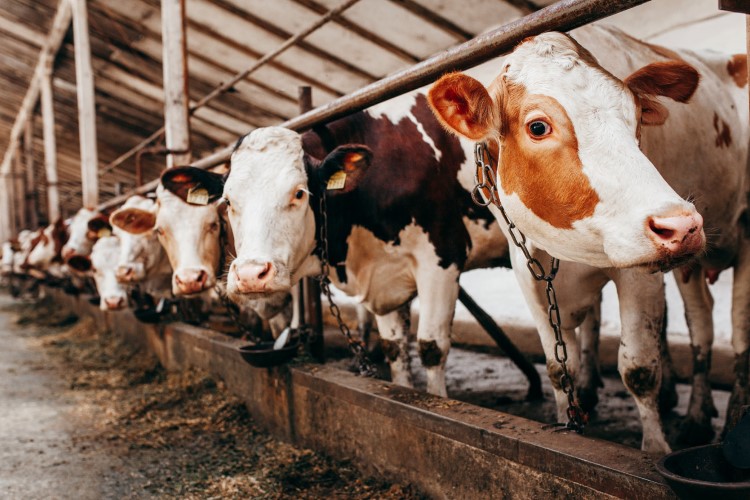
A team of experts in animal and dairy sciences, mathematical modelling and statistics, and building design engineering from the British universities of Reading, Essex, Cardiff and Writtle University College have come together to carry out a £1.24m first-of-its-kind project aimed at addressing heat stress in dairy cows. The study evaluates the relationship between barn microclimates and the animals’ physiological status, focusing on the combination of temperature, humidity, air quality and ventilation. While prior research has already established the negative correlation between hot weather and cow welfare, this research project seeks to provide granularity and uncover unprecedented detail about how environmental factors affect animal health.
Low productivity and behavior changes are common in cattle experiencing heat stress. The Biotechnology and Biological Sciences Research Council is funding the three-year study, which will be conducted at the University of Reading’s Centre for Dairy Research (CEDAR) and six commercial dairy farms across the UK. The UK Agriculture and Horticulture Development Board (AHDB), The Dairy Group, Etex, Innovation for Agriculture, and Map of Ag, in addition to the UK government’s Department for the Environment, Food and Rural Affairs, are all supporting the consortium.
The project relies on bespoke tracking and sensing technology provided by Cambridge-based companies, Smartbell and Omnisense, to offer unprecedented detail about the physical condition of each cow, enabling the researchers to piece together how different barn environment variables affect animal health. Environmental sensors across the barn will measure temperature, humidity, carbon dioxide and ammonia concentrations, and air flow, while Smartbell technology will provide a proxy for body temperature and activity for every cow. Omnisense will offer position and activity of each cow every few seconds, generating data that can be used to monitor the types of behaviors the animal undertakes, such as feeding, lying or standing, and their physiological status.
The project aims to share the findings with the industry steering group and farmers through an online dissemination event towards the end of the study. The team of investigators hopes to co-design potential mitigation measures with the groups of farmers they are working with throughout the study. This way, they can offer useful results to the industry as soon as possible. The six commercial farms in the south and west of the UK have diverse building design features and were chosen to take part in the study by steering group members.
Precision livestock technologies are already showing significant benefits to farm economics and aiding decision-making and animal welfare. The adoption of improved monitoring systems will offer valuable input to all producers, early detection of disease, oestrus detection, and feeding behavior, are all important factors for milk production. Dr Jonathan Amory, a principal lecturer in animal behaviour and welfare at Writtle University College, who concluded this research project, believes that the climate crisis is bringing new challenges to animal welfare, and through the use of new technology and industry collaboration, innovative solutions for improving livestock management can be developed.