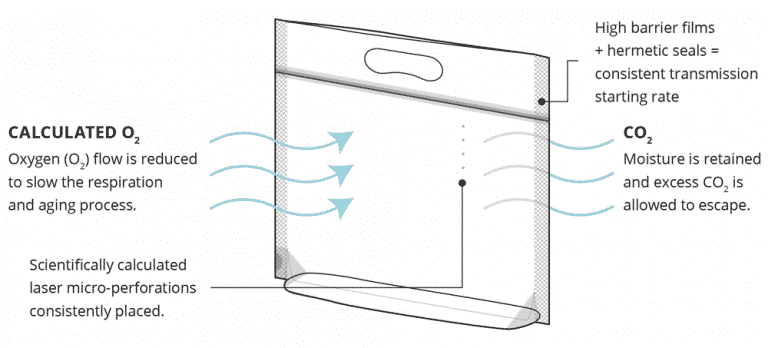
Up to 40% of the fresh produce harvested worldwide is never consumed. Even in industrialised markets, post-harvest losses typically remain between 10% and 20%.
The problem is rarely limited to crop yields or weather conditions. Significant losses occur during the stages that follow harvesting, when poor handling, deterioration and unsuitable packaging reduce product value. These challenges affect both environmental performance and commercial profitability. Intelligent laser perforation technology is now emerging as a practical way to address them.
Understanding the role of modified atmosphere packaging
Harvesting does not end the biological activity of fruit and vegetables. Fresh produce continues to respire, taking in oxygen and releasing carbon dioxide. This metabolic process gradually reduces quality during storage and distribution. Ethylene, a naturally occurring plant hormone, further accelerates ripening and eventual deterioration, creating a narrow window in which products must reach consumers.
Modified atmosphere packaging (MAP) helps extend that window by managing the gases within a sealed pack. By regulating the internal balance of oxygen and carbon dioxide, MAP can slow respiration, limit ethylene-related ageing and reduce microbial spoilage without relying on chemical preservatives.
Research into perforation-based MAP for fresh-cut leafy vegetables indicates that, when storage temperatures are properly controlled, shelf life can reach eight days or longer. However, achieving consistent results depends on maintaining precise levels of O₂, CO₂ and ethylene inside each package. This level of control requires Laser Micro Perforation Technology.
How laser perforation improves packaging performance
Permeable polymer films have traditionally supported gas exchange in fresh produce packaging. Nevertheless, their fixed permeability characteristics can create challenges, including unreliable seals and inadequate transmission rates for products with high respiration levels. Laser microperforation addresses these limitations by forming accurately positioned openings in packaging that would otherwise remain gas-tight.
The size, quantity and form of each perforation determine how oxygen, carbon dioxide and ethylene move through the film. Unlike passive materials, laser-perforated packaging allows engineers to control these exchange rates with far greater accuracy. In addition, the mass-transfer ratio remains consistent across different perforation sizes, enabling reliable mathematical modelling.
As a result, packaging specialists can develop specific equilibrium atmospheres for different commodities. This capability supports the wider development of food and drink packaging, while also responding to food manufacturing trends that demand better product protection, lower waste and more efficient production.
Real-time inspection for consistent results
Design accuracy alone is not enough if the finished film does not meet specification at operating speed. Spark Machinery’s Laser Micro Perforation Machines use integrated camera-based inspection systems to assess every perforation as it is produced. The technology measures the diameter and shape of each opening continuously across the production line.
If a perforation falls outside the required profile, the system identifies the variation and makes an automatic correction before the material reaches the packing operation. This closed-loop approach turns perforation quality into a measured and traceable production result rather than an assumed outcome.
That capability is particularly valuable for suppliers working to retailer requirements, food safety standards and increasingly detailed food and drink regulations. It also reflects the wider influence of food processing technology and food and drink industry innovation on quality assurance and production control.
## Benefits for supply chains and sustainability
Extending shelf life by even one day can reduce the likelihood that fresh produce will be discarded. Across large-scale supply chains, those additional days can significantly lower food waste and improve commercial returns. Laser perforation also supports packaging circularity because it can provide the required gas-management function without relying on complex multi-layer laminates, which are often difficult to recycle.
This makes the process well suited to mono-material and recyclable packaging formats—an important consideration as retailers, regulators and consumers place greater emphasis on food and drink sustainability.
Longer-lasting products can also travel farther, reducing the need for frequent deliveries and allowing businesses to streamline inventory. More efficient refrigerated transport can help lower associated emissions. These advantages align with evolving food distribution trends, including broader delivery networks and increased demand for reliable cold-chain performance.
Retailers benefit through reduced shrinkage and improved availability on the shelf. Growers and packers, meanwhile, can reach more distant markets and strengthen their position in a competitive sector shaped by changing food and drink consumer trends. Together, these outcomes demonstrate how advances in packaging can support wider food and beverage industry trends, from operational efficiency to responsible resource use.
To explore how intelligent perforation systems could help reduce waste and extend shelf life within your supply chain, visit sparkmachinery.com or contact the Spark Machinery team for a technical consultation.