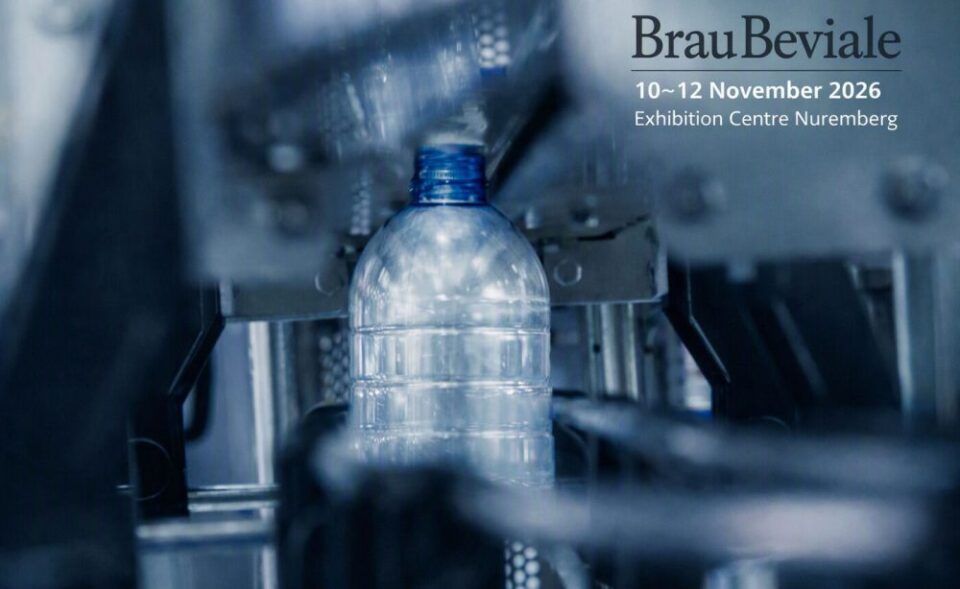
BrauBeviale 2026 will return to Nuremberg with eight halls dedicated to practical innovations that are ready for production. The event will showcase flexible fermentation, non-alcoholic processing, circular water management, lightweight reusable containers and advanced cleaning solutions for breweries, wineries and soft-drink manufacturers responding to mounting operational demands. Together, these technologies reflect key food and beverage industry trends, including efficiency, diversification and resource responsibility.
Addressing the realities of beverage production
Over three days and across eight exhibition halls, BrauBeviale 2026 will examine the everyday challenges confronting European beverage manufacturers and present technologies developed to address them.
A total of 769 exhibitors from 34 countries will represent the full process and production value chain, covering filling and packaging, logistics, handling and related services.
The exhibition’s structure follows the sequence of a contemporary beverage plant. As a result, visitors can move efficiently from primary processing through filling, packaging and distribution while assessing how different systems connect within an operating facility.
Markus Kosak, executive director of Yontex, captures the show’s ethos: “Many of the solutions at BrauBeviale do not start with abstract visions of the future, but with specific tasks in day‑to‑day operations.” Accordingly, the programme emphasizes flexibility, productivity and cost-effective production of new beverage varieties, from beer and wine to alcohol-free products.
The complete value chain across eight halls
Although every hall will focus on a different area, practical implementation remains the central message. Exhibitors will present systems that can connect with existing plant infrastructure, lower consumption of energy and water, and help manufacturers enter new categories without committing to extensive capital projects.
Key areas on display will include:
- Next-generation fermentation and biological processing equipment
- Modular tanks and flexible bypass systems
- Processing platforms for alcohol-free beverages
- Water treatment equipment and closed-loop water strategies
- Cleaning, hygiene and CIP developments
- Lightweight systems for reusable packaging
- Automated logistics and material-handling solutions
Across the event, the emphasis is on food processing technology and production solutions that manufacturers can apply today rather than concepts that may take years to reach the market. This practical approach also supports wider food manufacturing trends, including agile production and more efficient use of established assets.
Expanding production without replacing existing assets
Using current brewery infrastructure to create new fermented products will be one of the most notable themes in 2026. Many breweries already operate with stainless-steel vessels, controlled-temperature areas and teams familiar with biological processing.
A modular bypass platform at the exhibition will show how manufacturers can enter neighboring categories, including fermented foods, while avoiding a major plant reconstruction.
The external unit provides sterile aeration, controlled dosing, pH and temperature management, inline analysis, process-data capture and automation.
Because the system can connect to existing tanks in a flexible configuration, producers do not need to retrofit every vessel separately. For businesses seeking diversification, the arrangement offers a relatively low-risk way to add capacity and develop new product lines.
Building the non-alcoholic portfolio
Demand for non-alcoholic beverages continues to grow. BrauBeviale 2026 will therefore place substantial attention on equipment and processes that support expansion into 0.0% and low-alcohol categories.
More precise alcohol removal
One featured solution combines nanofiltration and fractional vacuum distillation to reduce alcohol content below 0.5% ABV in beer, wine, cider and other fermented drinks.
The technology operates through two complementary stages:
- Nanofiltration divides water and ethanol from sugars, acids, polyphenols and aroma compounds.
- Vacuum distillation extracts the ethanol while retaining volatile aromas and water, which can then be reintroduced into the beverage.
This approach helps manufacturers produce alcohol-free beverages with stronger flavour preservation and less exposure to heat-related quality loss. It also reflects food and drink consumer trends, as shoppers increasingly seek sophisticated alternatives without alcohol.
Dispensing systems designed around hygiene
Alcohol-free beer can create additional hygiene considerations during dispensing. One new system replaces the beverage line whenever a keg is changed, removing the requirement for traditional line cleaning and helping limit bacterial contamination. The solution could deliver significant benefits in high-volume hospitality environments.
Efficiency throughout the plant
Reducing resource use will be a defining priority at the 2026 exhibition. These developments align with food and drink sustainability goals while helping producers manage operating costs and meet increasingly demanding food and drink regulations.
Closed-loop water management
Beverage facilities produce several wastewater streams, each with a different level and type of contamination. A circular water system featured at BrauBeviale separates those streams, applies treatment suited to each one, and combines biological processing with ultrafiltration and reverse osmosis.
After treatment, the recovered water can support cooling towers, boiler make-up, rinsing, cleaning and other utility operations. This reduces reliance on freshwater and strengthens the sustainability profile of beverage manufacturing sites.
Reliable, efficient tank cleaning
Rotary jet cleaners can outperform static cleaning devices, provided that the jets maintain consistent movement. A patented optical sensor now checks rotation without physical contact, taking more than 1,000 readings each minute.
By confirming reliable operation, the technology may allow manufacturers to use rotary cleaning equipment in locations where safety concerns previously required static alternatives.
Packaging that combines lower weight with durability
Food and drink packaging will also receive major attention across the exhibition. New approaches aim to reduce material use, extend packaging life and improve the environmental performance of transport and reuse systems.
Advances in reusable glass
Thermally strengthened reusable bottles are moving closer to high-volume commercial production. Compared with conventional formats, they can weigh as much as 30% less, resist abrasion more effectively, last longer and generate fewer transport emissions.
For breweries and soft-drink manufacturers, the technology can support both packaging cost reductions and measurable progress in food and drink sustainability.
A lighter bottle for wine
A newly developed Rhine wine bottle weighs 350 grams, making it the lightest design currently available in Europe while retaining standard dimensions. Manufactured with 80% recycled glass, the bottle offers benefits in material efficiency, logistics and environmental impact.
Three days focused on immediate implementation
BrauBeviale 2026 is positioning itself as a working trade fair where beverage producers can meet technology partners, assess competing systems, discuss deployment requirements and identify ways to extend existing equipment. The event will also provide insight into food distribution trends, food and drink industry innovation and the operational priorities influencing food and drink marketing.
Whether manufacturers want to lower water consumption, improve cleaning performance, develop new product categories or reduce packaging weight, exhibitors across the eight halls will present solutions prepared for near-term use.
From 10 to 12 November 2026, the Nuremberg Exhibition Centre will serve as a meeting place for Europe’s beverage sector. The event will connect practical innovation with commercial priorities and help producers prepare for the next stage of industry development.