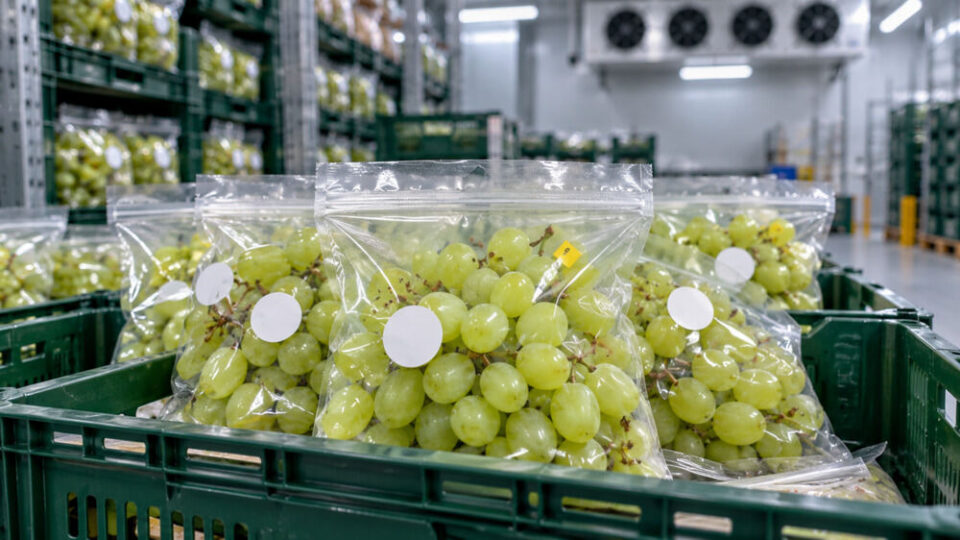
Table grapes often spend considerable time in refrigerated storage and transit before arriving at distribution centres and retail outlets. During this journey, quality can decline through rachis browning, fungal infection and physical defects, including berry shatter.
Fresh Inset conducted trials from 2022 through 2024 to assess how effectively Vidre+ could reduce these post-harvest losses. The work covered major European growing and retail markets in Italy, Greece, Spain and the United Kingdom.
The programme included 38 treatment variations and 354 matched comparisons with untreated controls. Researchers examined leading commercial cultivars, including Italia, Soultanina, Aledo, Dominga and Sweet Celebration. Testing took place across a range of storage environments and packaging formats, from loose bulk cartons to flow-wrapped retail punnets.
Nearly five additional days of marketable quality
Time-to-equal-quality shift modelling across the complete dataset found that Vidre+ increased the marketable life of table grapes by an average of 4.95 days. This equates to an overall extension of approximately 35%.
The treatment delivered measurable improvements across several important quality indicators:
- Berry integrity and shatter: Vidre+ postponed berry shatter and mechanical damage by an average of 10.5 days, representing a 65% improvement over untreated grapes.
- Rachis quality: Stem browning, an important visual measure of freshness for retailers and buyers, was delayed by 5.6 days, or 35%.
- Decay management: The appearance of post-harvest fungal decay caused by Botrytis cinerea and Mucor spp. was delayed by an average of 4.8 days, equivalent to a 28% improvement.
Separate consumer-facing retail evaluations in the UK, using Sweet Celebration punnets, showed that Vidre+ could preserve visual purchase appeal for up to two additional days.
These findings align with wider food and beverage industry trends focused on reducing waste, improving cold-chain performance and extending product quality. They also support the role of food processing technology and food and drink sustainability initiatives in delivering more efficient fresh-produce supply chains. As food distribution trends, food and drink packaging requirements and food and drink consumer trends continue to evolve, technologies that protect quality without changing established handling systems can provide commercial value.
Trial design and consistency of results
The study measured overall commercial performance rather than highlighting only the strongest individual results. The statistical model incorporated both favourable and unfavourable treatment outcomes to provide a broader assessment of operational effectiveness.
Results remained stable across several averaging approaches, including equal weighting at trial level, median calculations for each variant and pooled comparisons across the full dataset. In each case, Vidre+ extended marketable life by between 4.6 and 5.7 days.
This consistency demonstrates that the technology performed reliably across different microclimates, grape varieties and packaging configurations. It also reflects the growing importance of food and drink industry innovation, alongside developments in food and drink regulations, food and drink marketing and packaging strategies designed to maintain freshness throughout the supply chain.