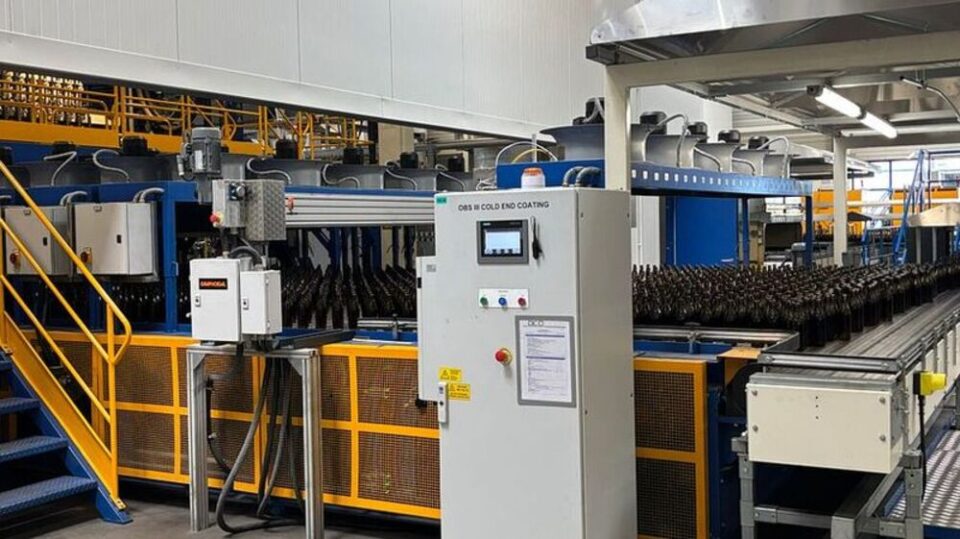
Vetropack has taken its Rezon lightweight glass bottle into full industrial production after commissioning a new high-capacity manufacturing facility at its Pöchlarn plant in Austria.
The facility began operating in late summer and makes thermally strengthened bottles at approximately twice the rate of the former pilot line, without increasing headcount. The development moves Rezon beyond the innovation stage and enables Vetropack to supply the beverage sector in substantially greater volumes.
As part of the production scale-up launched in spring, the company trained about 30 employees and produced more than 300,000 test bottles. Manufacturing has now been fully transferred to the new site.
According to Guido Stebner, chief technology officer at Vetropack Group, higher productivity has resulted from streamlined processes, greater automation and increased digitalisation.
“We have shown that we can produce Rezon reliably on an industrial scale – in larger volumes and at a level of quality we had not achieved before,” he says.
The project also contributes to Vetropack’s Strategy 2035, which places process improvement and digital technologies at the centre of the company’s future development.
Scaling Rezon for commercial production
Vetropack launched Rezon in 2019 as the first thermally strengthened lightweight glass bottle of its kind. By combining a lower glass weight with enhanced strength and durability, the technology addresses two key challenges associated with reusable packaging: the weight transported through the supply chain and the number of times a bottle can be reused.
More than 35 million Rezon bottles have been placed on the market since the product was introduced.
Since the beginning of 2024, Austria’s brewing sector has been able to use a 0.33-litre reusable Rezon bottle as a standard format. The solution supports brewers in meeting the country’s reusable packaging quota, with brands such as Gösser and Rieder among those already using it.
Industrial-scale manufacturing gives Vetropack greater flexibility to increase supply as customer demand expands. The company plans to commission a second large production facility at Pöchlarn in 2027 and aims to introduce Rezon manufacturing at additional Group locations over the medium term.
Armelle Dupont, commercial and programme director at Vetropack, says: “We expect significant market growth over the next two years. Market momentum is clearly picking up.”
Reducing weight while extending reuse
Rezon’s commercial proposition is based on its performance throughout the bottle’s life cycle, rather than on packaging weight or purchase price alone.
Compared with standard reusable glass bottles, Rezon containers weigh up to 30% less and can achieve as many as 60% more use cycles. Their thermal strengthening also improves resistance to scuffing, helping them maintain their visual quality during repeated circulation.
This combination can lower the total cost of ownership (TCO) for beverage manufacturers. Longer service life allows each bottle to complete more cycles, while the reduced weight may improve handling and transport efficiency across the distribution network.
Vetropack has redesigned the bottle and crate dimensions to increase pallet capacity by up to 33%. As a result, distributors can move more packaging within the same vehicle or warehouse footprint, supporting emerging food distribution trends focused on logistics efficiency.
The company says Rezon can deliver a life-cycle CO₂ reduction of up to 70% compared with single-use bottles, adding a sustainability benefit to its operational advantages. This aligns with broader priorities in food and drink sustainability and wider food manufacturing trends centred on lowering environmental impact.
Data Matrix codes can also be applied to the bottles, providing item-level identification and traceability throughout the reuse cycle.
Packaging engineered for the wider value chain
The transition to industrial production reflects a broader direction in food and drink industry innovation. Packaging developers are increasingly evaluating solutions across the complete value chain, including manufacturing, distribution, repeated use and end-of-life recovery.
In this context, Rezon demonstrates how glass packaging can deliver value beyond its basic role as a container. Its design responds to several food and beverage industry trends, including demand for efficient logistics, measurable sustainability performance and more durable reusable formats.
“Our customers expect more from us than just high-quality glass packaging. Rezon shows how we create measurable added value: less weight, more use cycles, more efficient logistics and a significantly better carbon footprint,” says Evan Williams, chief commercial officer at Vetropack Group.
“With industrial production, we can now increase the scope and scale of supply of Rezon. This investment demonstrates our commitment to the product and the technology and represents the next step in our leadership in reusable packaging.”
With over 35 million bottles already in circulation and additional capacity planned, Vetropack is preparing Rezon for broader market uptake. Its future growth will depend on how effectively the expanded production network meets demand from beverage companies seeking better-performing, more economical reusable glass packaging while responding to changing food and drink consumer trends, food and drink regulations, food and drink packaging expectations and food and drink marketing priorities.