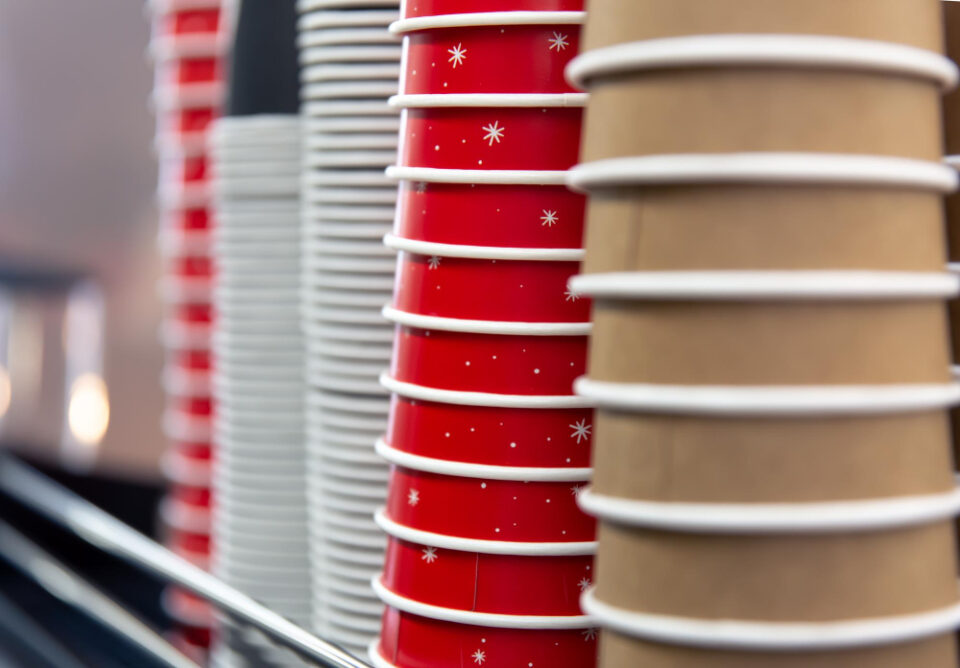
Environmental Action Germany (DUH) is currently appealing a court ruling that suggests Deutsche Bahn’s (DB) disposable cups used on trains are exempt from Germany’s reusable packaging regulations. The focus of the contention is whether beverages sold onboard are meant for immediate consumption within the train or are intended to be taken away by passengers after departure.
Tomra, a leader in recycling technology, emphasizes the necessity of convenient, scalable return systems for promoting reusable options in busy transportation settings where high foot traffic is common.
The ongoing legal battle between DUH and DB underscores the friction between single-use packaging laws and the effective incorporation of reusable solutions in frequently used environments. Last year, DUH filed a request for an injunction aimed at ensuring DB adheres to the reusable offer requirement outlined in Section 33 of Germany’s Packaging Act. As of January 1, 2023, businesses that serve drinks in single-use containers, such as coffee or tea, must also provide reusable versions.
However, DUH contends DB is illegally offering takeaway beverages solely in disposable cups on long-distance trains, without any reusable options, neglecting the fact that passengers may consume these drinks elsewhere. DUH advocates for DB to provide reusable cups for those purchasing beverages to go right before they exit the train, making it easy for passengers to return them.
The crux of the case revolves around defining what constitutes on-board consumption. While DB does offer reusable porcelain and glass options for drinks consumed in the restaurant car and first-class area, disposable packaging remains available for on-site consumption in accordance with the Packaging Act.
In March, the Frankfurt Regional Court dismissed the injunction, ruling that beverages sold in disposable cups on trains are intended solely for on-board consumption and thus not subjected to Section 33, which requires reusable alternatives for takeaway drinks.
DUH is now appealing this ruling at the Higher Regional Court of Frankfurt am Main, while DB has yet to comment at the time of this publication.
DB’s catering guidelines indicate that passengers are allowed to bring their own reusable cups for drinks. In 2022, the company also announced the availability of porcelain and glass options on long-distance services. Nevertheless, these offerings do not address the demand for a practical, returnable reusable cup system advocated by DUH.
Packaging Insights has also consulted Tomra, which has recently deployed two automated reusable cup return kiosks at Freiburg Central Station, to evaluate how reusable systems can be effectively integrated in busy public transport areas, including trains and stations.
This case serves as a litmus test for how Germany’s reusable offer requirements apply to beverages provided on trains. Thomas Fischer, Head of the Circular Economy Division at DUH, expresses that the organization disputes the court’s dismissal of the injunction, claiming it disregards the consumption habits of many rail passengers who frequently take their beverages off the train.
“The Frankfurt am Main Regional Court has confirmed that Deutsche Bahn is obligated to provide reusable cups. This implies that passengers wanting to grab a coffee to go before disembarking should be served in reusable cups. Otherwise, one must question why DB even offers disposable cups on board?” Fischer states.
He argues that if all beverages on DB trains are considered for on-site consumption, then the introduction of porcelain or glass cups should suffice, making the need for disposable options moot. Furthermore, he posits that this legal reasoning could enable any foodservice provider to assert that drinks in disposable cups are exclusively for on-site use.
Notably, DB, in a 2022 press release advocating its transition to reusable tableware, mentioned that unconsumed food or beverages could be taken off the train in the reusable containers, which can be returned at DB Lounges or during subsequent journeys with DB.
A spokesperson from Tomra highlighted the importance of establishing refillable cup systems in high-traffic transit locations. For these systems to thrive, convenience, efficiency, and clarity must be prioritized. DUH is encouraging DB to implement a reusable cup system for beverages intended for consumption off the train.
“While porcelain cups serve well inside the train, they are impractical for takeout consumption outside,” says Fischer. “DB could actively participate in a broader reusable cup initiative within the foodservice sector, such as the ReCup-System, allowing travelers to receive their drinks in a practical, reusable plastic cup against a deposit.”
DB has partnered with ReCup for employee dining services, touting it as a sustainable method to minimize single-use items and enhance sustainability. Yet, this ReCup initiative is not available for passenger food and beverage consumption.
The Tomra representative emphasized the necessity of implementing reusable takeaway packaging systems in contexts where they can effectively replace or significantly reduce the use of single-use options. “This is where reuse can yield substantial environmental benefits and alleviate overall resource strain,” they noted.
Moreover, they assert that these reuse systems must accommodate various packaging formats and focus on scalability, ensuring high integrity. “There is reason to believe these principles would also be applicable in a rail context.”