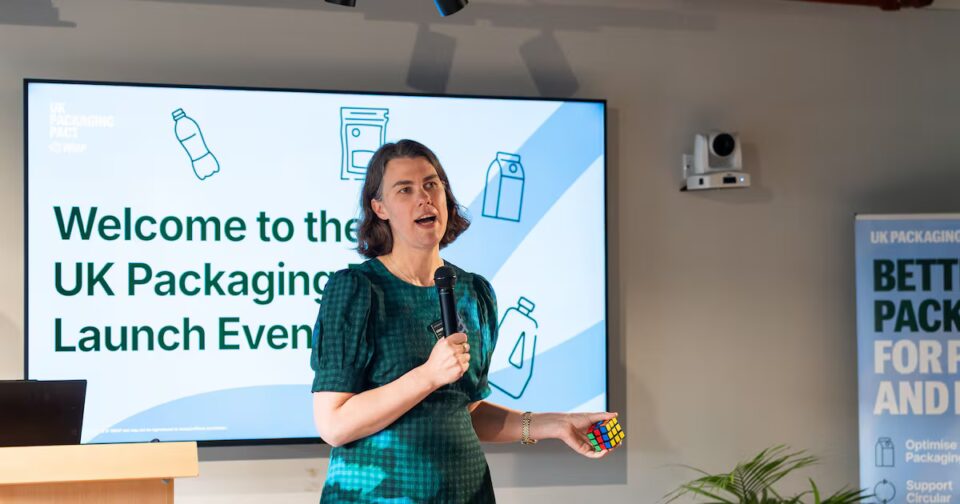
The ten-year voluntary initiative spearheaded by the environmental organization WRAP aims to promote more sustainable packaging practices within the industry, address related costs, and contribute to future policies and systems.
How does it differ from the UK Plastic Pact?
Building upon the UK Plastics Pact introduced by WRAP in 2018, the new UK Packaging Pact extends its reach to all types of packaging materials entering the market—including glass, paper, cardboard, metal, as well as various plastics and biobased options.
This new Pact also acts as a pivotal step forward in addressing the evolving packaging challenges. Unlike earlier efforts focused primarily on goal-setting, this initiative prioritizes the actual implementation of those commitments.
However, this doesn’t negate the achievements of the UK Plastics Pact; notable strides have been made in reducing single-use plastics in the marketplace.
“We’ve made a lot of progress – but there’s still quite a lot of unfinished business, particularly around recyclability and recycling rates,” stated Catherine David, CEO of WRAP, during the launch event with Food Manufacture.
What are the focal points of the new Pact?
While numerous companies have established plastic packaging targets, David emphasized that attention must expand beyond plastics to consider how new packaging and recycling policies will shape future materials.
The Pact encompasses the entire value chain—from manufacturers to retailers to recyclers—to ensure that changes benefit all parties and that any industry investments are sustainable and valuable.
Extensive behind-the-scenes work has been underway, with various brands and manufacturers trialing reuse initiatives in diverse formats. According to David, these pilots have yielded valuable insights that will inform the Pact’s future endeavors.
“There’s a wealth of insight and what a lot of it points to is that there needs to be interoperability. The infrastructure needs to be shared, no one can go alone; and from a consumer perspective it needs to make sense. And the only chance you stand of scaling that is if you collaborate.”
Moreover, the Pact plans to examine data integration and efficiency, aiming to streamline reporting requirements through standardization and alignment while improving traceability, thus facilitating data-driven design and sourcing strategies.
To avoid redundancies, David indicated that the Pact will work to highlight issues that risk being overlooked, and has received support from PackUK—the administrator for the UK’s Extended Producer Responsibility program—which will further contribute to a coordinated approach.
Global waste could hit 3.68 billion tonnes by 2025
The launch comes at a critical time, following a concerning alert in the World Bank’s third What a Waste (3.0) report, which states that waste production is outpacing both population growth and local systems’ capabilities to manage it. Without intervention, global waste could rise by 50%, reaching 3.86 billion tonnes by 2025.
Additionally, fluctuations in virgin plastic resin prices tied to oil market changes are exerting significant pressure on single-use packaging models, underscoring an urgent need to transition from outdated systems.
Why should businesses participate?
“The UK Packaging Pact is a unique, complete system approach to unlocking packaging transitions across the value chain. No other programme brings together the key players needed to deliver the enormous changes we must make,” David stated.
“Policies are essential, but they alone cannot deliver, and the Packaging Pact will provide the practical change needed through a flexible framework that allows participants to focus on what matters most to them.”
“If you want to unlock progress on EPR, data, and reuse/refill, the Pact is the place to make it happen.”
By engaging in pre-competitive collaboration, participants will be able to:
- Lower costs and EPR fees through smarter design and material reduction,
- Reduce greenhouse gas emissions,
- Prepare for and adhere to evolving UK and EU regulations, and
Currently, the Pact boasts 100 signatories.