


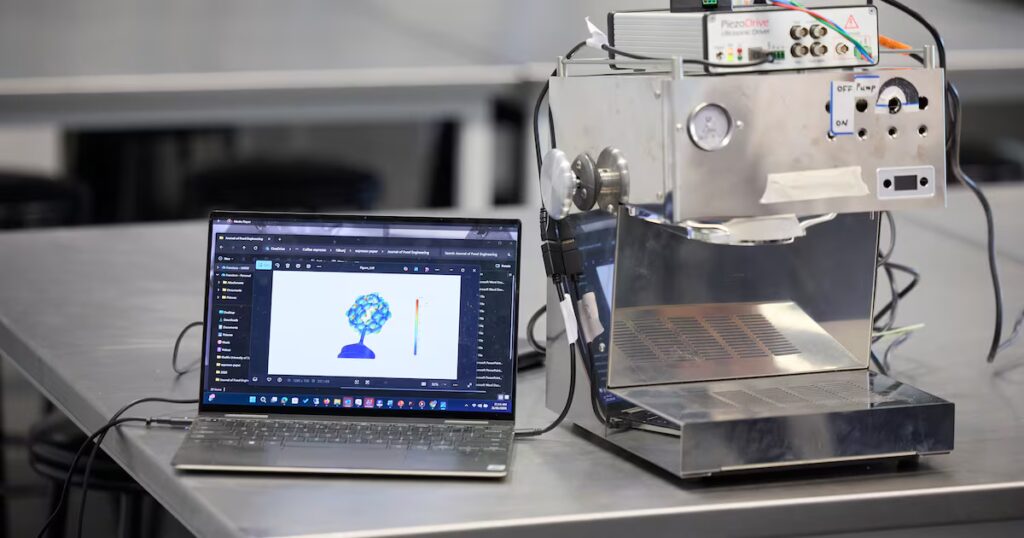
A research group from the University of New South Wales has discovered a method to brew espresso-strength coffee in just a couple of minutes at lower temperatures.
Traditionally, the process of making espresso involves using high temperatures (around 90–95 ◦C) and significant hydraulic pressure (approximately 9 bar) to push hot water through a tightly compressed bed of finely ground coffee.
Tamping, which is the process of pressing down the coffee grounds in the filter basket, is crucial for creating a dense mass that offers high resistance to water flow. This requires considerable pressure for the water to pass through the compact coffee puck.
This method facilitates the quick extraction of soluble compounds, emulsified oils, and aromatic volatiles, resulting in a rich and flavorful beverage.
However, the quality of the extracted coffee heavily relies on various factors controlled by the operator, including tamping pressure, flow rate and duration, the weight of dry coffee, and the grind size. Given its complexity, the process can lead to fluctuations in quality.
By employing a patented ultrasonic brewing technologie, the research team was able to prepare coffee in just 2-3 minutes, significantly shortening the brewing time while eliminating the need for high temperatures and reducing dependence on traditional pressure-driven methods.
In their experiments, the researchers achieved this without major alterations to aroma or key physicochemical parameters such as color, pH, caffeine levels, and chlorogenic acid concentration.
This novel approach enables the extraction of increased solids per gram of coffee, while providing enhanced control over the beverage’s strength and flavor, along with sustainability benefits.
When compared to standard espresso machines, the ultrasonic coffee method exhibited a remarkable 75% decrease in energy usage, presenting valuable opportunities for future cost reductions and more efficient coffee production.
The team noted that under similar circumstances without the use of ultrasound, achieving espresso-strength extraction would not be feasible.
Moreover, the same technology can be adapted for creating both concentrated and filter-style coffees, and it reduces cold brew brewing times from several hours to just minutes.
The comprehensive study, titled “Ultrasound enables espresso-strength coffee brewing in 2–3 minutes at low temperature with lower energy consumption,” has been published in the Journal of Food Engineering.