


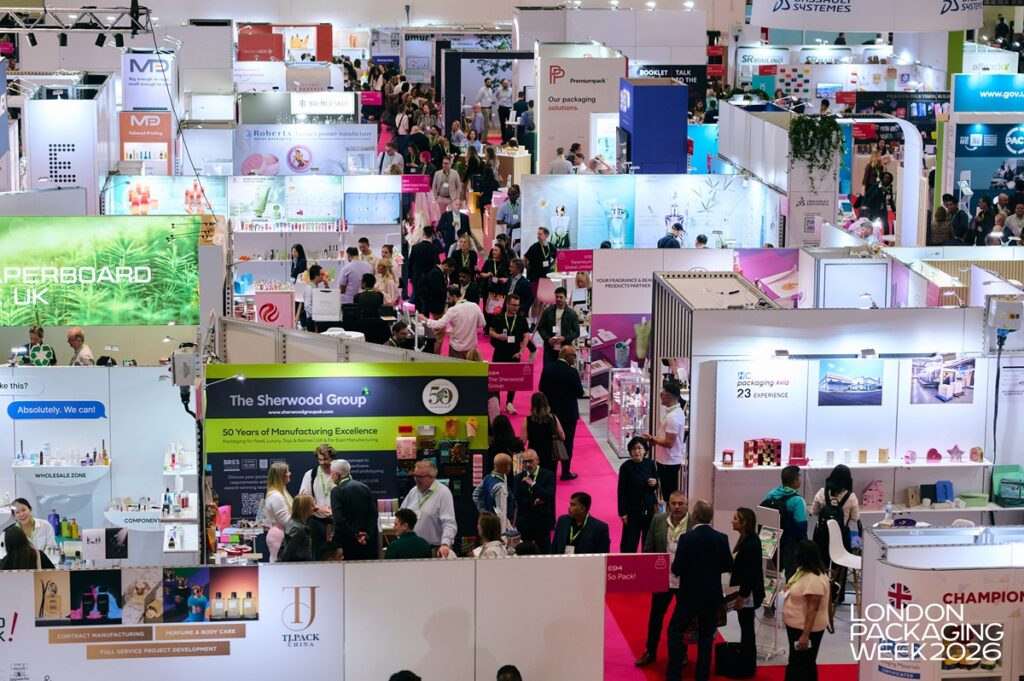
London Packaging Week 2026 has closed its doors for another year, but not before thousands of attendees enjoyed a blockbuster second day that included the Talking Rubbish podcast, a Women in Packaging networking event, and the renowned Innovation Awards ceremony.
The second day of London Packaging Week built on the event’s theme of ‘Discovery’, finishing with a flourish and marking another remarkable year of growth for the show. Combining four co-located events focused on luxury, drinks, beauty, and FMCG packaging, the second day highlighted examples of excellence across all four market sectors as the prestigious Innovation Awards returned on Thursday afternoon, sponsored by Nuon.
Prada, Jack Daniel’s x McLaren, Heinz, Hotel Chocolat, Fortnum & Mason, Refy, and HairGym were among the brands taking home trophies from the ceremony, while Marks & Spencer was named Packaging Team of the Year.
Paul Hamilton, Head of Sales & Marketing at full-service packaging supplier Hunter Luxury, which won the Luxury Drinks award for the second consecutive year for its work on the Jack Daniel’s x McLaren HALO MK1 project, said, “Winning this award again is incredibly special, particularly because Halo MK1 represents exactly the kind of challenge we want to take on at Hunter Luxury. The standard has only risen since last year, so our consecutive wins demonstrate what becomes possible when a brilliant creative idea is supported by the engineering and manufacturing expertise needed to make it happen.”
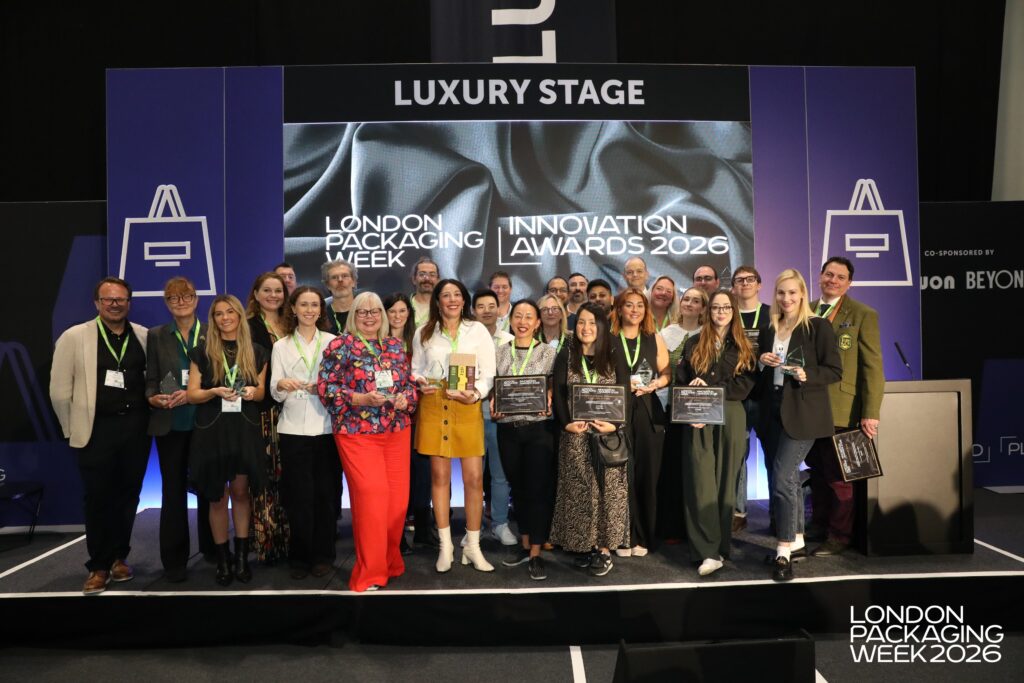

Casey McHugh, Senior Content Manager at event organiser Easyfairs, said: “What makes this year’s results so exciting is the sheer breadth of what innovation now means in packaging. Extraordinary pieces of luxury engineering sit alongside intelligent changes to everyday products, interactive experiences, new material approaches, and solutions designed to reduce environmental impact.
“The common thread is purpose. The strongest projects combine creativity with a clear understanding of the consumer, the challenge being solved and the value the packaging needs to create.”
Other innovations on show included the headline-grabbing Cool>Can™ from deltaH Innovations, which took home first prize in the competitive Innovation Gallery. This groundbreaking can features button-activated self-cooling technology, which has been successfully commercialised by Wales-based Brains Brewery. The ceremony drew attention from mainstream national media, highlighting the incredible reach impactful packaging innovation can have.
Earlier, the second day got off to an impactful start in an invite-only Power Hour session that provided exclusive insights from women in the packaging industry. One of the speakers was Sophie Christie, Supplier Enablement Lead at Tesco, who candidly discussed her role in implementing GS1-compliant QR codes for the retail giant. “The start of our project was just building our understanding,” she explained. “No one really knew how it would actually work in-store. We launched a trial in-store across a number of suppliers and substrates, and the QR codes weren’t at the standard we would expect now, but it took us actually launching into stores, seeing how it works from the factory to the store, and seeing how our colleagues and customers interact with it, to understand what needed to change.
“Sometimes you just have to try something, especially with new innovations. Having the opportunities to get things wrong provided the opportunities to learn from it. That was the bedrock for how we proceeded with the programme.”
The value of female insights was proven later on in the day, when Jane Martin, Head of Communications and Engagement at PackUK, and Karen Graley, Chief Operating Officer at UK Packaging PRO, hosted a fireside chat-style talk on EPR.
Karen said she wanted to create a sense of certainty around the future of EPR, commenting, “Everyone has a role to play, not just producers, but waste management companies, local authorities, and material recovery facilities. There’s no one stakeholder that can deliver the whole system. One of the things producer responsibility can do is bring all of that together, share those industry insights, expertise, and knowledge that’s been gained over decades. Policy is one thing, but with the producer voice and expertise, we need to translate that into something tangible, meaningful and capable of creating the change that we all need.
“Designers will say, ‘We shouldn’t be designing for poor infrastructure’, while infrastructure will say, ‘You need to be designing and giving us the right things and using the right materials because we can’t accept that.’ That’s why getting out there, understanding, and seeing these things for real matters. You really get to know what works and what doesn’t. These two things need to come together.
“So we’re looking at what’s worked elsewhere, maybe also what’s failed and why, and how we can bring those things into the UK. We want a best-in-class, world-leading producer responsibility organisation, and why not? It’s about having our ears open, listening and learning.”
Other speakers provided further perspectives on this theme of transformation. Creative designer Vincent Villeger delivered a presentation on packaging as a four-dimensional discipline, drawing on decades of experience working in the sector. “Packaging has probably always been about adding value from a brand perspective, but it feels like there’s now a real quest for theatre,” he said following the talk. “It’s about the experience from that first touchpoint right the way through. Consumers want to be taken on a journey. But there are so many headwinds in packaging at the moment, whether it’s legislation, cost, or dozens of other things.
He emphasised human connection between designer and client as key to overcoming these headwinds, adding, “You can put a pack into an awards ceremony and have it torn to pieces by traditionalists, then put it into the market and see it received rapturously by consumers. So my problem that I’m trying to solve when I come to a piece of design isn’t to win an award. In the first stages, the most important work I do is to establish: ‘Do I understand what it is you need, am I the right person to help you with it on a go? On a human level, can I work with you, are you going to understand what I want to do?’ There’s no doubt that the best creative work, in my experience, is when it’s very friction-free.”
Many other speakers delivered their own novel presentations on new innovations, drawing on their own unique creative approaches. Yoshi Nagamine, Founder and CEO of ZEROBOX, was one of them, delivering a playful yet insightful glimpse into the thinking behind his reusable modular logistics solution. Calling it ‘the black sock principle,’ he said, “You buy striped socks in pairs. One day, the left one gets a hole. So what do you do with its partner? It goes in the bin even though there is nothing wrong with it, because it can’t pair with anything else. Now look at black socks. One gets a hole, but it’s easy to pair with another black sock. It’s half the waste, but the only thing that changed was the design of the sock.
“That’s the black sock principle. Waste also creates collateral waste. That’s not a fact of nature, it’s a design flaw. ZEROBOX applies that principle to packaging. It’s a modular system of three components: Plates, pipes, and clips. Every plate is interchangeable with another. If one part breaks, you can exchange the broken part and use it again.”
Early attendance data indicated that the show was the best-attended yet, with the new features and packed schedule marking London Packaging Week out as one of the most innovative, forward-thinking, and valuable events in any B2B professional’s calendar.
To register your interest in London Packaging Week when it returns for 2027, visit www.londonpackagingweek.com today.