


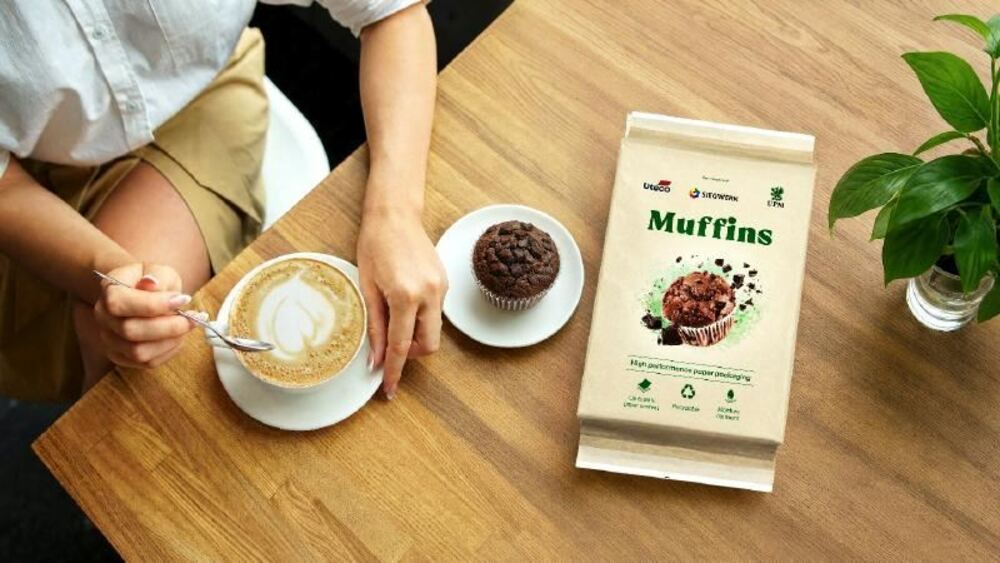
UPM, Uteco, and Siegwerk have partnered to develop a paper-based secondary packaging solution that enables food and beverage brands to reduce plastic use without compromising packaging performance. The innovation reflects major food and beverage industry trends, including the shift toward renewable materials and more responsible packaging formats.
The solution can raise the renewable content of secondary packaging to as much as 90%, offering brand owners a practical way to prepare for changing food and drink regulations, including the EU Packaging and Packaging Waste Regulation (PPWR). It provides a low-risk introduction to paper packaging because the primary pack continues to protect the product, while the outer packaging transitions to a renewable alternative. This approach supports wider food and drink sustainability goals and responds to evolving food and drink consumer trends.
UPM supplies the barrier base paper, while Siegwerk contributes its CIRKIT BAR SEAL coating. Uteco applies the coating using high-definition flexographic technology. Together, these components provide resistance to moisture and grease, as well as heat-sealing performance. At the same time, the finished pack remains recyclable through conventional paper recycling systems and meets CEPI and 4evergreen v2 requirements. The development represents a significant advancement in food processing technology, food and drink packaging, and broader food and drink industry innovation.
The system also supports efficient commercial production. Coating, printing, and heat sealing can be completed in one pass, helping converters and brand owners reduce processing time, energy consumption, and manufacturing costs. Its scalable design makes it suitable for demanding applications and aligns with emerging food manufacturing trends, food distribution trends, and evolving food and drink marketing strategies.