


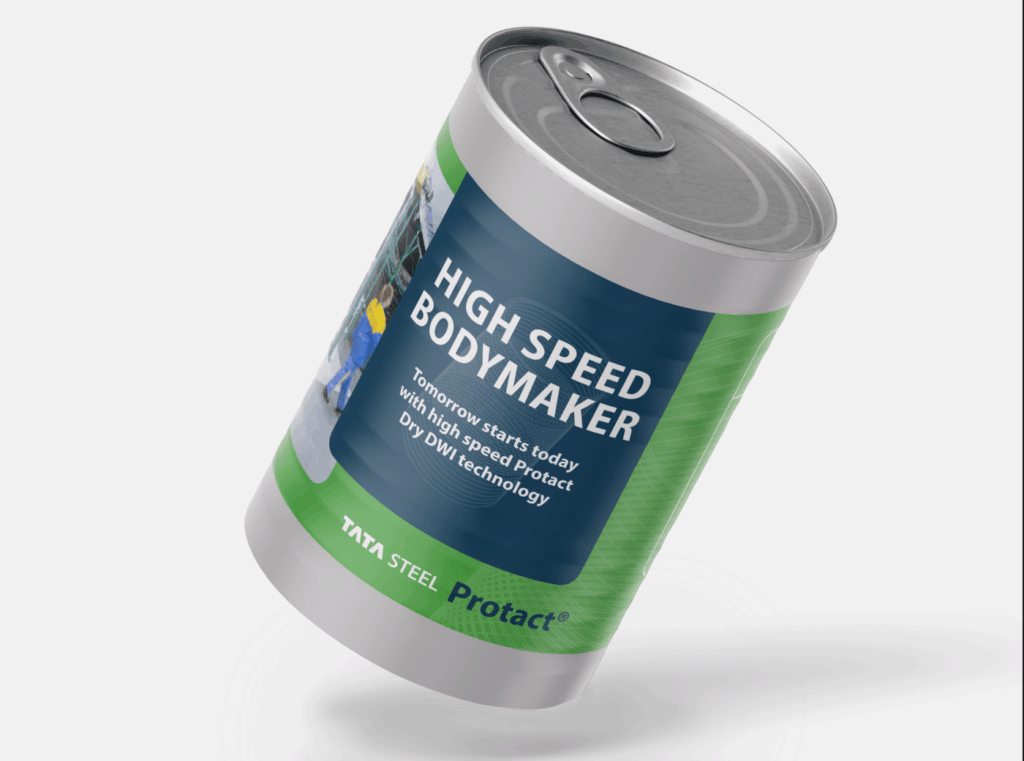
A new can-making machine has been commissioned at Tata Steel Nederland’s state-of-the-art research and development facility. This innovative bodymaker operates more efficiently than its predecessors, producing food cans akin to those found on retail shelves using a sophisticated dry forming technique.
By utilizing Protact steel and implementing advanced internal cooling for the tooling, Tata Steel’s new line facilitates a dry forming process. This advancement eliminates the necessity for emulsified water, significantly reducing energy consumption and lowering investment costs for customers.
Tata Steel explains that Protact is a polymer-coated steel designed to minimize friction during the forming process. “The polymer layer also ensures that the can meets all future food safety standards,” noted Hans van der Weijde, director of R&D at Tata Steel Nederland. “There’s no need to apply a lacquer to the steel. While lacquer is still permitted under current regulations, we observe a distinct trend toward phasing out these chemical coatings. Lacquered cans frequently contain tin. Protact facilitates a streamlined and cleaner production line.”
The new production line boasts the capability to manufacture up to 400 cans per minute—25% more than the industry standard of 320, according to the steel company. The machinery at Tata Steel acts as a proof of concept, allowing customers to witness the dry forming process with Protact at full industrial speeds. “That collaboration with the customer is crucial,” states Joris Essing, marketing manager for packaging steel at Tata Steel Nederland. “We possess the expertise in the dry process, but the customer must adapt it to their own production lines. We work closely together to ensure successful implementation.”
This partnership has already yielded significant results in the food and beverage packaging market. One noteworthy collaboration is Tata Steel’s alliance with Grupo Calvo, which led to the creation of an innovative Protact tuna can. The polymer layer applied to the steel minimizes the need for oil, keeping the tuna fresh and allowing for easier removal from the can. Additionally, the packaging is lighter, thanks to more efficient material usage, resulting in transport benefits.
In the Netherlands, steel packaging—including cans for beans, corn, or fish—stands out as the nation’s recycling champion. Over 95% of all steel packaging utilized in the Netherlands is recycled into new steel, making it the most recycled packaging material.