


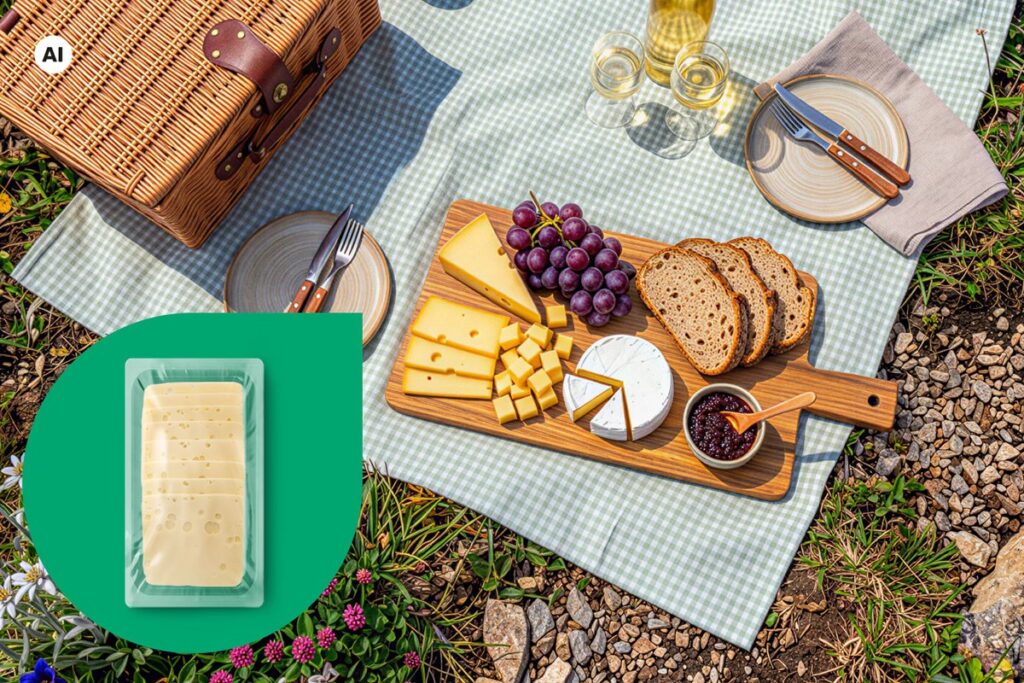
Europe accounts for almost half of the worldwide cheese market, making it the leading regional market globally. Growing cheese consumption, expanding product variety, and evolving regulatory obligations are increasing the need for packaging that protects cheese as a natural food while also supporting material efficiency, reliable processing, and recycling. For manufacturers and packers, this requires a systems-based approach that considers the product, packaging materials, machinery, logistics, retail environment, and consumer handling together.
The EU Packaging and Packaging Waste Regulation (PPWR) places stronger requirements on design for recycling, material reduction, and compliance with defined packaging criteria. However, sustainability improvements cannot compromise shelf life, food safety, or dependable production performance. SÜDPACK has been developing cheese packaging for more than six decades. The company’s origins date back to master dairyman and founder Alfred Remmele, who developed one of the first cheese-maturing pouches. Today, its dairy packaging range covers ripening bags, packs for cheese cuts, sliced and grated cheese, mozzarella, and other specialty products.
Three priorities influencing cheese packaging
Packaging development in the years ahead will be shaped by three central priorities: thinner structures with enhanced performance, recyclable mono-material solutions, and barrier properties designed specifically for each cheese application. Progress will also continue in sealing technologies, pack formats, and energy-efficient processing.
Every cheese type and packaging format presents different technical demands. Packaging may need to limit oxygen or moisture transmission, preserve taste and freshness, support controlled maturation, and operate consistently on existing equipment. The highest possible barrier is not always the best solution, however. Cheese products that generate gases can require a carefully controlled degree of gas exchange to maintain product quality.
Mono-material packaging supports circularity
SÜDPACK views PE- and PP-based mono-materials as important tools for advancing the circular economy. Established recycling systems for both polymers are available in numerous European countries, and the materials can serve a broad range of cheese formats. Applications include pouches, flow packs, and thermoformed packs for sliced cheese.
Improving current packaging designs can also provide meaningful sustainability gains. Depending on the application, reducing film thickness, refining the pack dimensions, or adding a resealable feature may offer advantages over multilayer laminates or packs that cannot be closed again after opening.
Material selection must be assessed alongside sealing behavior, puncture resistance, mechanical performance, and compatibility with packaging machinery. A structure that performs well in one area may create challenges elsewhere if the complete system is not considered.
PP- and PE-based flow packs from the CarbonLite® product family provide a suitable option for cheese snacks, mozzarella, grated cheese, and cheese cuts. Their lightweight construction can incorporate gas and water-vapor barriers matched to the product’s requirements. Cheese cuts, for instance, may need managed gas exchange, while mozzarella requires strong sealing performance when brine is present, along with resistance to punctures and leakage.
High-speed zipper sealing can be particularly demanding for grated cheese pouches. SÜDPACK addresses this challenge with PE structures, which can often be processed more consistently and safely on existing packaging lines than PP alternatives. This type of application-focused design reflects wider food manufacturing trends, where performance, efficiency, and recyclability must be achieved simultaneously.
Coextrusion enables tailored mono-material structures
Coextrusion is a core SÜDPACK capability. By combining multiple functional layers with precision, the company can adjust barrier protection, mechanical strength, sealing characteristics, and machinability to meet the needs of a specific product, process, and packaging machine.
New structures can undergo industrial-scale trials on the company’s advanced multiXtrusion pilot line. Following successful validation, they can transition directly into internal production. This approach lowers development risk for customers and offers greater confidence when moving toward recyclable mono-material packaging. It also supports the broader direction of food processing technology, in which manufacturers increasingly require flexible solutions that can be tested and implemented without disrupting established operations.
Resealable packs can help reduce food waste
Thermoformed packaging remains widely used for sliced cheese because it presents the product effectively in refrigerated retail displays and allows consumers to remove individual slices with ease. Adding a resealable function helps protect the remaining cheese after opening, slowing dehydration and reducing the likelihood of early spoilage. As food and drink consumer trends continue to emphasize convenience and waste reduction, reclose features are becoming increasingly valuable.
The Multipeel Pure PP top web can be sealed with a mono-PP rigid film to produce an all-PP pack that can enter established PP recycling streams.
Another option is to seal Multipeel to mono-APET trays. During recycling, the top web can be separated cleanly from the APET bottom web, allowing the tray to proceed through the relevant recycling stream as a high-purity material. These solutions demonstrate how food and drink packaging can support both product protection and improved end-of-life management.
Partnership supports dependable conversion
Regardless of the selected packaging format, SÜDPACK works with customers throughout the project, from initial concept development and material selection through testing, machine trials, and commercial implementation. Transitioning to design-for-recycling packaging involves important technical and financial considerations. Manufacturers must determine how to maintain product protection, whether machinery adjustments are needed, and how new films will behave during production.
SÜDPACK provides application and material expertise, sample production, performance testing, and evaluations of carbon dioxide impact and recyclability. This collaborative approach helps reduce conversion risks and supports the reliable integration of new packaging into existing manufacturing systems.
As food and beverage industry trends, food distribution trends, and food and drink industry innovation continue to evolve, packaging suppliers and producers must also respond to changing food and drink regulations, food and drink sustainability goals, and expectations around food and drink marketing. SÜDPACK’s packaging development approach is designed to help cheese manufacturers address these priorities while maintaining quality, efficiency, and dependable supply.
Further information is available at suedpack.com