


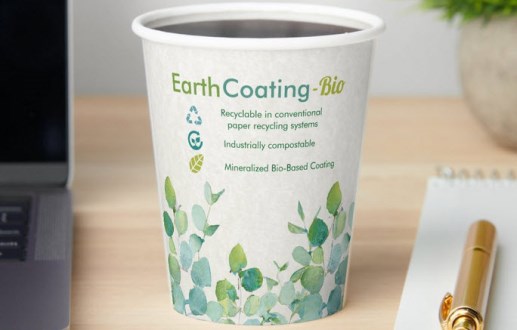
This innovative development utilizes polylactic acid (PLA), a biobased resin, combined with a specialized mineral blend to create a barrier coating. The company asserts that this coating enhances compostability and recyclability for paper cups and a range of barrier-coated paper packaging, aligning seamlessly with growing demands for food and drink sustainability.
Smart Planet Technologies emphasizes that, through the mineralization of the resin in the extrusion-coating process, its EarthCoating has been ‘proven’ to generate barrier paper packaging compatible with standard paper recycling systems. Moreover, it qualifies for recycling in premium recovered paper categories, catering to the evolving needs in sustainable packaging.
To date, EarthCoating has been applied to over 3 billion paper cups. These recovered cups have found new life in products like gift wrap for Hallmark and copy paper for Australian Paper, showcasing the potential of sustainable packaging in food and drink marketing.
While conventional PLA coatings meet industrial composting standards, they present recycling challenges similar to those faced by 100% polyethylene coatings, due to their entirely plastic nature.
Chris Tilton, co-founder and chief technology officer of Smart Planet Technologies, states, “The use of PLA, derived from renewable resources, enhances the sustainability profile of packaging materials. Additionally, the mineralization of resin in a barrier coating reduces the plastic content by ‘35-51%’ compared to traditional 100% plastic coatings.” This reduction significantly contributes to advancing food and drink consumer trends towards more eco-friendly solutions.
“Sustainable packaging regulations often face the challenge of deciding whether to prioritize recycling or composting. The commingling of packaging that may be compatible with one process can be incompatible with the other. With the introduction of EarthCoating-Bio, we offer a solution compatible with both processes while reducing plastic content. This is a more sustainable PLA-based solution compared to 100% PLA coatings.”