


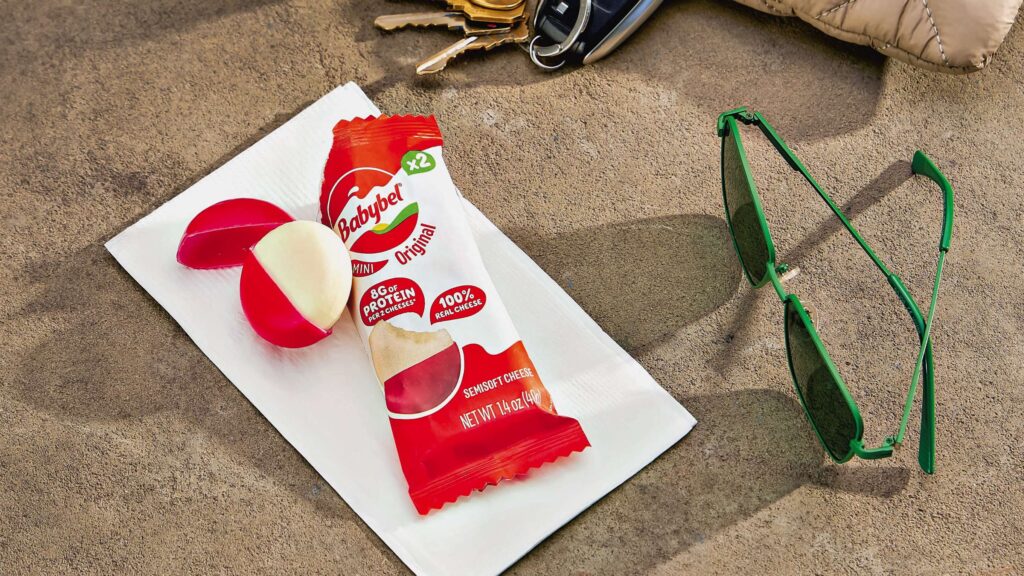
More than two billion Babybel portions are reportedly eaten around the world each year. While children account for the majority of consumers in France and Germany, the brand is targeting adults as it grows in the US market. An estimated 49% of adult consumers eat more than one Babybel in a single occasion.
Babybel 2 Go was developed to meet this demand, combining two Mini Babybels in a single paper flowpack. Sold in the US, Canada and selected European markets, the pack format is intended to support food hygiene, reduce waste and suit on-the-go snacking.
The flowpack uses Koehler NexPlus Seal Pure, a packaging paper engineered to deliver improved sustainability alongside dependable performance. Produced from 100% virgin fibre pulp, the material can be recycled under applicable European and US regulations, including the Packaging and Packaging Waste Regulation.
According to Koehler, securing recyclability certification across both continents is complex because the relevant recycling systems and assessment procedures differ.
“Manufacturers of flexible paper packaging with innovative barrier properties are under a great deal of time and performance pressure due to new EU regulations,” says Bettina Bastien, brand owner manager, Business Development Flexible Packaging Paper at Koehler Paper.
“The power to innovate is crucially important. We have to develop high-performance paper that is similar to films.”
“A lot of plastic packaging is now recyclable,” comments Victor Desmonts, packaging development manager at Babybel. “But plastic is made from fossil fuels. Paper, on the other hand, is made from sustainable forestry; i.e., from renewable raw materials.
“I believe that consumers are increasingly preferring paper packaging, even though it is not easy to change habits. We want to support this development.”
As the packaging transition progressed, the Bel Group needed a hot-sealable paper substrate that could run efficiently on existing packaging equipment across its manufacturing sites. It also had to perform at the speed of traditional plastic film and seal effectively at low temperatures.
For use in food packaging, the paper was required to withstand creasing and tearing while providing the appropriate grammage and dependable seal integrity. A smooth finish and strong printability were also essential for an attractive and consistent brand presentation.
“We’re delighted to have found a great solution with Koehler so that we can now replace the outer packaging plastic with paper,” Desmonts continued.
“Thanks to the stable and dimensionally stable paper, we were able to also save on the inner cardboard packaging, which improves our brand image and evokes strong emotions. This reduces costs and the environmental load.”
Last year, the Bel Group announced its intention to package all Babybel cheese snacks in responsibly sourced paper by 2027. The initiative is expected to remove 60% of plastic per net and prevent approximately 2,500 tonnes of CO2 emissions.
In France, the Bel Group’s Évron facility—which is reported to make one in every two Babybel snacks consumed globally—is now running a functional paper packaging line. The line was introduced after extensive technical trials and the establishment of industrial operating parameters.
Babybel aims to complete its shift to recyclable packaging by 2030, while the Bel Group continues to investigate a new formulation for the brand’s distinctive wax coating.