


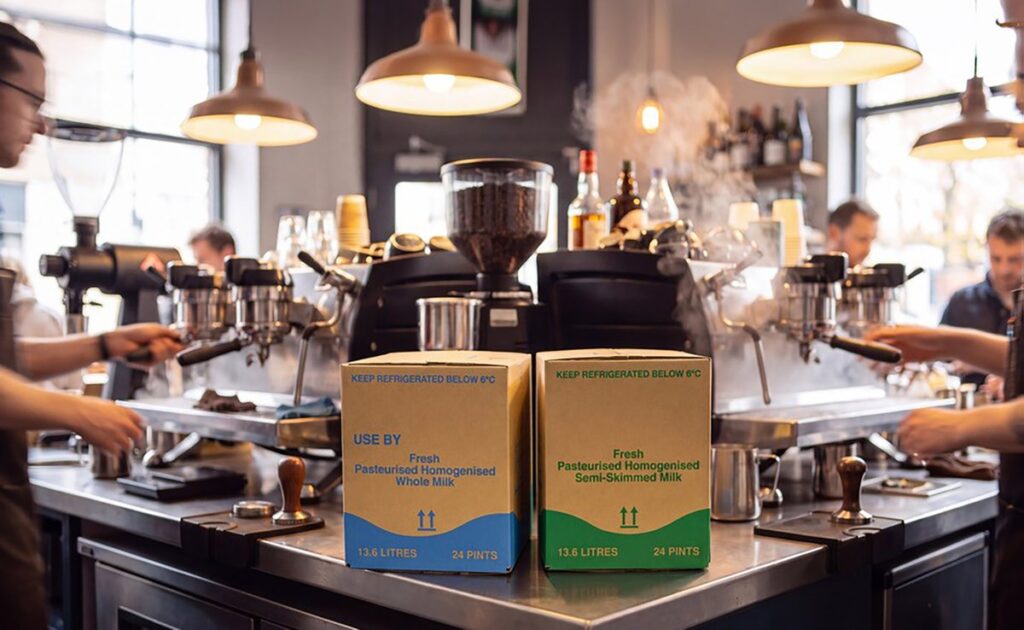
For coffee shops, milk is a high-demand operational essential rather than simply another ingredient. It must remain refrigerated, be stored safely and be available for rapid dispensing—often hundreds of times during a single trading day.
Rigid plastic containers remain widely used, but they can create challenges involving storage capacity, packaging waste, manual handling and product left inside opened containers. Bag-in-box pergals provide an alternative approach that can help cafés improve efficiency while supporting wider sustainability goals.
Greater milk capacity with less packaging
A major benefit of bag-in-box pergals is their efficient packaging format. The milk is held in a flexible inner bag and protected by a lightweight outer carton, which can reduce the quantity of packaging material used for each litre supplied.
This format can also improve logistics for busy cafés and foodservice businesses. Operators may need to receive, unpack and store fewer individual containers, while distributors may be able to transport greater volumes per pallet. Once empty, the packaging generally occupies less space before collection or disposal.
As a result, businesses may be able to reduce packaging use, make better use of storage areas and potentially lower the frequency of milk deliveries. These benefits align with wider food distribution trends and food manufacturing trends focused on resource efficiency and streamlined supply chains.
Simplifying daily staff routines
During peak service, even small additional tasks can affect productivity. Opening, lifting and replacing several milk containers throughout the day creates repetitive work for baristas and counter teams, particularly when the same process must be managed across multiple locations.
A pergal can connect directly to a dispensing system, enabling a consistent milk supply without repeatedly opening separate containers. Fewer changeovers can reduce disruption behind the counter, allowing staff to concentrate on customer service, speed and drink quality.
This type of food processing technology also reflects broader food and drink industry innovation, as operators seek practical systems that improve service without adding unnecessary complexity.
Reducing avoidable milk waste
The most significant environmental opportunity may come from reducing wasted milk rather than simply changing the packaging format.
Milk typically carries a much larger environmental footprint than its container, so preventing product loss is an important part of food and drink sustainability. As the flexible inner bag collapses during use, the system may leave less milk behind than a rigid container.
Because the product is dispensed through a closed system, exposure to air and the surrounding environment can also be limited. Depending on equipment design, storage conditions and operating practices, this may help preserve the milk after opening and reduce spoilage.
Even a modest daily reduction in discarded milk can deliver meaningful financial and environmental benefits. For café groups operating across several sites, those savings can become substantial over time and support measurable sustainability targets.
Making better use of limited premises
Space behind the counter is often at a premium. Refrigeration, dry storage and delivery areas must accommodate milk alongside ingredients, equipment and other operating supplies.
Larger bag-in-box formats can improve the amount of milk stored in relation to the space occupied, especially when they replace numerous smaller containers. Lower packaging volume can also reduce the amount of waste accumulating on site. This makes pergals particularly suitable for compact cafés, kiosks, transport hubs and other high-footfall locations.
The format can also support businesses responding to changing food and drink consumer trends, as customers increasingly expect convenient service alongside credible environmental practices.
A practical contribution to sustainability
Pergals can form part of a broader café sustainability programme by reducing packaging consumption, improving transport efficiency and limiting food waste. They can also support responsible purchasing strategies shaped by evolving food and drink regulations, food and drink packaging expectations and the wider food and drink marketing focus on transparent environmental performance.
The value of pergals extends beyond replacing one milk container with another. They can create a more efficient supply and dispensing process, with fewer containers to handle, lower space requirements, potentially less milk discarded and smoother service during busy periods. At the same time, they may reduce the packaging and logistical demands associated with supplying large volumes of chilled milk.