


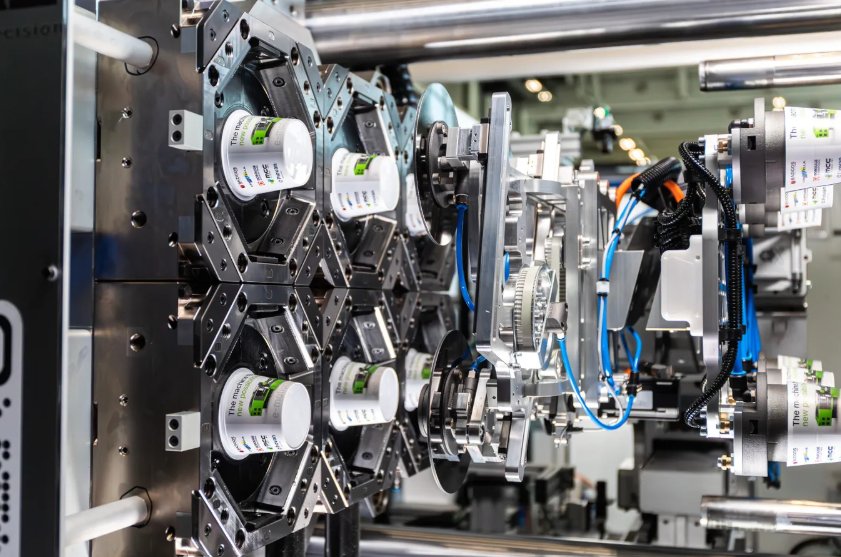
For manufacturers producing billions of cups annually, even a fraction of a second saved per cycle can deliver a significant improvement in margins. Built for the requirements of high-output packaging operations, the new generation of the e-motion 380 combines a dry cycle time of as little as 1.2 seconds with the output and cost efficiency required for modern food manufacturing trends.
High-speed thin-wall packaging has traditionally relied on advanced hybrid or hydraulic injection moulding machines. At Fakuma 2026, ENGEL will demonstrate how all-electric technology can achieve comparable productivity while reducing energy consumption. During a live production trial, the company will show that the all-electric machine can use approximately 30 per cent less energy than equivalent hybrid or hydraulic systems. For high-volume applications, that saving can lower unit costs and strengthen overall profitability while supporting wider food and drink sustainability objectives.
These developments reflect broader food and beverage industry trends, in which manufacturers are seeking greater efficiency, dependable automation and more sustainable production methods without compromising output.
Higher output with dependable production
By reducing dry cycle times, the e-motion enables manufacturers to complete more cycles and increase production volumes. The machine is also designed to support reliable, continuous operation in demanding packaging environments. Although energy performance remains a major consideration, consistent output and protection against unplanned downtime are equally important in high-volume production. ENGEL previously showcased the potential of all-electric technology for thin-wall applications at K, where it presented a thin-wall PET application using injection compression moulding.
The next benchmark for all-electric performance
The latest e-motion generation extends all-electric capability into conventional thin-wall polypropylene applications, including dairy containers and other food packaging formats. Making its debut at Fakuma, the e-motion 380 is the first model in the upgraded range. Its redesigned clamping and injection units make it the most powerful all-electric machine currently available in the ENGEL portfolio. The new clamping unit will subsequently be introduced across the full e-motion series, raising performance standards throughout the range.
“We are demonstrating that all-electric technology can also meet the requirements of conventional thin-wall food packaging, while offering potential for efficiency gains,” says Christoph Lhota, Vice President Medical and Packaging at ENGEL. “Equipped with a screw diameter of 70 mm, the new injection unit achieves injection speeds of up to 500 mm per second – a production-ready level of performance previously associated primarily with hybrid or hydraulic machines.”
Producing a 0.28 mm yoghurt cup
ENGEL will demonstrate the machine in a live six-cavity production cell making an in-mould labelled (IML) yoghurt cup. The application features a wall thickness of only 0.28 mm and a flow-length-to-wall-thickness ratio of 370, creating demanding conditions for every stage of the injection moulding process. The high-speed injection unit is particularly well suited to these requirements, producing finished cups weighing just 6.33 grams.
When the mould opens, a side-entry robot collects the completed cups from both sides and places fresh labels into position for the following cycle. The automation must therefore deliver rapid, precise acceleration and deceleration to maintain the required production rhythm.
Integrated expertise across the process chain
The application’s performance depends on close coordination between specialist partners throughout the manufacturing process. Campetella provides the IML automation, Bazigos supplies the mould, MCC Verstraete produces the labels, Borouge International, formerly Borealis, provides the material, and Piovan delivers the material handling system. ENGEL integrates the complete solution and, when requested by the customer, builds and tests the entire production cell, including automation, at its own facility. This approach provides a genuine single-source solution for advanced food and drink packaging applications.
The integrated system also illustrates how food processing technology, food and drink industry innovation and evolving food distribution trends are influencing packaging production. By combining high-speed machinery, automation and efficient material management, manufacturers can respond more effectively to changing food and drink consumer trends while meeting increasingly demanding food and drink regulations.
“Close cooperation with specialist suppliers across the entire process chain is extremely important to us – this performance can only be achieved when every component works seamlessly together,” concludes Christoph Lhota.
As food and drink marketing increasingly highlights efficiency, recyclability and responsible resource use, production systems must support both commercial performance and sustainability goals. ENGEL’s all-electric e-motion platform is designed to address these priorities while helping processors respond to ongoing food manufacturing trends.