


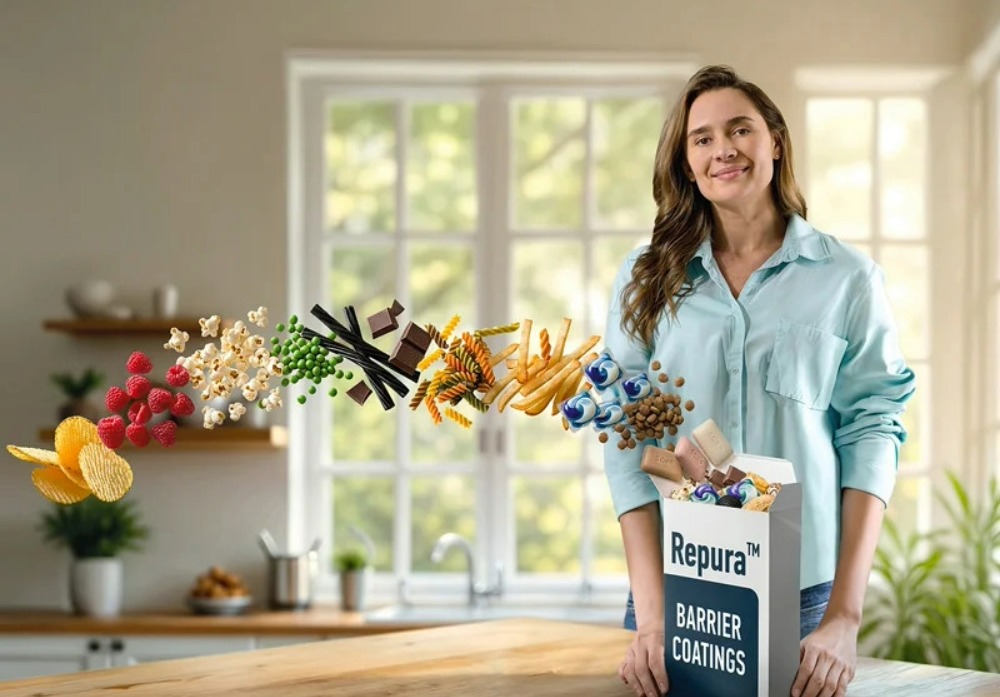
Stahl’s introduction of its Repura barrier-coatings line at Interpack 2026 represents a pivotal advancement for food producers looking to transition from plastic to efficient, paper-based packaging that ensures product protection remains uncompromised.
This innovative range is specifically crafted to aid brands in achieving increasingly rigorous sustainability goals while retaining visual appeal and food safety, all while keeping the packaging entirely recyclable and repulpable.
In food segments like bakery goods, snacks, ready meals, confectionery, and dry products, there is a growing demand for packaging solutions that provide exceptional barrier capabilities without detracting from circularity objectives.
Stahl sees the Repura line as a direct response to these industry needs. The coatings deliver superior protection against crucial risks such as oil and grease, moisture, and oxygen transmission—issues that have historically hindered the adoption of paper-based options in food applications. Stahl asserts that this robust defense allows manufacturers to substitute plastic films and foils across various formats while safeguarding product integrity under real-world conditions.
Paul Grzebielucha, group director of packaging coatings at Stahl, emphasized that the portfolio aims to instill confidence in brands as they make this transition. “With Repura, we enable brands to protect what matters most: product quality, consumer trust and circular design. Our barrier coatings combine high performance with recyclability, helping brands move toward paper‑based packaging without compromise.”
A significant benefit for food manufacturers is the capacity to transition from flexible plastic packaging to fiber-based alternatives. This move is increasingly vital as businesses brace for stricter regulations on packaging waste and retailer-driven sustainability assessments. By minimizing dependence on materials such as polyethylene, polypropylene, PET, and aluminum foil laminates, Repura helps meet the demands of evolving recyclability standards and extended producer responsibility requirements, enabling simpler mono-material paper structures for effective waste sorting.
The coatings are formulated to ensure food safety throughout processes including filling, transportation, storage, and consumer interaction. Their resistance to oil and grease is ideal for bakery, snack, and fast-food products, while their effective moisture and vapor barriers protect items sensitive to humidity. Additionally, oxygen barrier features help maintain freshness, aroma, and shelf life, addressing a significant concern associated with moving away from plastic.
Substrates treated with Repura can easily work with standard paper recycling systems, negating the need for specialized de-lamination processes and enhancing high-quality fiber recovery. This recyclability stands out as a key differentiator for manufacturers striving for packaging solutions that are both practical and authentically circular. Furthermore, the coatings are appropriate for direct food contact, broadening their applicability to include primary packaging formats like wraps, pouches, trays, and folding cartons.
The portfolio is designed for adaptability across various paper, board, flexible packaging, and high-speed converting lines, enabling manufacturers to seamlessly incorporate Repura into their current production processes with minimal disruption.