


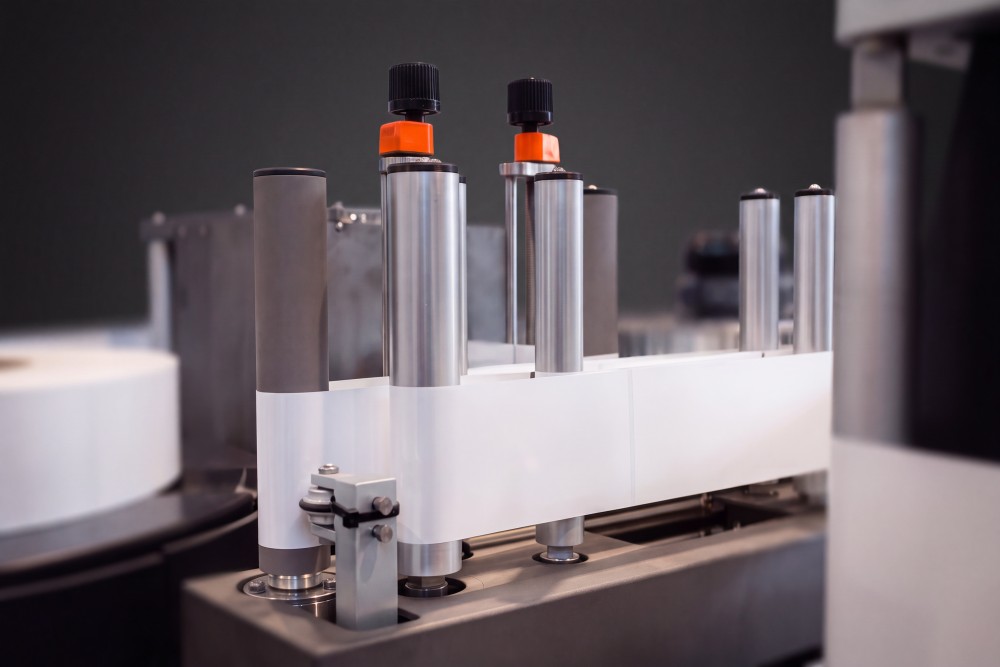
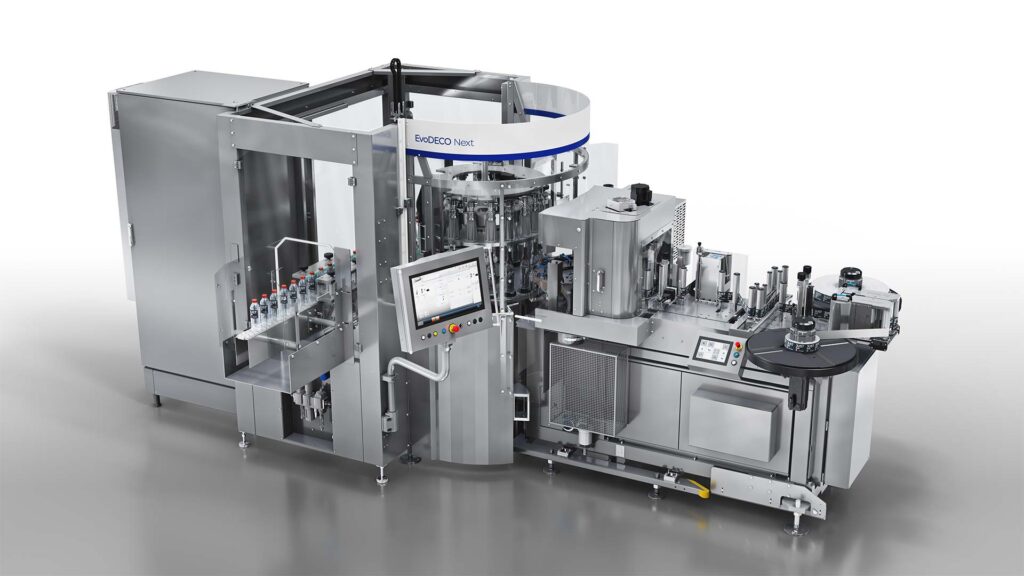
Sidel has launched EvoDECO Next, a new-generation roll-fed labelling system developed to help beverage manufacturers combine high-speed output with greater design flexibility and significantly lower material usage.
For the first time, the platform brings partial labelling to a roll-fed solution. This enables producers to reduce the amount of label film required while allowing more of the bottle to remain visible.
Greater design flexibility
As PET packaging evolves in response to lightweighting and circularity goals, beverage brands must also find new ways to attract attention on the shelf. Until now, material optimisation has largely focused on the bottle’s body, neck, and base. EvoDECO Next applies the same principle to the label.
The system supports two partial-label formats: 90° and 180° configurations. These options provide an alternative to conventional full wraparound decoration, helping brands reduce label coverage while creating a more distinctive pack design.
Leaving a larger area of the container and transparent PET exposed also enables manufacturers to make the bottle’s shape part of the visual identity. This can support a premium appearance while responding to wider food and drink consumer trends around packaging efficiency and design differentiation.
Lower material use and operating costs
Partial labelling can deliver both environmental and financial benefits. Depending on the selected format, the label surface area can be reduced by up to 75% with a 90° configuration or by as much as 50% with a 180° configuration, compared with a standard wraparound label.
For a high-volume producer, replacing a full wraparound label with a 90° partial label could reduce annual BOPP consumption by 208.4 tonnes. The change could also lower associated carbon dioxide emissions by 346 tonnes and deliver approximately €723,000 in yearly raw material savings.
This development supports Sidel’s wider JUST label approach, which combines reduced environmental impact, stronger brand presentation, lower total cost of ownership, and streamlined equipment design. It also reflects key food and beverage industry trends, including food and drink sustainability, efficient food and drink packaging, and food manufacturing trends focused on resource reduction.

Reliable, continuous production
Rather than modifying an existing roll-fed labeller to accommodate shorter labels, Sidel designed EvoDECO Next as a fully integrated platform. Its system architecture incorporates several technologies intended to maintain stable, high-speed performance.
The Cutter 2.0 uses a rotary cutting mechanism mounted directly on the transfer drum. Equipped with two high-speed blades, it processes shorter labels efficiently without compromising production rates.
A smart buffer manages reel changes without interrupting line speed. It retains the standard film-path footprint and allows splicing at nominal operating speed, supporting consistent production output.
The smart camera system removes the need for conventional reference marks and quiet zones. This creates greater labelling flexibility while supporting automatic correction, auto-homing, and more advanced diagnostic functions.
The platform also includes high-speed changeover components with a sliding surface and air-blade system. These features help limit glue cross-contamination and reduce stress on the label material. As a result, machine autonomy can increase by up to five times, while the risk of unplanned stoppages is reduced.
EvoDECO Next can also be combined with Sidel’s automated CoboREEL reel-management solution. This integration reduces operator involvement, adds built-in traceability, and supports autonomous operation with up to 18 reels. Together, these capabilities demonstrate how food processing technology and food and drink industry innovation are helping beverage producers improve efficiency while advancing sustainability objectives.